

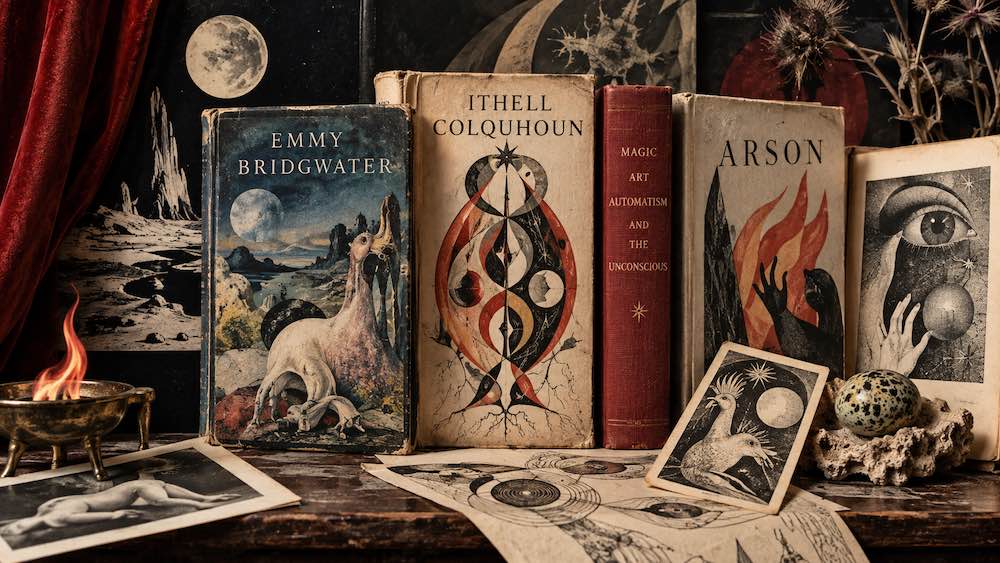
On the Surrealism Bookshelf
Surrealism has never been only an art movement. Its territory has always extended into poetry, dreams, magic, eroticism, photography, automatic writing, popular culture and the place between conscious intention and the uncanny.
An explosion of interest formed around the hundred-year anniversary of surrealism and shows no sign of abatement. Recent exhibits include: Marcel Duchamp in Philadelphia and MOMA, The Surrealist International at the Seattle Art Museum, a Lenor Fini Retrospective in Frankfurt, Brassaï: The Secret Signs of Paris at the Moderna Museet, Stockholm, and the upcoming Surrealism and the Book at MOMA opening October 1st.
Last year we put together a Surrealist Bookshelf with some of the writers, artists and histories that continue to shape our understanding of the movement. This year’s shelf takes a slightly different route—toward magic, automatism, overlooked artists, strange animals, experimental books and the continuing effort to recover the parts of Surrealism that never quite fit the official story. Ordering links for titles go to our affiliate page on Bookshop.org and can be ordered online, but if you live near the store drop by soon, most titles are in stock.

MAGIC, ALCHEMY & THE UNCONSCIOUS
A Walking Flame 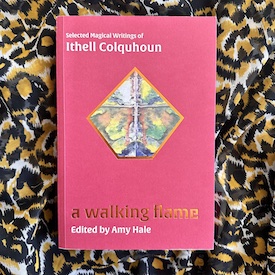 — Ithell Colquhoun
If there is an artistic figure who seems to be having a moment in 2026, it is Ithell Colquhoun (1906-1988). Painter, writer, occultist, traveler and Surrealist, Colquhoun spent much of her life moving between worlds that others prefer to avoid.
A Walking Flame, edited by Amy Hale, gathers Colquhoun’s writings on magic and esotericism, including her best-known essay ‘The Children of the Mantic Stain’, (1951) a masterpiece on Surrealist automatism and the attempt to bypass conscious intention in order to discover patterns, images and subjects emerging from the subconscious. Magic and its cross-pollination of art and creativity are the central core of Colquhoun’s writing.
‘Lights in the Air’ is a compilation from her diary writing on experiencing “strange light phenomena” around Cornwall between July and December in 1965—an experience she ties to UFOs.
Colquhoun’s tarot essay ‘Taro as Colour’ (1977) is republished here, in which she notes that after seeing slides of the birth of star systems and nebulas in outer space,”These recalled my designs and confirmed my conviction of their cosmographic function.” Although the beautiful book Taro as Color has gone out-of-print, the publisher Fulgur in the UK has issued a facsimile of the Taro card deck, a masterpiece of surrealist art.
Her range of writing and topics show a deep imagination and devoted passion for personal truth and investigation, a magic/art practice she worked on through a study of ancient and difficult alchemical resources. Colquhoun published often in esoteric journals, and the collection begins with a lecture she gave to the Quest Society in 1928 when she was 22 years old, ending in 1979, with several essays published in The Hermetic Journal also dealing with colour in magic.
Hale gathered a significant amount of writing from the long out-of-print Medea’s Charms and the novel I Saw Water both edited by Richard Shillitoe a leading scholar and editor of her work. A wonderful online resource and archive is maintained by Shillitoe, dedicated to the life and work of the artist at: Ithell Colquhoun.
The book reveals how Colquhoun’s interests in magic, painting, writing and the unconscious were closely intertwined-her transgressive and forceful nature may’ve been a hindrance to her career, but they were decisions she always made on her own terms. The present renaissance of feminist surrealism and reinstatement of her work is of value for anyone interested in the methods and life of this prolific and energetic artist. A Walking Flame is treasured addition to the Colquhoun legend.
Sex Magic: Diagrams of Love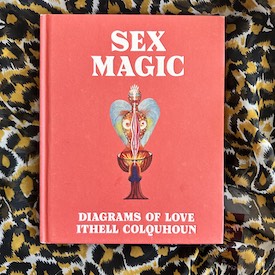 — Ithell Colquhoun
Amy Hale’s introduction places Colquhoun’s occult investigations at the center of her thought during the beginning of World War II. Hale writes:
“From around 1939 to 1942, during the most intense and frightening years of the Second World War, Ithell Colquhoun created a body of obscure and explicit visual work focused on the principles of sacred sexual union. It is likely the earliest sustained and explicit visual expression of a sex magic programme associated with modern Western magical subcultures and it was created by a woman.”
The diagrams and poems in Sex Magic were influenced by figures like the Golden Dawn, Crowley’s O.T.O., The Kabbalah Unveiled, Richard Burton’s Kama Sutra, and others. Hale speculates that Colquhoun’s meeting with W.B. Yeats in 1937, and his death in 1939 planted a ‘metaphorical seed’ for the project. Again, as in her essay collection A Walking Flame, colour and form also play a dominant role throughout the book illustrations again bridging magic to art.
The idea of the Divine Androgyne and the transcendence of fixed gender categories were ideas that connect Colquhoun’s esoteric interests with magic, ritual, and some of the more radical possibilities of Surrealism.
Hale writes, “What seems certain is that goal of Colquhoun’s project was the formation of the Divine Androgyne, and the individual and collective transcendence of gender-an important theme of the esoteric landscape of the early twentieth century…”
What is interesting is Hale avoids going into the magic system and practice concerning ritual which was an area Colquhoun was obsessed with-and she was known to have a daily practice of keeping a diary. The number of secret societies she took part in, and her interest in the Golden Dawn and O.T.O would also point to some practical use-and daily practice, like a focused tantric meditatation on her Diagrams of Love. Interspersed with the artwork are several period poems-that may actually be the rituals Colquhoun created -like magical Thelemic incantations-that may’ve developed over time. Here is the opening poem: ‘Love Charm I:
Love Charm I
Messengers, listen to me!
Take him the symbols he understands
Here is a dove, a swan
A lynx leading the tribe of cats
A garden with clover
Honey, a grove of myrtle
An apple tree, the opening flower of a rose
Benzoin, red sandalwood, the soft odours
I give him the drug damiana, drink!
The image of a doorway
And all enclosed in a girdle.
Her poetic incantations go off in many directions-as her focus develops from Male to Female to Hermaphrodite-and beyond into potentials of the Cosmos. Hale writes that “this particular project and much of the symbolism seems to come to a rather abrupt halt by 1943, coincidentally around the time of Colquhoun’s marriage to Toni del Renzio.”
The book is 96 pages and entirely produced around the drawings, paintings, and diagrams of this radical project and it has the feel of a rare look into an artist’s private sketchbook. Hale’s excellent introduction helps guide the reader through the colour, symbolism and decoding of the work. The book is small but its high quality production values, embossed cover, pink endpapers and matt printing, give it the feel of a delicate fine press book.
The Goose of Hermogenes 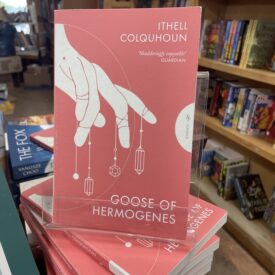 — Ithell Colquhoun
Colquhoun’s strange, compressed novel follows an alchemical and occult trail through dreams, literary exploration, transformation and the unstable boundary between the ordinary and the magical. It was one of the books our reading group took up this year, and made for a particularly good discussion.
The Crying of the Wind — Ithell Colquhoun
Colquhoun was also a remarkable writer about place. In The Crying of the Wind, her account of traveling through Ireland, landscape, folklore, ruins, ancient traditions and the people she encounters become part of the same searching investigation that runs through her paintings and occult writing.
“Exquisitely strange… Colquhoun’s writing is lit from within by an incandescent glow… An enchanting read.”
—Irish Times
“Colquhoun is an incisive observer of Irish social mores… An eccentric visitor not only willing to embrace the country but also to expend her creative energy on its history, idiosyncrasies and traditions.” —Apollo
The Living Stones: Cornwall — Ithell Colquhoun
Colquhoun’s other great landscape book turns toward Cornwall, the landscape that eventually became her home. The book gives another view of an artist who saw geography not simply as scenery but as something layered with history, myth and mystery.
“The perfect gateway drug for readers new to Colquhoun… She was that vanishingly rare thing, someone who was wholly, unaffectedly, unapologetically herself.”
—The Washington Post
The Alchemical Feminine
Another important 2026 title from Fulgur Press, exploring the relationship between women, alchemy, symbolism and esoteric traditions. It belongs naturally beside the Colquhoun books and helps place her work within a much larger history of the feminine and the occult.
Surrealism and Operative Alchemy – Patrick Lepetit
Lepetit explores the relationship between alchemical traditions and Surrealist thought. This is a revised edition of his earlier work and more compact in its argument of alchemy’s influence in surrealist practice.
THE WOMEN WRITE BACK
Surrealist Women’s Writing: A Critical Exploration
This scholarly collection shifts attention from the paintings to the writing of women associated with Surrealism. The essays consider figures including Claude Cahun, Leonora Carrington, Colette Peignot, Suzanne Césaire, Kay Sage, Unica Zürn, Ithell Colquhoun, Leonor Fini and Dorothea Tanning.
It is another reminder that the literary history of Surrealism is considerably larger than the familiar names of Breton and his circle.
Dorothea Tanning — Alyce Mahon
A substantial new consideration of Tanning’s work as a painter, poet and writer. Tanning’s career continually crossed the boundaries between the visual and literary sides of Surrealism, and this volume provides another way into that complicated territory.
Surrealism of Angst 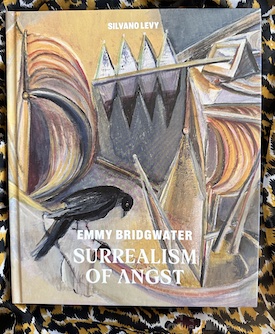 — Silvano Levy
A new monograph devoted to British Surrealist Emmy Bridgwater, a member of the London Surrealist Group whose work has remained largely outside the standard histories of the movement recently surfaced. Another welcome recovery of an artist who deserves to be better known.
Biridgwater, like Colquhoun used elements of automatism in her work, but here it takes a rougher, more personal and violent approach to the fine detailed work of other surrealist painters. Levy reads much of Bridgwater’s work as working through trauma and painful emotional issues. This is also the early 1940s, and the pressure and horror of World War II was being felt deeply in London. Also in 1940, Bridgewater had a year long affair with Toni del Renzio an Anglo-Italian art critic, gallerist, publisher, and promoter of British Surrealism.
Bridgwater’s year-long relationship with del Renzio overlapped with his growing involvement with Ithell Colquhoun, whose erotic and occult work—including the Diagrams of Love—was developing at the same time, although del Renzio praised Bridgwater’s paintings in his surrealist journal Arson in 1942, he oddly panned Colquhoun’s artwork. Levy places much of Bridgwater’s later work within this personal love triangle, though there is clearly more to her paintings than the story of a broken romance.
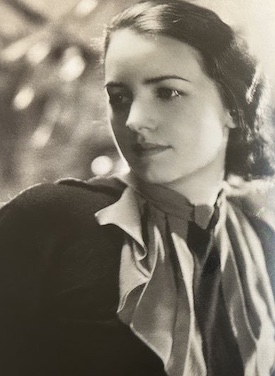
Emmy Bridgewater about 1940
Her canvases and drawings from this specific period are famously populated by sinister, aggressive birds, savage cats, and explicit scenes of mutilation and bodily violation. Del Renzio, writing in Arson championed and described Bridgwater’s paintings: “In the liquid atmosphere of these lunar landscapes rare creatures encounter one another in the sensuous curves of animal innocence…” He continues with her “shell-less Crustacea” seeking dark caverns, and says that Earth, Sky, Fire and Water are mixed together, ending with the famous passage: “We do not see these pictures. We hear their cries and are moved by them. Our own entrails are drawn painfully from us and twisted into the pictures whose significance we do not want to realise.”
Although del Renzio published several of Bridgewater’s paintings and praised her in Arson, he actually dismisses Colquhoun’s work in the same issue writing, “Miss Colquhoun has finally damned herself publicly with her admission of endeavouring to do in painting what the ‘New Apoplexy’ is doing in literature.” According to Shilltoe’s chronology, Colquhoun was trying to get her work into Arson, before they ever met, but “there was no room available” according to del Renzio. Two months after Arson was published in March 1942, del Renzio moved in with Colquhoun.
It’s clear that Bridgwater guarded her privacy and made no public comments on her personal life. Although the drama in Levy’s book sometimes gets in the way of the artwork, it’s great to see Bridgwater’s work in a major publication for the first time together with a selection of her rarely seen poetry. Below is ‘Closing Time,’ an example included in the book. Written in 1941, it seems melancholic, but could also be a metaphor for both World War II and her relationship turning south. After he moving into her studio, Colquhoun ended up paying off del Renzio’s printing debt for Arson, and married him in 1943. They would divorce in 1947.
Closing Time
So comes the flame out of the serpent’s mouth
So plucks the bloom, the red-tipped fingered hand.
So, as the clock goes round and round and round
So turns again the record of the sound.
Repeat the space where swallows try their turns
Reveal the place where ants begin to crawl,
Remove the time when rain begins to drip,
Re-seal it all
-Emmy Bridgewater (1941)
Satisfied Sarcophagi — Joyce Mansour
An outlandish, dark, and erotic surrealist collection that reads like a collision between Leonora Carrington and Georges Bataille.
“Mansour saw in the erotic the possibilities for individual and collective freedom. Inside the void, a reimagining of the self and the world can occur, illuminating new ways to live that contrast with the default world of the everyday.”
–Ama Kwarteng, Los Angeles Review of Books
THE STRANGE ANIMAL / THE STRANGE OBJECT
Surrealism and the Tarot: A Love Story 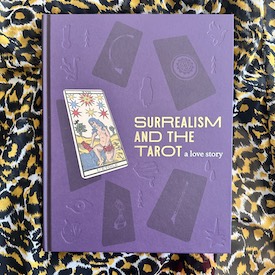
A lavishly illustrated new book from Fulgur Press, one of the publishers doing interesting work around feminist Surrealism, esotericism and neglected histories. Tarot is a perfect tool made for Surrealist investigation: symbolism, chance, archetypes, visual association and the possibility of finding meaning in unexpected combinations. A fascinating book for anyone curious about the history of symbolism, tarot, and its intersection with art and artists especially since the 1920s.
Spanning the 1920s to the present day, the book explores the full breadth of international surrealist interest in cartomancy. Surrealism and the Tarot highlights work from a wide-ranging slew of Surrealists, from Penny Slinger to Ithell Colquhoun, from Victor Brauner to Jorge Camacho, and from Kay Sage to Alejandro Jodorowsky, among many others. A consotiuum of over a dozen writers and scholars began this project in 2019, and some of them appear in the book launch video below.
The Surrealist Menagerie — Ian Walker Morris
Animals have always occupied a strange place in the Surrealist imagination, from insects and birds to cats, dogs, horses and creatures that seem to have wandered in from dreams. This beautifully illustrated book looks at the role of animals and animal symbolism throughout Surrealism.
The Surrealist Book — The Museum of Modern Art, New York
A nwq MOMA exhibition, and a particularly appropriate subject for a bookstore. This volume considers the book itself as a Surrealist medium—manifestos, illustrated books, photographs, collages, artists’ books and other experiments in which the physical book became part of the artwork. We’re looking forward to this one! The Surrealist Book will be out later in the fall but can be preordered on Bookshop.org -or just let us know and we’ll hold a copy for you.
It also reminds us that Surrealism was never just something that happened on a gallery wall. Books, pamphlets and journals were one of Surrealism’s principal ways of spreading ideas-and that closely entwined relationship continues.
The Complete Crepax: Surreal Stories — Guido Crepax
Crepax’s comics occupy wonderful territory between eroticism, dream logic and graphic experimentation. A good reminder that Surrealism continued to find unexpected forms long after its supposed historical ending.
Man Ray: Shapes of Light
In On Photography, Susan Sontag wrote, “Surrealism lies at the heart of the photographic enterprise: in the very creation of a duplicate world, of a reality in the second degree, narrower but more dramatic than the one perceived by natural vision.” Man Ray’s photographic experiments remain central to the history of Surrealist photography, particularly his transformations of familiar objects through light, shadow, chance and darkroom experimentation.
Surrealism keeps refusing to stay historical. The books being published now suggest that the old questions—about dreams, chance, automatism, sexuality, magic and the unconscious—are still with us, symbols and myths that are still present and we continue to explore for meaning.
