Yayoi Kusama: a life in graphic novels by Sean Beiri
Among the profusion of graphic novel-style artist biographies published in the last several years (personal favorites currently on the Book Beat shelves include bios of Unica Zürn, Claude Cahun, and Hieronymus Bosch) are not one but two volumes on the late Yayoi Kusama, whose dramatic life and bold, deceptively whimsical style lends itself well to the comics art form.
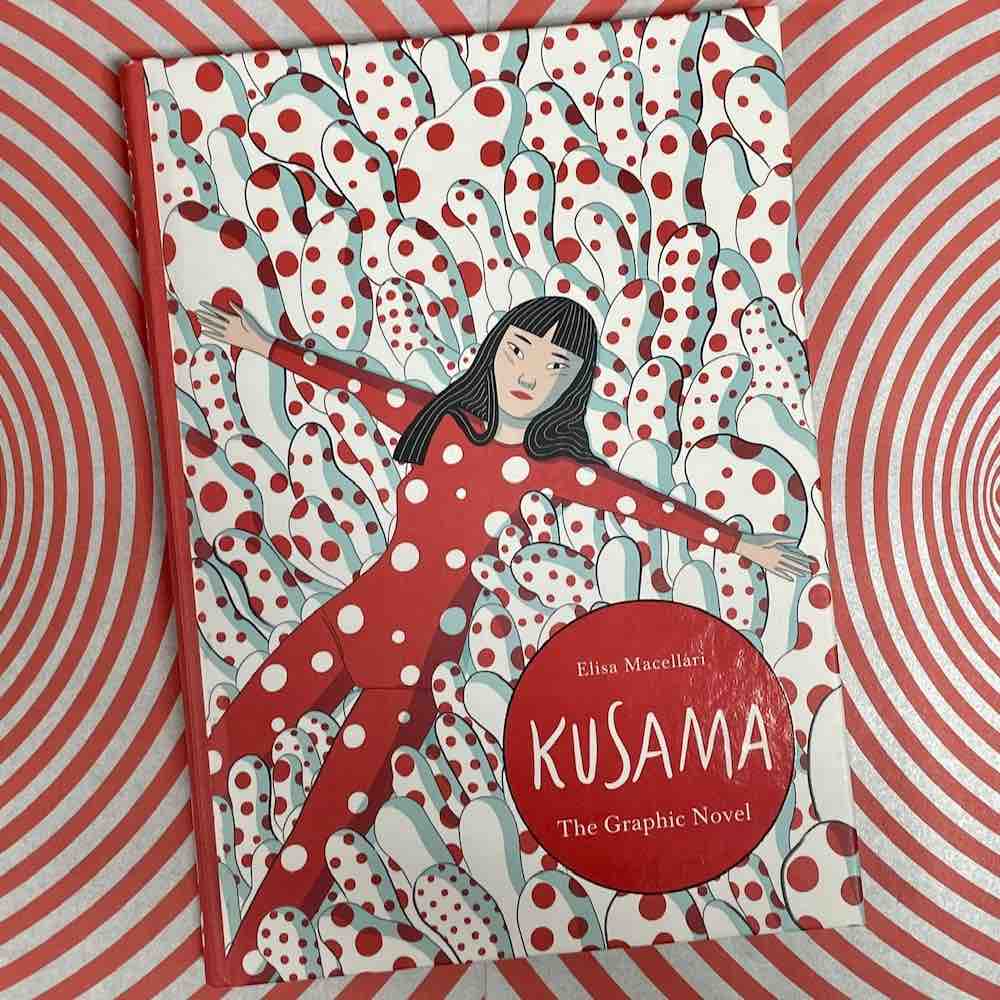
Of the two bios, Elisa Macellari’s Kusama: The Graphic Novel takes the more straightforward narrative tack, with a clear, fine-lined drawing style and surprisingly muted palette of tomato red, violet, and teal. (The orange of the New Mexico desert makes a brief appearance when Kusama writes to her early inspiration, Georgia O’Keeffe.) Macellari walks us through the Kusama timeline: from childhood trauma in her native Japan and early success in 1960s New York (including her notorious public nude Happenings), to her retreat to a mental institution in the ’70s and her rediscovery in the ‘80s. Macellari ticks off names from the list of Kusama’s famous art world friends: Donald Judd, Warhol, Dalí, and most importantly Joseph Cornell, whose own sexual neuroses dovetailed with Kusama’s to form a loving platonic relationship. Macellari’s elegant art style and measured approach make all the more striking the moments when she segues into symbolism, as when a bodysuited Kusama climbs a mountain representing the art world and is swallowed up by one of her own “infinity nets,” a cloud of obsessively drawn loops; or when Kusama looks out at night over a glittering wireframe version of the NYC skyline that appears rather like one of her own mirrored “infinity rooms.”
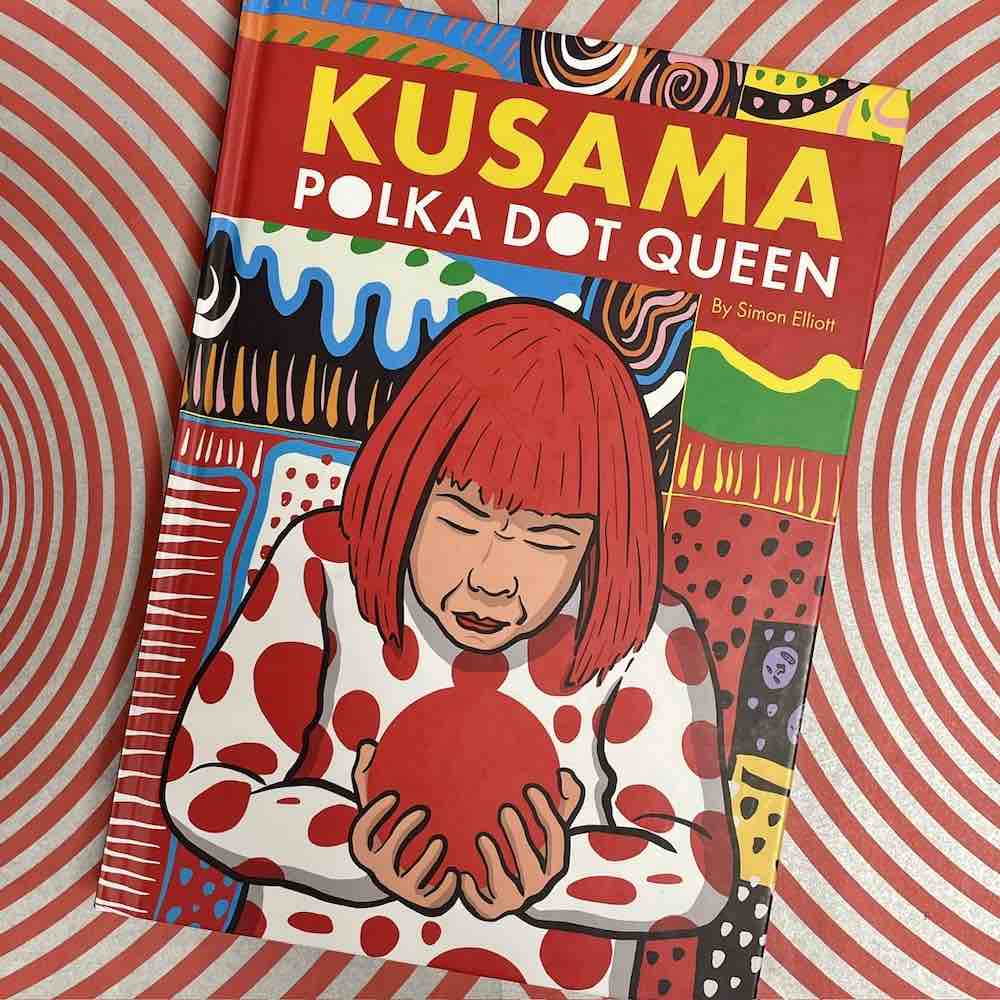
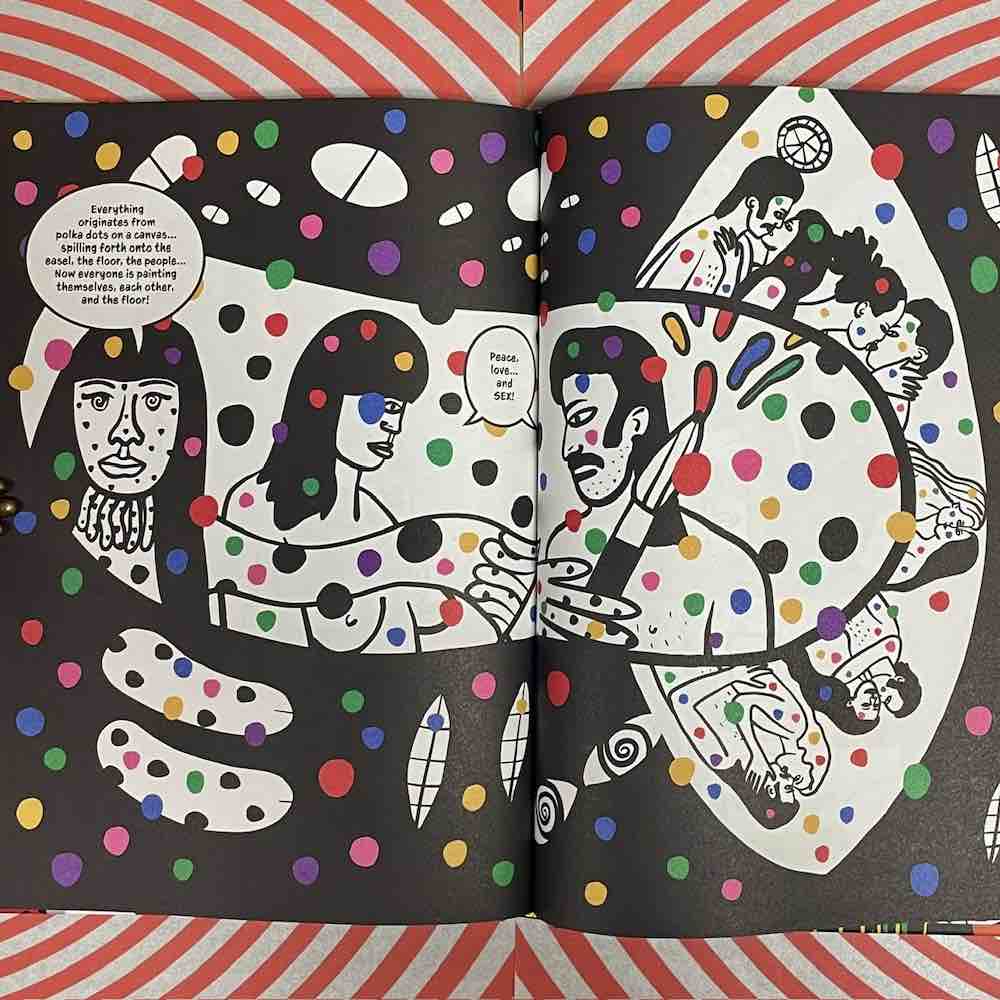
Simon Elliott’s Kusama: Polka Dot Queen is the more visceral, impressionistic telling of the artist’s story. Bluntly drawn with thick brushy lines, the panels are irregular ovals and biomorphic shapes, not unlike Kusama’s dots and soft sculptural forms, that float in an inky black void. Color appears sparingly at first in the largely black-and-white art — red on her philandering father’s slapped cheek, or on the rising sun of the imperial Japanese flag, for instance — but when young Kusama’s hallucinations of talking dogs and pumpkins begin, and then when she finally escapes her abusive mother into the New York art world, vivid rainbow hues begin to proliferate across the pages. The dialogue mostly comes in snippets and blurts, interspersed with occasional longer info dumps. By the end of the book, Kusama’s “obliterating” dots and loops speckle and pattern nearly every page. Elliott’s style often immerses the reader in a trippy ambience that evokes the work of Kusama herself.