
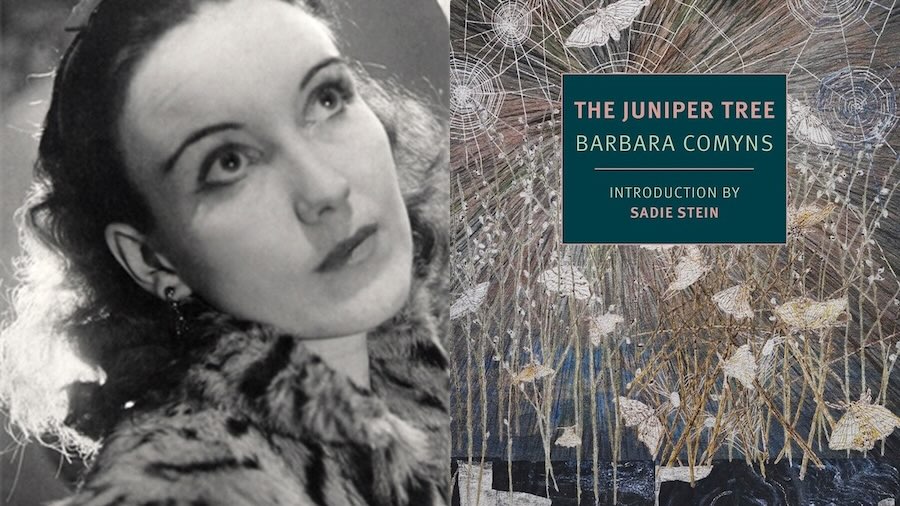
I Read a Strange Book: Vol. 2: The Juniper Tree by Barbara Comyns
Barbara Comyns is the author of one of my favorite books, 1959’s The Vet’s Daughter. I suspect she’ll become one of my favorite authors period once I’ve read more of her work, but at present I’ve only read the aforementioned more than once and now, 1985’s The Juniper Tree for the first time. Comyns is an English writer who was born in 1909 and died in 1992. She wrote eleven novels, three of which have been republished by New York Review Books (the one I haven’t mentioned yet is 1950’s Our Spoons Came from Woolworths). Her work is generally classified as domestic fiction, which belies the undercurrents of the fantastic that run through at least the two that I’ve read. Domestic gothic serves her better, and she dips into magical realism and even surrealism, too. She is wonderfully imaginative and can be surprisingly funny, her deadpan wit tempering atmospheres that are otherwise harsh and even terrifying.
The very first biography of Comyns was published in 2024, which tells you something about how neglected she has been in the canon of twentieth-century women authors. In Barbara Comyns: A Savage Innocence, Avril Horner writes that Comyns established a reputation as a talented and unusual writer with The Vet’s Daughter (her fourth novel) but fell into obscurity until feminist British publisher Virago Press started reissuing her books in the 1980s. 18 years had passed without new work from Comyns but then came The Juniper Tree, a deceptively stripped down novel that is unnerving, upsetting, and compulsively readable.
The Juniper Tree is an adaptation of the Brothers Grimm fairy tale of the same name, which Horner describes as having haunted Comyns’ imagination for many years. It’s one of the Grimms’ more gruesome stories, with themes of child abuse, murder, and cannibalism. You might also know it from the 1990 film adaptation, a medieval fantasy drama with the distinction of featuring Björk in her debut film role. In both the fairy tale and the film, an evil stepmother is behind the abuse. Comyns, however, subverts this dynamic and switches the perspective; the darkness is maintained, but the stepmother character is our protagonist.
We inhabit the mind of 27-year-old Bella Winter, a single mother with a biracial two-year-old daughter; the setting is present-day southwest London. Bella’s life is marred with cruelty and abuse; there’s the scar on her cheek, the result of a car accident caused by an ex-boyfriend’s reckless driving, and her dysfunctional home life, in which her father is absent and her mother is emotionally distant and initially visibly racist toward her own grandchild. Despite this, Bella trundles on and eventually finds a job in a small antiques shop, which suits her very well. She is befriended by a rich couple who she meets through the shop and soon becomes an important part of their upper-crust life, a far cry from her own hardscrabble background. Considering that the novel is an adaptation of a 200-plus-year-old fairy tale, it should come as no surprise that when the wife dies in childbirth, Bella is thrust into the role of stepmother; the parallels to the grisly events of the original unspooling toward a horrible collision that manages to shock despite its preordainment.
Comyns’ language is constrained but the images she conjures are often quite vivid, imbued with a dreamlike quality that perfectly matches the disarming tone of the fairy tale form.
“One afternoon there was a fearful acid smell of burning coming from the kitchen and I remembered I’d left a pie in the oven. I left a trusted customer in charge of the shop and hurried to the kitchen to save my pie only it wasn’t a pie burning in the oven but a plastic toy piano and ten little men Tommy must have put there. I took them out and held them under the running tap although the piano would never play again and the men looked as if they had been hit by an atom bomb; their faces all warped and their limbs twisted.”
I was drawn to this book after finishing Janet Frame’s Owls Do Cry for the Sub Rosa Book Club earlier this year; I wanted to read more Frame but didn’t have any on hand, and Comyns felt like a good fit. I was correct, as I ended up tearing through this 177-page book in just a couple days. Frame’s work is much more explicitly modernist, but they both share a flair for magical realism and ability to depict characters struggling against poverty and isolation with depth and humanity.
The plot of The Juniper Tree is fairly straightforward, with a sinister sensibility that floats to the surface through Comyns’ interpolation of the fairy tale. But it’s also a story that captures real inequities faced by women, children, and underserved groups. It’s a quiet novel that packs a desperate, violent punch, a pain to contemplate and a pleasure to read, as charming as it is appalling.
“We had our last picnic under the juniper tree, Gertrude ignoring the food I’d arranged on the table but almost greedily gulping down the last of the juniper berries that grew on the shady side of the tree—the berries so blue and poisonous-looking, and smelling strange too. I’d seen her do this before; but this time she was snatching at the fruit with her long white hands and putting several in her mouth at once, and her lips became stained and her dress all spattered with the needle-leaves. I wished Bernard were there to control her.”
I Read a Strange Book is a column in which part-time Book Beat employee and full-time writer Ana Gavrilovska evangelizes backlist titles she has read and enjoyed. Strange is always complimentary but otherwise wide-ranging. Find a copy of each month’s selection in her section of the Staff Picks shelf at the store, call the store to order directly from us, or shop via our Bookshop.org affiliate page.