
F. Holland Day: Books, Beauty, and Desire
“Beauty is truth, truth beauty,—that is all / Ye know on earth, and all ye need to know”
—John Keats, “Ode on a Grecian Urn”
“The capacity for delight is the gift of paying attention.”
—Julia Cameron, The Artist’s Way
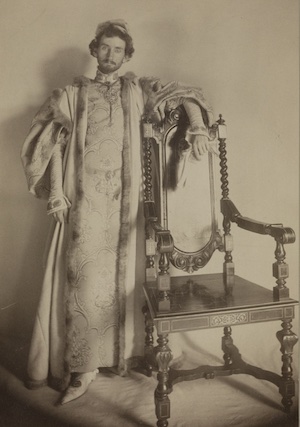
F. Holland Day, self-portrait in medieval costume, c. 1893. For Day, photography was not simply a way of recording the world, but a means of entering another one.
Bibliophiles are touched by madness. They live thousands of lifetimes, which can leave the present feeling vacant or spectral. F. Holland Day was born in Boston in 1864; his family wealth came from the cattle and tannery business, allowing him to freely indulge his curiosity. Fred Day was an only child and autodidact who lived for art, beauty, and the pursuit of books, spending lavishly on his passion. John Keats was Day’s guiding light in all matters of art and the spirit, and he built the finest collection of Keats in America.
While his parents were on vacation, Day helped design the Tudor mansion they lived in, which is now a historical museum in Norwood, Massachusetts, run by the Norwood Historical Society just outside Boston. His bedroom on the third level had a private staircase that gave him access to his extensive multi-level library without going through the main house.
Day had secret shelves built into the wood paneling to hide his treasures. Next to his desk, shielded from the rest of the library, was a corner shrine he built for his Keats collection which included thirty-one letters from Keats’s fiancèe Fanny Brawne to Keats’s sister, scrapbooks, letters from Balzac, and pencils that once belonged to Oscar Wilde. In the library on a shelf above the books and relics of Keats, Day placed a three-foot plaster replica of the winged angelic sculpture Victory of Samothrace or Nike. The original was installed at the top of a Louvre staircase and was one of its most celebrated displays.
One of Day’s hobbies was to create grangerized “extra-illustrated” books that included photos, ephemera, and articles about his favorite authors. In one of his scrapbooks he pressed botanical specimens collected near the homes of famous writers. On one page he noted, “Leaves found on the grave of John Keats.”
Day was a self-taught photographer and took up the practice in 1886, developing his approach to Pictorialism through study and experimentation—mastering complex photo-printing techniques on his own. His thoughts on the visual arts aligned with the Aesthetic movement, drawing inspiration from painting, mythology, and literature. Day’s art joined bibliomania, Pictorialist photography, religious performance, and queer desire into a single vision of beauty as sacrifice.
By the late 1890s both Day and Alfred Stieglitz (who were both born in the same year), were considered among the finest photographers in America. Stieglitz, Rudolf Eickemeyer, Jr. and Day, were the first Americans elected into the Linked Ring Brotherhood—an elite London photo salon founded by Henry Peach Robinson and George Davison.
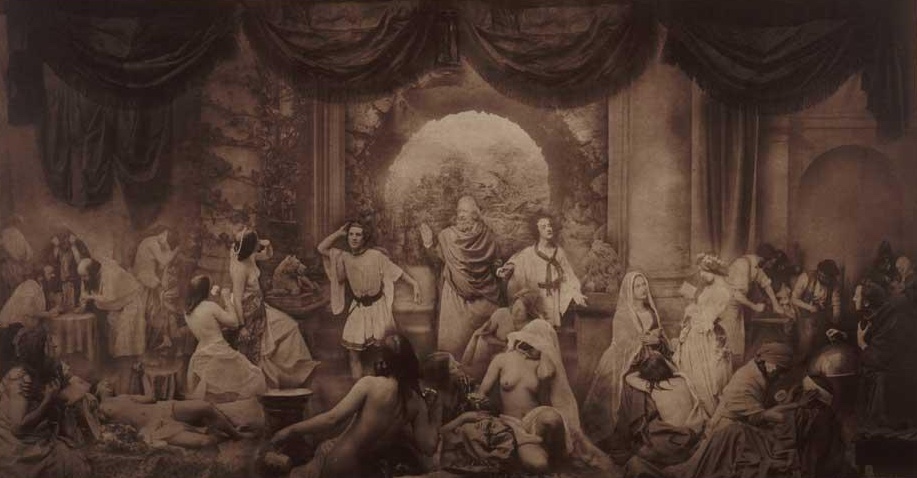
Oscar Gustave Rejlander, The Two Ways of Life, 1857. Before photography had decided whether it was a science, an art, or a record of the world, Rejlander gave it a moral dilemma, a classical allegory, a theatrical spectacle—and a cast of twenty.
Photography Before Pictorialism
Pictorialism was an outgrowth of Symbolism, able to shape literary myth and the sacred into performance art for the camera. Before the advent of silent cinema, photography drove visual culture, overshadowing painting because of its wider circulation, which gave rise to the cult of celebrity. Collecting mania enveloped the medium and the psychic forces from Symbolism and myth jumped from painting directly into photographic art.
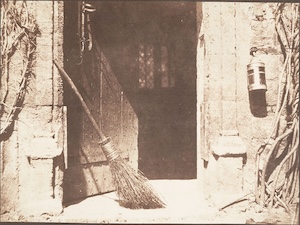
William Henry Fox Talbot, The Open Door, 1844. A broom, a doorway, a lantern: the ordinary world, newly discovered as an image.
The Symbolist idea was a force born alongside the inception of photography—a concept bridging science and art—that has never left the medium. Louis Daguerre, who claimed the invention in 1839, was a designer of Dioramas, where theatrical lighting, illusion, and spectacle created immersive experiences. William Henry Fox Talbot, the English pioneer associated with the paper negative, created one of his earliest studies of a broom in sunlight known as The Open Door, as a composition based on seventeenth century Dutch genre painting. Meanwhile, one of the earliest and most audacious fictional performances for the camera was Hippolyte Bayard’s Self-Portrait as a Drowned Man (1840). Bayard an unacknowledged third co-inventor of photography, staged the portrait as both a protest against his exclusion from history and proof of his process. Bayard’s Photographic Album (1839-1855), now housed at the Getty Museum, remains one of the first photobooks ever created.
O. G. Rejlander was an early father-figure of fine-art photography. His Two Ways of Life (1857) was a milestone photograph and drew upon Raphael’s School of Athens for inspiration. It was the first major masterpiece of combination printing, requiring more than six weeks to complete and using twenty models and over thirty separate wet-collodian glass negatives. When the work was exhibited, Queen Victoria purchased it as a gift for Prince Albert. Rejlander later served as a mentor to Lewis Carroll and Julia Margaret Cameron, whose work strongly influenced Day. He also shaped the direction of H. P. Robinson, who changed course after seeing Rejlander’s example. Robinson went on to co-found the Linked Ring, photo salon in 1892, and author influential manuals on Pictorialism, establishing himself as a master printer of emotional, moralistic, and allegorical photographs.
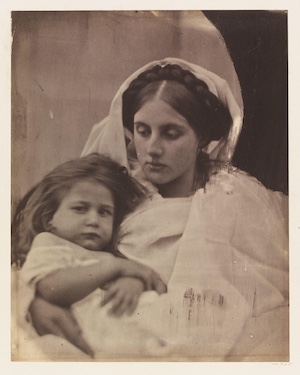
Julia Margaret Cameron, La Madonna della Bonaventura / La Madonna della Reconciliation, 1864
These Victorian photographers used models and muses, literary narrative, medieval romanticism, and psychological drama—all shaped by their kinship with the Pre-Raphaelite Brotherhood. That circle included Dante Gabriel Rossetti, John Everett Millais, and William Holman Hunt as its core trio. William Morris, who led the Arts and Crafts movement, belonged to a second wave alongside Charles Swinburne and George Meredith. Together, these influences helped establish Pictorialism as the dominant form of art photography by the end of the nineteenth century.
Day held Julia Margaret Cameron in great esteem, viewing her as the finest photographer of the Victorian era and a master of portraiture. In his London lecture delivered at the opening of the New School of American Photography, Day cited Cameron as a major influence on the Pictorialist movement in America. His use of props and adaptation of mythology and dream imagery owed much to his admiration for Cameron, whose work was closely linked to her friendship with the poet Alfred, Lord Tennyson.
The demise of Pictorialism was driven in part by the rise of cinema, high-speed cameras, roll film, and mass-circulation magazines. Surrealism and modernism were also introducing new ways of seeing. Yet even as the modern era embraced sharp focus, documentary styles, and street photography, the underlying impulse remained a form of Symbolism—simply adapted to a new age.
Copeland & Day: Publishing and the Decadent Movement
Day was also a member of a private Boston bohemian club known as the “Visionists” —a “homosocial network” of highly talented young architects, writers, and artists who went on to reshape American culture. Devoted to William Morris and the Arts and Crafts movement, they rejected the mass production of the Industrial Revolution, advocating instead for handcrafted, medieval-inspired aesthetics. Their interests also extended into mysticism, Eastern religions, Theosophy, and the writings of Madame Blavatsky. Within this circle, Day met Herbert Copeland, and together they created Copeland & Day, a publishing house for avant-garde literature inspired by Morris’s Kelmscott Press.
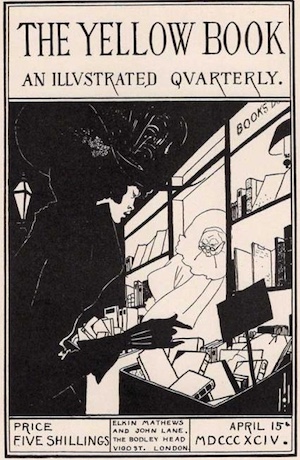
Aubrey Beardsley, illustration for The Yellow Book, 1894. Beardsley’s strange, elegant black-and-white designs helped define the decadent visual world that F. Holland Day brought to American publishing.
Copeland & Day aligned American book design with the fine-press aesthetic of the Arts and Crafts Movement and served as the American publisher for the notorious The Yellow Book—a controversial and influential British aesthetic journal issued quarterly over three years. The Yellow Book treated art and literature independently and separated them into distinct sections. It represented the culmination of the late Decadent period while actively championing new women writers.
Day traveled to England in July 1894 to dedicate a memorial monument to John Keats. At the ceremony, he met both Oscar Wilde and Aubrey Beardsley, who agreed to contribute work to Copeland & Day. Day was fascinated by Beardsley and became a major patron and collector of his drawings and rare proofs, quickly assembling the finest collection of Beardsley’s work in America.
Copeland & Day issued American editions of Wilde’s plays Salome and The Sphinx. Beardsley’s illustrations for Salome were considered so shocking that the Boston Public Library locked the book away in its restricted collection. The Yellow Book’s art was seen as equally scandalous, lending Copeland & Day an aura of avant-garde audacity—precisely at the moment Oscar Wilde was arrested for “gross indecency” in London. When newspapers reported that Wilde was carrying a “yellow book” under his arm upon his arrest, the public assumed it was the journal. An angry mob marched on the office of its British publisher, The Bodley Head, smashing its windows, even though Wilde was actually carrying a yellow paer wrapped French novel.
Between 1893 and 1899, Copeland & Day published ninety-six beautifully designed titles, including Stephen Crane’s landmark poetry collection, The Black Rider and Other Lines (1895). As Day’s devotion shifted increasingly toward photography, the firm wound down its operations and its list was absorbed by another Boston publisher: Small, Maynard & Co.
Pictorialism & Myth before the Camera
Beardsley converted to Catholicism on his deathbed and died of tuberculosis just short of his twenty-sixth birthday, on March 16, 1898. Following a High Requiem Mass held in London to memorialize the artist, Day was deeply moved and wished to honor him in Boston. He did so by organizing his own Requiem Mass at the Convent of the Sacred Heart on April 23. Copeland & Day printed an elaborate invitation for the service, which was held privately to avoid public scandal.
At the ceremony, Day immersed himself in holy ritual—candles, incense, vestments, chant, and sacred performance—perhaps as preparation for his own staged vision of Christ before the camera: his self-crucifixion. The idea had been brewing in Day’s mind ever since he attended the Oberammergau Passion Play in 1890.
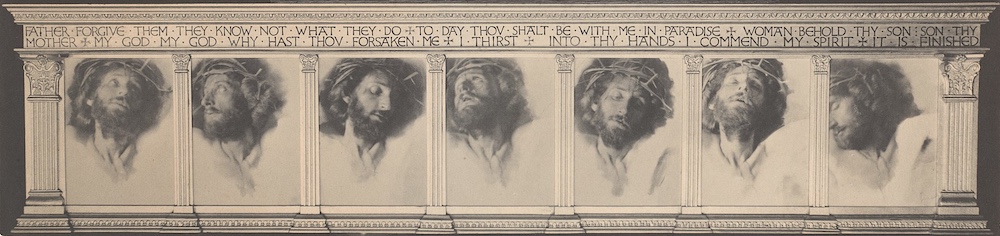
F. Holland Day, The Seven Words, 1898. Collection of The Metropolitan Museum of Art, Alfred Stieglitz Collection.
His reenactment of the Passion Play resulted in 250 negatives taken in the course of a day. This was Day’s most elaborate photographic performance—and perhaps his most personal. His biographer Estelle Jussim described the scene in Slave to Beauty, “In the grand manner of a silent film director, Day arranged the supernumeraries (almost all Norwood residents), coached the Boston actors, designed his camera angles, and had himself attached to a large wooden cross imported from Syria.” In preparation for the event, “He starved himself for months and let his hair grow while keeping himself in seclusion at Norwood. When he climbed the cross, he was an emaciated, tortured symbol of suffering, his ribs protruding like a Gothic grotesque.”
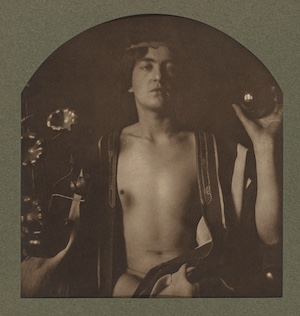
F. Holland Day, Beauty Is Truth—Truth Beauty, c. 1896.
When the work known as The Seven Words was exhibited, there was condemnation and protest. The twenty-one-year-old photographer Edward Steichen, came to his defense and said, “Few paintings contain as much that is spiritual and sacred in them as do the ‘Seven Words’ of Mr. Day. … If we knew not its origin or its medium how different would be the appreciation of some of us, and if we cannot place our range of vision above this prejudice the fault lies wholly with us.” Steichen would repudiate Pictorialism and become a titan of commercial photography and eventually the Director of the Department of Photography at the Museum of Modern Art.
For Keats, beauty is only valuable because it is fleeting. Day mirrored this sentiment by using photography—a medium that captures a temporary moment. His sacred tableaus and portraits of dying mythological figures, like The Martyrdom of St. Sebastian, The Death of Oedipus, and his studies of Orphic imagery, framed death as the ultimate artistic statement. “Orpheus was the perfect myth for Day,” writes James Crump. “From 1905, until the very last years he remained active as a photographer, he extensively mined the Orphic myth, and in the process created one of his most lasting impressions. Orpheus articulated the dimensions of Day’s own troubled past, and his utopian fantasy of the future.” In Crump’s monograph on Day, Suffering the Ideal, he emphasizes the homoerotic tone of Day’s work and his tourism to Morocco and Algeria searching for the Immoralist author André Gide with his cousin, photographer Alvin Langdon Coburn.
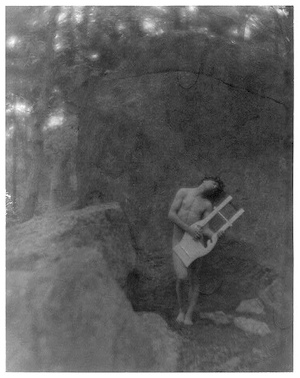
F. Holland Day, Nude Youth with Laurel Wreath and Lyre (Orpheus), 1907.
In her study on the politics and eroticism of Day’s work, Shawn Michelle Smith noted the harsh criticism and neglect historians aimed at Pictorialism. “Most have regarded pictorialism as imitative, trite, and somewhat embarrassing,” Smith wrote. By the end of the nineteenth century the female nude had become the central symbol and major trope in photography.
Smith’s book The Edge of Sight: Photography and the Unseen closely follows the erotic nature of Day’s Orphic studies, and sees Pictorialism as a vehicle to express both the visible world and the nether worlds of Symbolism and desire:
Day’s Orpheus photographs are notable for more than their mythological themes—they are undeniably erotic. Much of the discussion of Day among art historians has tiptoed around his sexuality, noting his devotion to aestheticism and male beauty, his admiration for Oscar Wilde and Aubrey Beardsley, and his bachelorhood, but nevertheless hesitating to suggest that Day was homosexual. Even more surprising, and much more important, is that some scholars have been reluctant to read the homoerotic desire presented in Day’s extraordinary work.
The haunted images of ideal male beauty in Day’s Orpheus series offer a lens through which we might read much of Day’s work, including the Christ series and the Saint Sebastian images. In Day’s photographs, the revered male body is also frequently the tortured male body, a pattern that hints at sadomasochistic desires and that metaphorically represents the criminal persecution of the homosexual man at the turn of the century.
In 1896, Day had a solo exhibition at the Camera Club of New York. There he exhibited Truth and Beauty and Christ Entombed, hanging Truth above Entombment, and posing himself as the dead Christ. “Among the rarest of Day’s prints,” wrote Jussim, “the two together were now making more than the ‘ideal embodiment of an abstract creation’: they were making an ideological statement straight out of Keats.”
Around this time, Day began to tutor and mentor a poor 12-year-old emigrant from Lebanon, Kahlil Gibran, who barely spoke English yet showed a strong talent for drawing. Day introduced Gibran to Symbolist authors, and artists, reading him Maurice Maeterlink’s Treasure of the Humble, and putting the future author of The Prophet on the path to fame
In describing his photographs of Gibran, James Crump wrote, “The dream of eternal youth preoccupied Day as it had (Thomas) Mann. Made in the “rapture” of imagination, these portraits underscore Day’s own fascination with “gazing and admiring.” […] Day refined the act of looking with the imagination, with the goal of uncovering the inner soul of his young male sitters.”
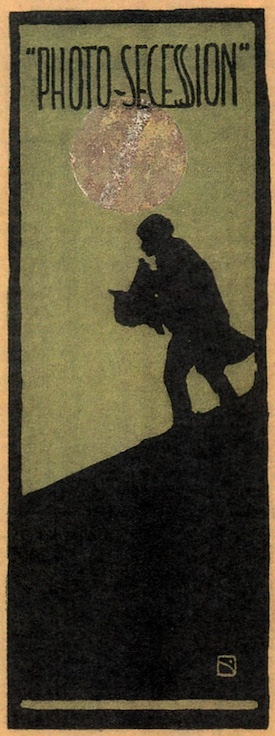
Edward Steichen, Photo-Secession, 1906. Inserted in Camera Work XIII
The Rivals: Alfred Stieglitz & Fred Day
As the 19th century was ending, Day implored Alfred Stieglitz, editor of Camera Notes, to establish an “American Association of Artistic Photography” in Boston. Stieglitz refused and was planning to begin Camera Work, a new journal of photography and art, and center the photographic avant-garde in New York City. This rebuff, in Day’s mind, “forced” him to take a collection of major American Pictorialist works to London and exhibit it through the Linked Ring—a European center of artistic photographers where he was a member. Day’s Ring project angered Stieglitz, who refused to participate because he had worked to positioned himself—and his ideas—as the leading force in American photography and Day called his bluff. Stieglitz cabled the Linked Ring and asked them to shut down the exhibit, which they did.
Day then moved the exhibition to a rival group, the Royal Photographic Society. The exhibition of the New School of American Photography opened October 10, 1900, with over 400 original prints, including works by Gertrude Käsebier, Frank Eugene, Frances Johnson, Joseph Keiley and others. Stieglitz refused to show his own work in the show and continued to condemn it. Stieglitz biographer Richard Whelan writes:
Stieglitz and Day were struggling not only over the question of who would be the primate of American photography but also over the loyalty of [Edward] Steichen. As if it weren’t bad enough for Day to challenge Stieglitz as a roving ambassador, the Bostonian was also alienating the affections of Stieglitz’s prime protégé. […] When Day took an abridged version of his exhibition to Paris in 1901, Steichen invited him to share his studio on the boulevard du Montparnasse.
The rivalry between Day and Stieglitz was a struggle that would steer the future of photography, and its survival as fine art. Stieglitz had a short fuse and was commanding, ambitious, self-promoting and competitive. His comments and opinions were often blunt and insensitive. His anger erupted when Day challenged his authority. Day was almost opposite in temperament; modest, studious and as Patricia Fanning notes; “his encouragement of other artists—especially women and younger photographers—became legendary. […] Day began to make his mark quietly.” Day was an idealist with a long memory and would never bend under the rule of Stieglitz. He shrank away from controversy and returned to his monk-like devotion to art and beauty. Day was appalled at competition and puplic bickering. And although he kept up his photography he never again would collaborate with Stieglitz.
When Stieglitz began Camera Work, he tried to overlook their differences and invited Day to be the featured artist in the first issue. Day refused the offer—one that could’ve changed his life and the way we view his work today, but Day would continue refusing Stieglitz’s requests for the rest of his life, helping to seal off his own obscurity.
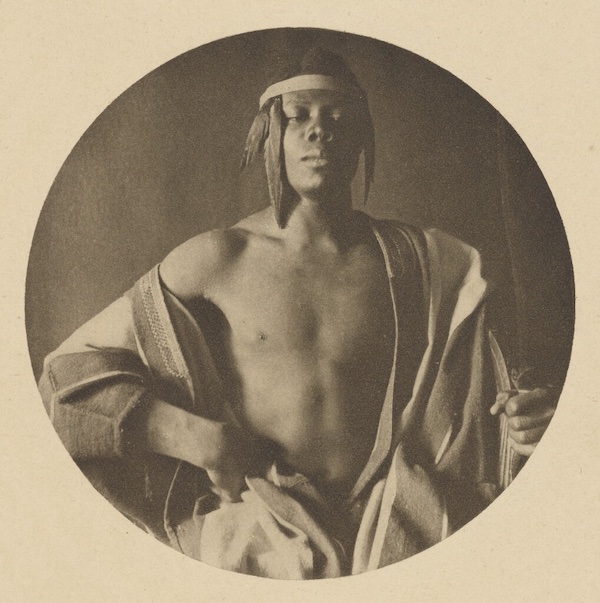
F. Holland Day, An Ethiopian Chief, c. 1897. Photogravure from Camera Notes, Book Beat collection.
Black is Beautiful: A Lost Identity
Day’s series of Black portraits included An Ethiopian Chief, first attributed by the Metropolitan Museum of Art in 1973 as being a portrait of Day’s valet, chauffeur, and confidant Alfred Tannyhill—an attribution that could easily be verified by comparing photos of the two subjects. That false attribution was carried into several major histories and biographies on Day, and effectively cut the true subject out of history.
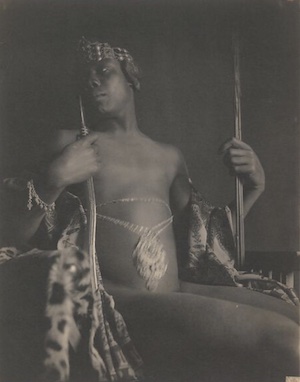
F. Holland Day, Menelek, 1897. Platinum print. The Metropolitan Museum of Art, Alfred Stieglitz Collection.
Dr. Patricia Fanning a sociologist and archivist of the Day Collection explored Day’s letters in the Smithsonian archive and was able to rewrite this lost chapter. Fanning found that Black artist and model J. Alexandre Skeete was the figure of An Ethiopian Chief, Menelik and others. She also discovered that Skeete was born in British Guiana (now Guyana) in 1874 and that, beginning in 1900, Skeete would become a featured illustrator of Colored American Magazine, illustrating the famed serialized novel Hagar’s Daughter by Pauline Hopkins.
Fanning also identified the Black model J.R. Carter who posed for Ebony and Ivory—one of Day’s most highly praised works. Carter was a native of Danville, Virginia, and a professional model, who was described in Colored American Magazine as “a young man of grand physique, as straight as an arrow, and as graceful as a dancing master.”
Fanning’s breakthrough research done for the Norwood Historical Society resulted in major revisions to photographic history, especially in the identity of his Black models, resulting in the essential biography: Through an Uncommon Lens: The Life and Photography of F. Holland Day (2008).
Fanning wrote an interesting take on the powerful triptych Armageddon, another image that stirred controversy, and confounded critics. A version of Day’s An Ethiopian Chief is enlarged and forms the centerpiece of Armageddon. Fanning writes:
Although Day did not initially comment on the work, in Paris in 1901 he informed a French critic that “the central figure represented the majesty and sternness of Justice, the left hand image stood for “Sin disquieted by punishment, the right depicted “the tranquil sleep of the righteous man.” Traditionally, it is Christ who separates the sinners from the righteous on the Judgment Day, but in Day’s vision, Justice would be meted out by a black man. Such an interpretation, noted a later scholar, “turned conventional imagery and conventional wisdom on its head, particularly in largely segregated Jim Crow America.”
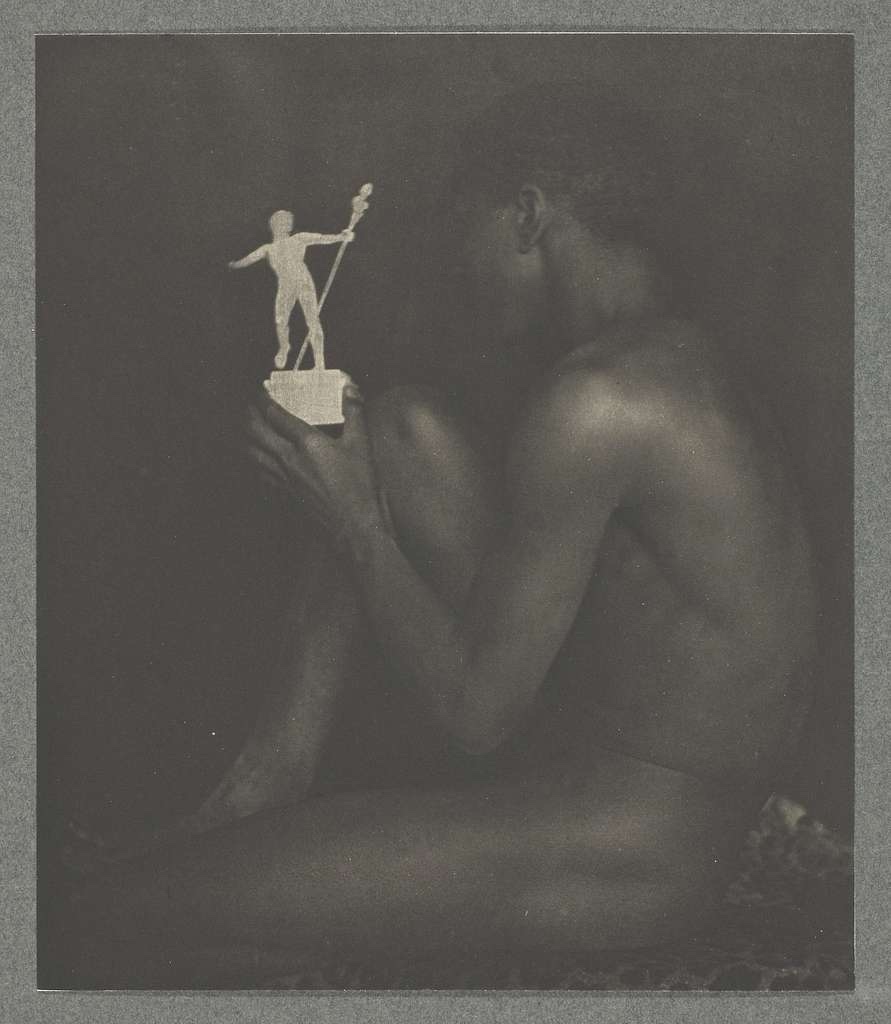
F. Holland Day: Ebony and Ivory, platinum print, 1897, Art Institute of Chicago, J.R. Carter model.
Appearing in the second issue of Camera Notes, the photograph Ebony and Ivory was described as “one of the masterpieces of pictorial photography. As a nude, in photography, it stands unequalled.” Some have noted that Day created some of the earliest depictions of “Black is Beautiful”—a phrase unheard of until the 1960s. Stieglitz owned over 70 original prints by Day, including a platinum print of Ebony and Ivory, part of a donation he made to the Metropolitan Museum.
In At the Edge of Sight, Smith proposes a more radical reading of Ebony and Ivory. She writes:
Day’s objectification of his model, however, may work toward surprising ends. By placing the nude, as a kind of statue, on a pedestal, Day also positions the African American man as an ideal of beauty, and perhaps as the African source of the Greek beauty symbolized by the small statue he holds.
The statue being held by Carter is the Roman God Mercury, a deity of communication and books, seen raising his caduceus, a wand to guide souls through the underworld and back. Ebony and Ivory is a study in contrast which Day complicates with this messenger between worlds-a figure that bridges literature, art, and death.
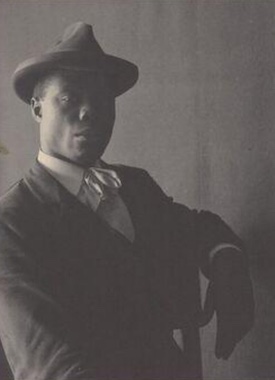
F. Holland Day, Portrait of Artist and Model J. Alexandre Skeete, 1897
Looking at Day’s portrayal of Menelek (1897), Smith writes:
Day’s summoning of Ethiopian greatness is explicit and direct in Menelek (1897), which celebrates Menelik I, Emperor of Ethiopia, son of Solomon and the Queen of Sheba. Day’s Menelek also evokes the contemporary history of Menelik II, the Emperor of Ethiopia who defeated the Italians in the first African conquest over European colonists, in 1896.
The images register the flattening tropes of an exoticized otherness, but they also highlight the self possession of the subject’s solemnly composed face. While exoticism drives these images, so does idealism, and that idealism is linked, through the naming of these works, to overt political resistance to European colonialism, as well as to heavily contested ideas about the racial origins of Western culture
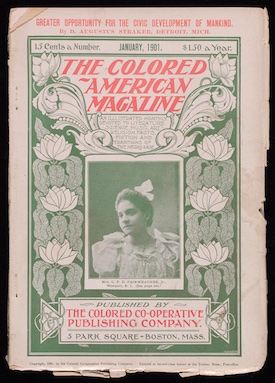
The Colored American Magazine, January, 1901
*
In November 1904, Day’s studio burned down in the Harcourt building. He lost his negatives and many priceless images, including his entire collection of Beardsley drawings. After the fire, he bought new equipment and returned to photography until around 1920. Ironically, Stieglitz’s large collection of Day’s work given to the Metropolitan Museum ensured the legacy of Day’s work.
Fred Day’s Legacy
Day spent the last thirteen years of his life in seclusion at his home in Norwood. Like Marcel Proust, he suffered from an unknown illness and rarely left his bed, dependent on household staff. Alfred Tanneyhill’s daughter Ann assisted with his genealogical and literary research, but time had stopped for Day. The age of Decadence had passed, and he died in 1933. In his will, Day left his Keats collection to the Keats House, a writers’ museum in Hampstead near London. Sadly the rare letter’s he had taken from Keats’s sister were never shared with researchers or even his closest friends.
New scholarship on Pictorialism and the male nude in photography began to surface in the 1970s. Among the first studies was Estelle Jussim’s Slave to Beauty, a major work that helped seal Day’s reputation as an avantgarde thinker and photographer. As Trevor Fairbrother points out in Making a Presence, by the 1980s Robert Mapplethorpe was an openly gay photographer who owned photographs of Day’s work and drew inspiration from his example.
Day wrote several essays on photography, among them are: “Is Photography Art?”; “Sacred Subjects in Photography”; and “Portraiture and the Camera.” From his essay on portraiture, found in the Almanac of American Photography 1899, he wrote:
Among the various branches of the art of the camera, portraiture holds the place of the most difficult and is least often truly successful. That this should be so in these days when reproductions of the works of the great masters are so readily obtainable, appears quite inexplicable, unless we are to assume that he who produces likenesses by means of the lens and a dry plate has no desire to produce anything else. A likeness and a portrait are far from being one and the same. […]
If one expects to produce art, one must have at least a rudimentary acquaintance with examples and the history of art as a background upon which to draw in or model the subject chosen. […]
That which is the rarest of all qualities of the operator and which we will term a sense of composition would appear, from the very extent of its scarcity, to be acquired only with the most arduous difficulty. This sense of composition covers more than mere lines and curves. It includes spots and masses. It means light and shade in all their vagaries as well as brilliancy. […]
Some will say they have studied composition in an art institution! Very well, go and unlearn your learning as fast as you can, for you will find every rule you have been taught to abide by, is ruthlessly disregarded by one or another of the truly great. […]
We are told of the length of art and the shortness of life, therefore discouragement should be admitted only after prolonged procrastination in those who have any regard for Beauty or the Beautiful.
Day’s legacy lies not simply in his photographs, or the people he mentored, but in his insistence that photography could belong in the same world as painting, poetry, ritual, myth, and fine books. His life was shaped by devotion—to Keats, to beauty, to the male form, to sacred suffering—and that devotion made his work both fragile and prophetic. The last years of his life were spent surrounded by his collection of books and memories—a hermetic world of metaphysical desire where his photographs still inspire by their great fragile beauty and mythic charge.
She dwells with Beauty—Beauty that must die;
And Joy, whose hand is ever at his lips /
Bidding adieu…
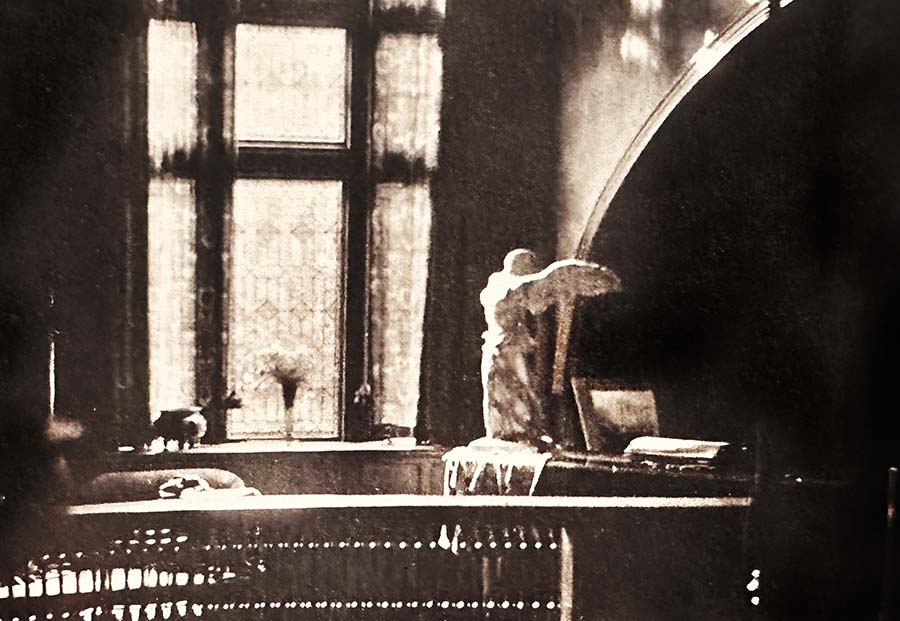
Detail of the Winged Victory of Samothrace at the entrance to F. Holland Day’s library, Norwood, Massachusetts, 1900. Photographer unknown. Platinum print. F. Holland Day Collection, Norwood Historical Society.
Notes and Sources
1. Norwood Historical Society. F. Holland Day house and related historical material. https://norwoodhistoricalsociety.org/
2. The West End Museum. “The Visionists: The Bohemians on Pinckney Street.” https://thewestendmuseum.org/history/era/immigrant-neighborhood/the-visionists-the-bohemians-on-pinckney-street/
3. The Victorian Web. Material on The Yellow Book, decadence, and late Victorian aesthetic culture. https://victorianweb.org/decadence/yellowbook.html
4. The Metropolitan Museum of Art. F. Holland Day, The Seven Words. https://www.metmuseum.org/art/collection/search/269295
5. Princeton University Art Museum. Oscar Gustave Rejlander, The Two Ways of Life. https://artmuseum.princeton.edu/art/collections/objects/18132
6. Estelle Jussim, Slave to Beauty: The Eccentric Life and Controversial Career of F. Holland Day, Photographer, Publisher, Aesthete. Source cited in the essay for Day’s self-crucifixion and the making of The Seven Words.
7. James Crump, F. Holland Day: Suffering the Ideal. Source cited in the essay for Day’s Orpheus imagery, homoerotic themes, and related biographical interpretation.
8. Edward Steichen’s defense of Day’s The Seven Words is quoted in Edward Steichen, A Life in Photography (Doubleday, New York, 1963).
9. Trevor Fairbrother, Making a Presence: F. Holland Day in Artistic Photography, (Addison Gallery of American Art, 2012) for images of Day and the Day house and research on Robert Mapplethorpe.
10. Shawn Michelle Smith, At the Edge of Sight: Photography and the Unseen. Source cited in the essay for the politics of Day’s work, the Orpheus photographs, homoerotic desire, and the tortured male body.
11. Patricia J. Fanning, Through an Uncommon Lens: The Life and Photography of F. Holland Day. Source cited in the essay for research on Day’s models: J. Alexandre Skeete, J. R. Carter, and the correction of earlier misattributions.
12. Camera Notes. Source context for Day’s Ebony and Ivory, Stieglitz’s publication circle, and the reception of pictorial photography.
13. Richard Whelan. Alfred Stieglitz: A Biography, Biographical writing on Alfred Stieglitz. Source cited in the essay for the rivalry between Stieglitz and Day and the New School of American Photography exhibition.
14. F. Holland Day, “Portraiture and the Camera,” in Almanac of American Photography 1899. Source for the closing quotations on portraiture, art, composition, and beauty.