
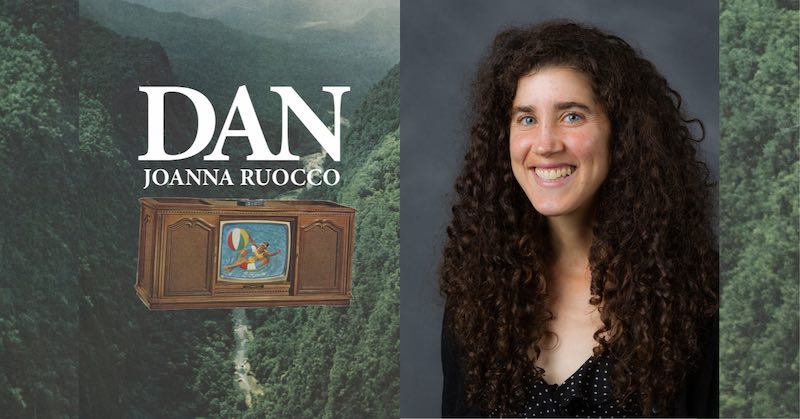
 I Read a Strange Book: Vol. 1 -Ana Gavrilovska
Dan  — Joanna Ruocco
Dorothy, a publishing project
Joanna Ruocco’s Dan was published in 2014 by ‘Dorothy, a publishing project,’ a St. Louis-based press that publishes works of fiction, near fiction, or writing about fiction, largely by women. It sat on my shelf for a couple years before that undefinable pull that compels me to suddenly pick a book up finally drew me to this one. And when I did, I was surprised that I hadn’t previously clocked the comparison to Thomas Pynchon (my favorite author) on the back cover, where Dan is described as “a slapstick parable” that incorporates “the restless undercurrents and unabashed campiness of Thomas Pynchon.” Pynchon is known for his unique sense of humor (among about a thousand other things), though “campiness” isn’t usually how it’s described. I’d be lying if I didn’t admit I was a bit skeptical (it’s not easy to achieve true Pynchonian-ness), but Ruocco does achieve something of a Pynchonian sensibility in her own style, which actually reminded me, on the level of the prose, much more of Donald Barthelme than Pynchon. In both cases, it’s about playfulness, and Ruocco is decidedly so. I like this from Kirkus Reviews: “Modernist-style experimentation ain’t dead yet. Giddy, intriguing stuff from a writer eager to let words misbehave.” For example:
“How do I know so much about mothers? thought Melba, and shivered. Surely she hadn’t known so much yesterday?
But is something different about me? thought Melba. Or is it just a different morning? Melba tried to think about the morning.
What kind of morning was it? Damp, but that was the weather, not the morning. Unpleasant, but that feeling—that feeling of being not entirely pleased—that was her feeling, not the feeling of the morning. The morning did not feel anything. The morning was precisely that: unfeeling.
A monster, thought Melba Zuzzo.”
But what is this book actually about? There is no plot in any traditional sense of the word, but we do follow what appears to be a day or so in the life of a protagonist with an adorably Pynchonian name. She lives in an incredibly unsettling town named Dan, a place which shares the clipped, uncanny weirdness of Twin Peaks without any of its charm.
Melba has odd interactions with virtually everyone, but it’s the men of the town who loom the largest. Many of them are figures of some authority: Mark Rand, her landlord; Principal Benjamin from grammar school; Officer Greg; Dr. Buck; Zeno Zuzzo, her father; Leslie Duck, the owner of a bakery and her employer; and Mr. Sack, her high school history and phrenology teacher. But the strangest one of all, whose house becomes an important setting toward the end of the book, is Don Pond, who holds the proud distinction of being the bakery’s first customer every single day. Melba eventually ends up at his home, which is initially described as a fairly normal abode that quickly turns into a seemingly labyrinthine place that couldn’t possibly exist.
Because a direct comparison to Pynchon is invoked right on the back cover, I will take it one step further and thematically link Melba to the character of DL Chastain, who appears in his 1990 novel Vineland. Without getting too into the weeds (you can read more about Vineland in my review of Pynchon’s most recent novel, Shadow Ticket, for Current Affairs), it’s enough to describe DL as a side character who gets a long set piece in the middle of the novel. DL, an initialism which stands for Darryl Louise, is, in the parlance of Pynchon, a ninjette, who has come to her trade through a past as a military kid whose abusive father ended up stationed in Japan. Teenage DL, who had already been training at a dojo since childhood, seeks and then finds an instructor in unarmed combat. She eventually becomes a master of the aggressive arts (and a whole bunch of other wild stuff happens), but I mention her in relation to Melba because as characters, they are both concerned with a woman’s embodiment and the deleterious effects of patriarchal bureaucracy, though they differ in one major way: DL is utterly self-assured and unwillingly dragged into situations she has done her best to avoid, while Melba has virtually no self-assurance at all and seemingly willfully allows herself into situations where men get to determine what happens to her.
Here’s DL in Vineland, expounding on her experiences:
“As days and weeks passed, DL found herself entering into a system of heresies about the human body. In an interview with Aggro World years later, she spoke of her time with Inoshiro Sensel as returning to herself, reclaiming her body, ‘Which they always like to brainwash you about, like they know it better, trying to keep you as spaced away from it as they can. Maybe they think people are easier to control that way.’ The schoolroom line was, You’ll never know enough about your body to take responsibility for it, so better just hand it over to those who are qualified, doctors and lab technicians and by extension coaches, employers, boys with hardons, so forth—alarmed, not to mention pissed off, DL reached the radical conclusion that her body belonged to herself.”
Melba is clearly caught up in the same whirlwind of patriarchal social expectation. Consider this section in Dan:
“‘My leaving the bakery was Dr. Buck’s idea?’ gasped Melba. ‘When you said the men in this town..’
‘You didn’t know I meant Dr. Buck?’ Don Pond’s voice was frankly incredulous. ‘You think the laypeople of Dan have gotten into the habit of diagnosing safe and unsafe without the help of a doctor? Melba, Dr. Buck is the only person in this town qualified to make decisions about your wellbeing. He told me you have a condition that makes you mistrustful of representatives of the medical profession and that you’d be more likely to heed my advice if I pretended it came from a group of anonymous men, men who’d reached their decision through a democratic process. I was under no circumstance to reveal Dr. Buck’s leading role in the matter. Now I’ve blown it,’ Don Pond sighed.”
Here’s some more from Dan, a beautiful example of both Melba’s preoccupation with bodies and Ruocco’s playfulness with language:
“Having a human body is like eating a fish for dinner, thought Melba. You have to be so slow and careful. You can’t just enjoy yourself. There’s always a worry about the bones.
Melba sighed and tried to concentrate on the alley. The bakery vents hummed and dripped. She knew that the dough inside the dumpster was rising, pushing up the lid. There was so much activity in the alley, but not like a footrace or a conversation, where it was expected that you would stagger on and there was always someone to try to get the better of; it was the unaffected and aimless activity of waste processes, not the sort of thing anyone endorsed.”
Fundamentally, Dan is an absurdist anti-fantasy with an immense amount of depth tucked into its 149 short pages. Through all of Melba’s interactions with the aforementioned men (as well as a handful of women, including her mother and other townspeople), Ruoco circles around ideas of time, the self, identity, patriarchal repression, power dynamics, and the stifling effects of bureaucracy. The language is a strange, staccato delight. Melba is a sympathetic and curious character. One hopes she can find her way out.
“She felt as she did when, like Ned Hat, she had been driven by circumstances to fill her mouth with hydrogen peroxide. She would drink the peroxide swishingly and grip the edge of the sink as her gums began to seethe. In those moments, her roaring mouth sounded like the inside of a conch shell, which sounded, in turn, like the outside of the ocean, and through these echoes—a form of geo-sonar—Melba felt that she could establish, briefly, a sense of her location on the earth. She could also establish other things. For example, her body had the consistency of a stone fruit, although with a different ratio of hard parts to soft parts, and those parts differently distributed. She had a keen sense of the human body—blemished and juicy, a lobe of oddly —and of Dan, the endless thicket in which these bodies formed, growing in clusters but dropping one by one to rot in the understory, contributing nurturing ooze to the tangle of brambles and brackens ever-spreading their roots.”

“I Read a Strange Book” is a column in which part-time Book Beat employee and full-time writer Ana Gavrilovska evangelizes backlist titles she has read and enjoyed. Strange is always complimentary but otherwise wide-ranging. Find a copy of each month’s selection in her section of the Staff Picks shelf at the store, call the store to order directly from us, or shop via our Bookshop.org affiliate page.