
Poverty, arbitrary law, physical and emotional abuse, fatalism, argumentativeness, alcoholic men prone to violence, and women and children at the mercy of volatile men: no one characteristic is unique to Russian culture, but in the aggregate recurrence as topics in poetry, fiction, and nonfiction over the past 150 years they create an enduring literary portrait, whether or not they accurately describe every Russian life. Whether under tsarist or communist thumbs, at any given time, most of the population is discontent with their lot and evaluate regimes more for what they prohibit than what they permit. Depending on the era, the government is either in the background or at the forefront of the works under review.
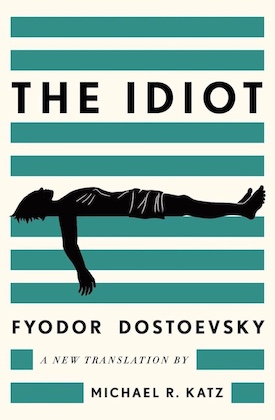 The Idiot
Fyodor Dostoevsky / Michael Katz
Liveright
Dostoevsky loved a good moral dilemma, and his irresolute characters tend to make matters worse. Even love between two people raises questions of what love is; what its social dimensions are—i.e., is the relationship socially respectable and fiscally responsible; and what the couple owe each other, physically and materially.
The Idiot begins with our hero, Prince Lev Nikolayevich Myshkin, on a train entering Russia from Switzerland, where he has lived in a sanatorium for the past four years undergoing treatments for a condition akin to epilepsy. Because of his illness, his education has been spotty (he’s 26), and he is often ill-at-ease in company. His social naivete leads him to speak plainly, directly, and honestly—to the point of social impropriety. He’s a good soul whose eagerness to apologize for his mistakes and forgive others makes him seem idiotic to them, unsophisticated.
The Idiot was first serialized in Russia between 1868 and 1869. Dostoevsky didn’t want to be trapped into writing a novel that conformed to predetermined, conventional modes of plotting and thinking. Writing to format lacked the spontaneity and unpredictability he wanted his writing to express, an unpredictability more in accord with the world as he experienced it.
Rather than adhering to a rigid plot, Dostoevsky preferred to create vividly realized characters, place them in morally charged situations, and discover where their interactions led. Thus, The Idiot is rife with proclamations, declarations, instructive anecdotes, and long arguments between and among characters about moral issues. (I assume that because for Dostoevsky behind moral stances are theological, God-derived directives, he frames issues as moral rather than or in addition to being ethical.)
One so-called moral stance includes a letter published in a newspaper denouncing Prince Myshkin. The claims made by the letter’s author, a character named Keller, are false. After Keller has read his false accusations against Myshkin at a party, and after his accusations have been demonstrated to be made in full knowledge of their falsity, Keller’s defense of his letter anticipates the sort of reasoning that would become grimly familiar during the Soviet era in defending mass murder of its own citizens:
It’s somewhat harsh, do you mean to say? But it’s one might say, for the public good, you must agree; in any case, is it possible to ignore such a provocative incident [Keller falsely accuses Myshkin of stealing someone’s inheritance]? So much the worse for the guilty party, but the good of society comes first. As far as the few inaccuracies are concerned, hyperboles, so to speak, then you’ll agree that the initiative is the most important thing: its goal and intention matter above all else. What’s important is the valuable example; only afterward will we examine individual cases. . .
One situation like this would form the basis of one installment and give Dostoevsky a month to think of something else for his characters to do. As a result, human unpredictability is plentiful here—unpredictable but not self-contradictory—and events tend toward dramatic whipsawing. Michael Katz’s translation has a lightness to it I don’t recall in translations of other works by Dostoevsky by other translators, a lightness that keeps the prose from feeling oppressive a la Rogozhin and instead retains the hope of Myshkin.
The Idiot is not just a jumped-up four-way lovers’ squabble over who gets who. Subplots abound regarding inheritance money, theft, false witness, suicide, and so forth—topics upon which Myshkin’s social milieu has decided opinions. Often, these subplots result from what the various characters tell Myshkin.
On the train he meets a man named Rogozhin, who will become his nemesis. Rogozhin tells Myshkin that he’s going to Petersburg to win back his lover, a woman named Nastasya Filippovna Barashkova, a beautiful young woman many men are eager to woo. Myshkin is also going to Petersburg but to track down a distant relative. Myshkin’s parents are dead, and the man who paid for Myshkin’s treatments in Switzerland is dead, and with his death, Myshkin’s treatments ended. He hopes that this distant relative might be able to suggest a place where he might work. He is especially pleased with his penmanship.
Before they depart the train, Rogozhin suggests they meet again in Petersburg.
Here it is best to cut to the chase.
Through his interactions with others, his behavior and speech, Prince Myshkin quickly demonstrates his Christ-like tendencies. Rogozhin functions as his Satan-like counterpart, who woos Nastasya with cash and jewels. Myshkin notices that Rogozhin tends to appear when least expected although sensed everywhere as a pair of eyes following a person’s every move, waiting for a weakness to reveal itself. Rogozhin is sophisticated, sly, and tactical.
Which leads us to the two main love interests in the novel, Nastasya and Aglaya Ivanovna Ypanchin, its Mary-like figures. Nastasya is the fallen woman, and Aglaya the virgin (although not innocent), but neither reduces to type or allegory. Each is a bundle of contradictions, and it’s as easy to empathize with Nastasya as it is to be put off by Aglaya. Both love and are repelled by Myshkin, and he loves them back, but in an agape way. Rogozhin insists he will have Nastasya. Aglaya’s love for Myshkin is tempered by her observation that (Jesus-like or not), “You have no tenderness, only truth, and that’s not fair.”
Myshkin is an outsider to this community, and his simple directness with others often results in him being publicly ridiculed at almost every gathering he attends. But those same people who, shall we say, deny him in public are eager to talk to him in private. For instance, at one point Aglaya tells Myshkin she likes her ability to talk to him without the embarrassment she feels when talking to her friends and family: “I want to discuss everything with you, even about the main thing, if I want; and on your part, you must never conceal anything from me. I want to be able to talk about everything with at least one person, just as I do with myself.” Is this not a description of prayer?
It’s also a description of how deeply flawed and morally hobbled Dostoevsky saw his present-day Russia. And when the devil’s involved (or his Satan-like counterpart), tragedy will befall the morally confused.
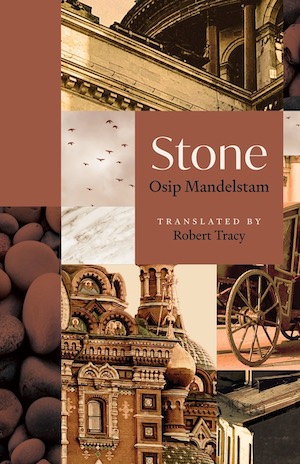 Stone
Stone
Osip Mandelstam / Robert Tracy
Princeton University Press
I am the gardener, the flower as well,
Never alone in the world’s prison cell.
—Mandelstam
Written when he was between the ages of 17 and 24, from 1908 until 1915, after Russia entered World War I, the poetry in Mandelstam’s Stone shows the influence on him of, first, the Russian Symbolists and, then, the Acmeists during the Silver Age of Russian literature (circa 1890-1921). The Acmeists preferred craftsmanship in poetry over subjective emoting and they eschewed mysticism. The Acmeists’ search for writing with greater clarity and precision may have reflected a larger pan-European concern captured by the essays in Robert Musil’s Precision and Soul (1911-1937).
The poetry Mandelstam’s Stone is more interested in concrete things than ideological topics, be the ideology attached to theological or political visions. His commitment to the here-and-now was such that his wife Nadezhda Mandelstam once claimed “that Mandelstam knew that he had exhausted a poetic impulse whenever he found himself writing about stars.” Although poem 7, written in 1909, references Roman gods of the household and hearth, Lares and Penates, they are deities brought down, figurines made equal to humans in their fallibility and frailty:
These spells are austere—
Their harmony is deep, their calm is high;
Far from the starry Lyra in the sky
I have set up my Lares here.
By the well-washed niche where they stand,
At the sunset hour, I listen;
I hear my Penates then,
Constant rhapsody without sound.
How trivial are the fates
And how timid the laws they rule,
These bodies carefully tooled
And the cold of these fragile shapes.
One need not offer other gods prayer;
These are your equals—you may
In a cautious and gentle way
Even shift them here and there.
Although Mandelstam’s Acmeist goal was to shape poems into well-wrought works built on clarity and precision, Mandelstam was far from mechanically rationalist. The associations created by getting from point A to point B are hardly straightforward. In his essay “Talking about Dante” (not included here), for instance, Mandelstam (quoting Robert Tracy’s summary of it);
likens the reading of a poem to a man crossing a Chinese river by leaping from one to another of the junks that are sailing up and down. His route is the logical one under the circumstances, but each leap is taken because of the sudden juxtaposition of one moving junk to another, and so the logic of his progress cannot easily be recovered or charted.
Poem 11 (1909) shows an attitude toward the soul that seems almost Daoist, suggesting that a person should aspire to the level of acting naturally—by intuition rather than as trained and acculturated:
There is no need for speech
And nothing to teach;
How sad, yet beautiful
Is the dark brutal soul.
It has nothing it wants to teach
And lacks even the power of speech,
But like a young dolphin swims
Where the world’s gray deeps are dim.
Repeatedly, Stone returns Mandelstam to the sufficiency of lived experience, an experience that can be understood and appreciated on its own terms rather than as an indicator pointing beyond itself.
But in 1914, Russia entered the war against Germany, and weariness enters Mandelstam’s poetry to its core, seeming to question the clarity a solid piece of stone once exemplified, while noting the need for precision to remain:
The fire tongues
My dry life away;
No more stone songs,
I sing wood today.
It is light and rough,
From one piece, no more;
Both the heart of the oak
and the fisherman’s oar.
Drive piles more firmly in,
Hammers, pound tight,
O wooden heaven
Where all things are light.
(Poem 73, 1914)
The material changes, but the imperative to build well remains.
The uncertainties Mandelstam began wrestling with in 1914 worsened during the 1920s after the installment of the Soviet government. With the new regime in place, Mandelstam’s poems found fewer outlets for publication.
To make ends meet, he wrote children’s books and translated novels by Western writers. However, going unpublished and keeping a low profile wasn’t enough to save him from Stalin’s persecutions, and he died of typhoid fever in the Soviet Gulag in 1938, aged 47.
A body is given to me—what am I to make
From this thing that is my own and is unique?
Tell me who it is I must thank for giving
The quiet joy of breathing and of living?
I am the gardener, the flower as well,
Never alone in the world’s prison cell.
My warmth, my breathing have already lain
Upon eternity’s clear pane.
Imprinted on the glass a pattern shows,
But nowadays a pattern no one knows.
Let the dregs of the moment drain away—
The pattern’s loveliness must stay.
(Poem 8, 1909)
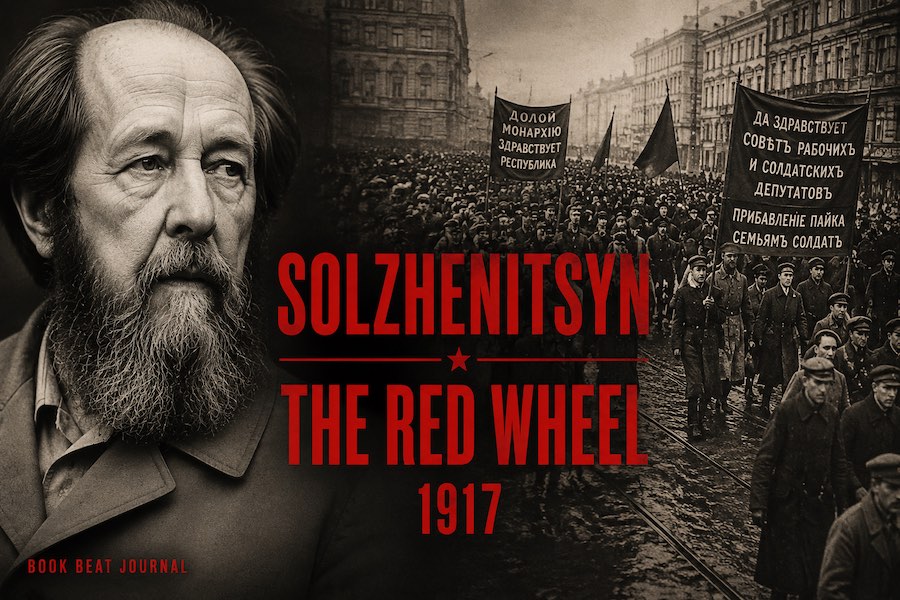 The Red Wheel: Node III—March 1917, Books 1-4 & Node IV—April 1917 Book 1
Aleksandr Solzhenitsyn / Marian Schwartz (Node III) and Clare Kitson (Node IV)
University of Notre Dame Press / The Center for Ethics and Culture Solzhenitsyn Series
The Red Wheel is Aleksandr Solzhenitsyn’s masterwork—in size and ambition if not renown—about the Russian Revolution—the events leading to it, the overthrowing of the Tsar, and the struggle for political power after the fall of the Tsar among Russia’s leftist factions. Its scopes and themes are as vital as Tolstoy’s War and Peace, but six times longer.
The completed work stretches from August 1914 to May 1917, and is divided into four parts, or nodes as he called them, with reference to their mathematical meaning as a fundamental point of interest within a structure or network. That is, each node may be read without reference to the others, even though they appear on a timeline as part of a continuum. (Both August 1914 and November 1916 are published in English as single volumes of about 900 pages each.)
An implication of organizing the novels this way is that it suggests—and the novels repeatedly bear this out—that at almost any point during almost any single event along this timeline, events could have gone otherwise. There is nothing deterministic about the sequence of occurrences, and thus the series may be read as anti- or at least non-Marxist in outlook.
March 1917, aka Node III, is when the Revolution finally erupts, and Solzhenitsyn covers the frenzy of the Revolution’s first days and weeks so extensively that it takes him about 2,400 pages (four 600-page volumes) to detail 23 days of it. (Node III starts on March 8.)
April 1917, aka Node IV, continues to describe the skirmishes among the leftist factions vying for power, now with Lenin returned from exile in Switzerland.
The protagonist is Mother Russia herself. The other characters are her children—the Russian people themselves, from peasant to Tsar. The individual characters—dozens of them, some historical, some fictional—are less important than the events surrounding the social-political upheaval. A nation at war against Germany now risks fighting a civil war as well since Lenin is determined to turn political conflict into revolutionary struggle. Readers eager for an immersive experience will appreciate that each volume includes a bibliography of its historical figures, maps of Petrograd (where most action occurs), and a dictionary.
Solzhenitsyn engaged in intensive research and writing on this series for twenty years, exhaustion cutting him short of concluding with the end of Russia’s Civil War. Solzhenitsyn includes a kaleidoscope of perspectives of the events that unfold, from transcripts of government documents to crowds jostling with Cossacks on horseback, conversations among military officials, workers, and so forth. It is the depth of feeling for each character, however fleeting a part in the books, the care it takes to look for specific details and avoid generalizations about them, that provide the novel’s emotional drama. Grand and nineteenth-century in emotional scope though The Red Wheel often is, many of its narrative techniques belong squarely to literary Modernism: shifting points of view, unreliable narrators, typographical experimentation, documentary insertions, film-script sequences, meeting minutes, and conventional narration all coexist within the same work. (At least the narration is chronological!) But unlike a Modernist impulse to destabilize, defamiliarize, or make new the ordinary, Solzhenitsyn presents his case as a portfolio of manifold evidence united by a narrative thread unspooled by the chaos and anarchy imposed by a revolution trying to establish authority.
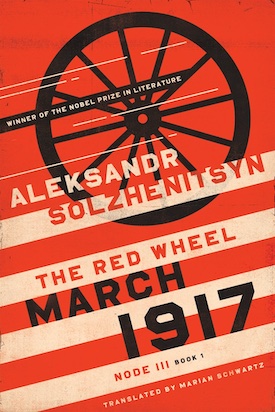 March 1917: Book One
Book 1. Covering March 8–12, Book 1 begins in the Tsarskoye Selo palace with the Tsar Nikolai and Tsarina Alix. The unconventional mystic Rasputin had been murdered recently, Nikolai has done nothing about it, and the murderers live free. Alix thought he was a miracle-worker because of his seeming success in alleviating the suffering of her hemophiliac son, Alexei; otherwise, Rasputin was enormously unpopular with the royal family’s inner circle and the population at large. Alix nags Nikolai about his timidness, his need for resolve and sternness, traits Nikolai berates himself for lacking, making him eager to leave the palace and Alix’s nagging to be shut of it. Nikolai’s lack of resolve will ultimately be his undoing.
Yet in the countryside, where Nikolai retreats to, peasants are asked by the government to sell wheat for bread at prices below production costs. In the cities, bakeries for poorer Russians are running out of bread while the rich continue to dine unaffected. Russian legislators in the Duma are ineffective and unable to devise and enforce plans to pay farmers and feed the poor. Angry mobs are beginning to confront troops sent in to disperse them from demonstrations of protest. Russian society is on the cusp of disaster as even members of the military—brought in to maintain calm—sympathize with the underfed and refuse to shoot or arrest the mobs.
The novel’s actions are presented in a variety of ways and through a variety of characters: In addition to the Tsar and his wife, Solzhenitsyn presents street scenes of Petrograd as a film treatment and inserts documents that record committee meetings at the Duma. About a quarter of Book 1 is devoted to the single long day of March 12, tracking the rapidly changing fortunes of the royal family.
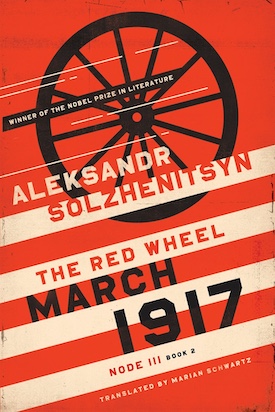 March 1917, Book II
Book 2. Revolutionary fervor grows along with calls to oust Tsar Nikolai from power and with it the entire form and structure of Russian rule. The days of March 13-15 are packed enough with incident to warrant all of Book 2 to them.
Solzhenitsyn wasn’t a poetic writer, nor a writer with a musical or rhythmic sensibility, but he could convey information with clarity and concision, insight into human motivation, and an eye for important details. The revolutionary wheel is grinding closer to the royal family. Tsarina Alix hears of unruly citizens wending their way to the palace, but she finds the idea ridiculous of leaving Tsarskoye Selo, partly out of delusion, partly out of fear for the lives of her children with measles, suffering from temperatures of 39? C. Meanwhile, Nikolai, in the countryside, remains oblivious to much of what is happening.
Solzhenitsyn’s account of the forces coalescing around the nascent frame of a new government to replace the Duma and tsar makes it clear that a fully formed Leninist Communist Party ready to step into place did not exist. Instead, various leftist sects—Mensheviks, Socialist Revolutionaries, Bolsheviks, and other socialist factions—fight for inclusion in the many new committees and the renaming and redirection of others. Less than 24 hours into the national political disruption, it’s clear that infighting will soon begin. And if infighting inside the Duma recapitulates the fighting against tsarist principles on the outside, it will become mortally violent.
The collapse of the tsarist government takes with it people in minor positions of power who are replaced by new people accountable to no one. The means of communicating messages and materials in and out of Petrograd via telegraph and railroad have become disrupted, and the problem of inadequate food distribution exacerbated.
As the tsarist government falls, it takes Nikolai with it, who abdicates the throne. He meets with pro-monarchy moderates who favor a constitutional monarchy. Knowing that Nikolai is unpopular with the people—and his wife even more so—the moderates urge Nicholas to abdicate the throne to his son, Alexei. But, for that to happen, Alexei will be separated from his parents, with no communication until he comes of age. Nikolai will not stand for being separated from his son—the one thing in his life he is inflexible about—and so offers to transfer the throne to his brother Mikhail instead.
After an agreement is reached, Nikolai is allowed to take a train to General Headquarters, where he must tie up the loose ends his abdication has engendered. On March 15, late in the evening, alone in a railcar on his bed, he assumes his wife and children are still safe in the palace.
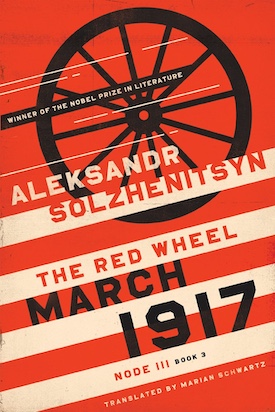 March 17, Book III
Book 3 covers March 16–22 as the monarchy falls and the revolution rolls across the front lines. National matters are in turmoil because of communications—communications missing, delayed, based on rumor, unbelieved, or contradicted by other messages. Those in charge of railways refuse to allow the now-abdicated tsar’s train to proceed to General Headquarters because railway officials had not yet received notice of the abdication, yet his abdication is supposed to remain secret until Nikolai arrives at General Headquarters. Military leaders responsible for supplying troops fighting on the front during WWI do not know who to report to or on whose authority they can take actions of any sort.
The revolution continues spreading through Russia’s major cities. The locations of Nikolai and Alix are unknown, and the various revolutionary committees are planning, writing, and rewriting proposals and edicts regarding the structure of the new government. However, the committees represent different factions, none of which has enough power and influence to take the helm. Just ten days into the revolution and already there is talk of purges, of arresting and jailing the abdicated tsar and his family.
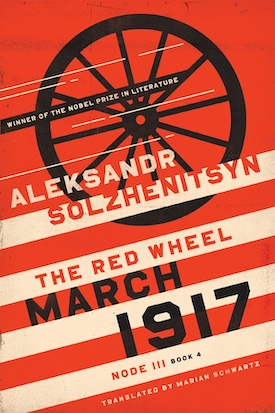
March 1917 Book IV
With every form of authority now in question, Book 4—March 23–31—shows how ungovernable Russia quickly became once the monarchy fell. The Revolution’s early questions remain unresolved: Should Russia stay in or withdraw from the war, what becomes of military hierarchy and practice, how are merchants to conduct business, and which of the bodies now vying for power speaks on behalf of the People—the Provisional Government, the Executive Committee, or none of the above? Who are the Provisional Government and Executive Committee to say they have any right to make decisions affecting the nation? Is it irresponsible to initiate a revolution while in the middle of a war? Should troops protect the nation from Germany or the authorities from the people?
Encouraged by revolutionary appeals that identify bourgeois warmakers as their common enemy, Russian and German troops fraternize across the lines. Back home, these actions stoke fears that Germany will invade and carve up Russia for its own use. No recognized authority exists to force the soldiers to resume fighting. Soldiers are now free to question and ignore commands. Officers fear for their lives from troop reprisals.
Meanwhile, exiled in Switzerland, Lenin plots how he can use the confusion in Russia to his advantage and begins negotiating for passage through Germany to Russia. Let the committees and people in the street talk about how to share power: Lenin would come to take it.
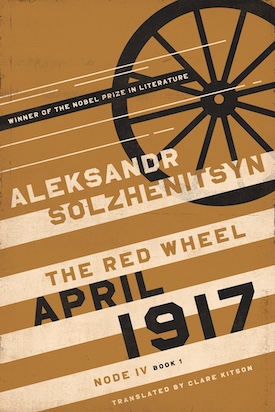 April 1917: Book I
Book 1. From April 11 to May 5, the various leftist alliances begin to fray as each bloc vies for ultimate command of Russia and its role in the ongoing battle against Germany. No one group has sufficient power, authority, influence, or numbers to govern alone. Arguments continue about how the government should be formed and run, what the rights of citizens will be, and which citizens will have them. (So far, women have been promised the vote, and Jews have seen the removal of social barriers based on religion.) One committee member makes an unfortunately prescient statement about the Soviet leadership to come:
At times like this, one moment of indecision is enough to forfeit power forever. It’s better to make some errors in your actions than it is to hold back from acting at all.
Extremism in the name of communism is no vice!
Lenin arrives and addresses a rally. While there, he ignores his adversaries, speaks briefly but effectively, sets his argument in stark, direct terms, and aims it at proletarians only. His intolerance of compromise or collaboration gives the Bolsheviks an unusual advantage. While the other factions focus on making peace with each other, Lenin brings his case straight to the people, in unambiguous terms.
Part of Lenin’s appeal to the people is that the nation must end its participation in the war, that the leaders of the warring nations are competing capitalists who hold the proletariat of all European nations under their yoke. Rather than engage in a “mere” defense of the fatherland, the Russian Revolution is for the betterment of all mankind. Wounded veterans are furious that Lenin describes the war in which they fought and made great physical sacrifices as unworthy.
Solzhenitsyn’s Lenin consistently dismisses ideological opponents as class enemies, leaving little room for compromise. Nor does he show interest in pluralistic democratic processes that might impede his revolutionary seizure of power. His stance seems to offend as many people as it attracts as he whips up anger and resentment among the populace. He also clearly has no use for peasants, whom he views as too uneducated and simple to be of much use to the Revolution. A divisive figure, far from being accepted by other politicians and the general population, Lenin is seen as crude, unreasonable, unrealistic, and intolerant.
Solzhenitsyn depicts Lenin as a manipulative rationalizer of his own hypocrisies but an implacable foe of everyone else’s—and worse toward those who disagree with him honestly. Aware of his inadequacy as a public speaker, he often hides behind others who parrot his words to better effect. In one situation, he hides in a building as a group of high schoolers (!) shout “Down with Lenin!” and demand that he come out and talk to them. Instead, he spends hours of the afternoon hiding, pouting after the high schoolers leave that they have ruined his day.
Newspaper reports from within Russia as well as international sources show an overall gratitude for the revolution, ambivalence toward Lenin, and anarchy on the streets. As the various political factions vie for power, join forces, and hammer out compromises, the streets of Russia are increasingly prone to acts of criminal behavior during the cover of night and openly during the day.
On the front line, Russian soldiers are defecting, refusing to obey their superiors, even jailing their superiors. At any rate, they’re not fighting, in part because they are upset to hear that factory workers are being given eight-hour workdays, while they must work around the clock. They also demand that Russia’s revolutionary turn toward democracy include them, too:
Committees were being formed in every HQ and every greenhorn squad, as well as separate committees of paramedics, veterinarians, quartermaster clerks, radiotelegraph operators, noncombatant staff, and separate committees of the Ukrainians, Poles, Muslims, and Georgians.
One newspaper editorializes that the military should be included in votes at General Headquarters: “They will have the right to examine all matters and all questions relating to the competence of the commanders-in-chief! And all orders to the armies and the army groups must be counter-signed by the commissariat!” On the battlefield, Germans easily rout a disorganized and poorly led Russian army.
Russia’s farmlands are in chaos. In addition to troops arguing about whether to continue fighting the war against Germany, there is confusion concerning the basis upon which land distribution will be determined: By the time the book ends, Spring is already a month old, but no farmers—landlord or peasant—want to sow fields that will only be taken from them come harvest. Worse, the government has no idea how many peasants Russia has or how many acres there are to distribute among them.
News that Trotsky has left his exile in the U.S. to join Russia’s revolutionary activities is received tepidly by officials in Russia’s Provisional Government who are already fighting among themselves over the form and actions the new government should take. Worsening the infighting are announcements published in newspapers by various leaders of various departments—sometimes from factions within departments still fighting for internal leadership—who presume to publicly declare what Russia’s international intentions will be, who the new government will and will not work for, and to what ends.
As disagreements about leadership narrow to one between the Provisional Government and the Bolsheviks, with Lenin as their leader, tensions rise to a murderous pitch when fighting breaks out between the two major contenders for power. The Provisional Government lacks the power and authority to stop the Bolsheviks. Trotsky’s impending arrival may bend events further towards the Bolshevik side, but his force of personality—as powerful as Lenin’s—portends yet another power grab.
The book ends with a sudden change of course, an entirely plausible pause in the climactic action, that seems to ask, “And what did Russia’s youth make of this Revolution?” A young man and woman meet by chance at a party. Both come from wealthy families on the steppe, but the young couple (for that is what they immediately become) are eager to see what toil is like. Presumably, Book II of April 1917 will show them and document how long their wistful outlook lasts.
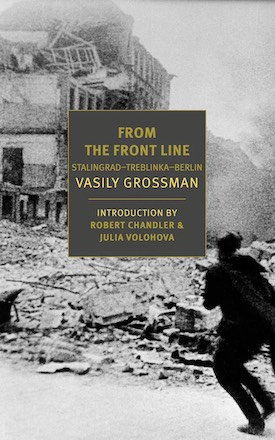 From the Front Line: Stalingrad-Treblinka-Berlin
Vasily Grossman / Robert & Elizabeth Chandler
NYRB Classics
From the Front Line collects some of Vasily Grossman’s journalism from WWII at key battle scenes. His reports combine eyewitness description, personal reflection, and interviews with soldiers, peasants, military officials, and others he meets along the way. The soldiers are heroic men compelled to perform awful acts—killing, because it is war—in defense of their homes. Vasily Grossman (1905–1964) trained as a chemical engineer before becoming a journalist and novelist. As a correspondent for Red Star, he accompanied the Red Army from Stalingrad to Berlin, producing some of the most important eyewitness accounts of the Second World War.
The first part of the book focuses on Stalingrad’s 200-day siege by the Germans in 1942. Grossman combines eyewitness testimony with his own observations, reinforcing the credibility of the conditions his sources describe. Supreme sacrifices, astounding bravery, acts of vengeance and kindness—extreme times bring out extreme abilities, for good and ill. Grossman’s descriptions of various stages of the battle will conjure memories of his eponymous novel for those who have read it.
The second section of the book occurs during 1943, following the Red Army’s westward advance after the Soviet victory at Stalingrad. The horrors the Nazis committed were everywhere in evidence as the Soviets repelled them back to Germany. Among the survivors he encounters are eight men trapped inside a coal mine the Nazis had sealed—eight of an original group of twenty-seven.
“Ukraine without Jews” recounts the hundreds of thousands of Ukrainian Jews murdered by Nazis and their collaborators. Grossman’s two-page list of the occupations and ages of these murdered thousands is affecting and awful. It reveals the ongoing selective slaughter by Nazis and their ideological reasons for the mass murder.
Grossman’s prose can reach levels of hyperbolic patriotism, most of which the Chandlers have excised to limit redundancies and eye-rolling purple prose. But what they’ve kept at least exemplifies excellence in the rhetoric of uplifting patriotic address, such as this passage from “Thoughts on the Spring Offensive” about a convoy of military vehicles stuck in axle-deep mud:
And thousands of wiry, skinny, sweating men gritted their teeth to haul these vehicles forward. Day and night, under eternal rain and eternal, thrice-cursed sleet, they hauled along the vast weight of the armies’ rear support units. They hauled with their sinews, with the sheer force of their will, with their iron strength of character; they hauled with thirst for victory, with the fire of vengeance, and with infinite endurance.
In the third section, Poland is liberated, and the Nazis are repelled to Berlin. But what Grossman has seen so far, over 18 months—deaths from starvation, bombs, bullets, bayonets, and worse—has not prepared him for what he encounters at Treblinka.
“The Hell of Treblinka” is a 40-page essay on Treblinka based on Grossman’s interviews with eyewitnesses who described to him how the camp was arranged, the number of people crammed into cattle cars (150-200), and the various steps the prisoners were taken through, each designed to strip them of both their humanity and their capacity to resist before the gas chamber doors closed.
Grossman discovered that the Germans had developed an elaborate system for collecting, combing through, and collating by type the clothing and goods Jews brought with them, separating “worthless” from saleable or reuseable (including “about 25 carloads of hair packed in bales, 248 carloads of men’s suits, about 100 carloads of shoes,” etc.).
Grossman wrests emotional impact from facts and figures—the “facts” usually some group of humans and the “figures” categories of their miseries and abuses quantified. Although he often overestimates the numbers of people killed, Grossman was scrupulously accurate given the evidence available to him in 1944, his accuracy in other matters he reports on corroborated by independent contemporary sources.
Grossman’s final report in this volume—largely taking place inside the Berlin Zoo—written during the final days of the war and Hitler’s life, couldn’t be published by the Soviet press, since Grossman’s comparisons between freedom and cages and treating humans as animals could have easily been read by Russians as alluding as much to life under the Nazis as it did life under Stalin. (Grossman also omitted from these essays the mass rapes committed by Soviet troops against German women, though he recorded them in his notebooks.)
That said, From the Front Line confirms Grossman as a major figure in 20th-century literature, able in both fiction and nonfiction to recreate in palpable words the experiences of millions of people coping during the worst of times. His ability to find composure or clarity of mind in what he witnesses—often horrific—is astounding. Thanks again to translators Robert Chandler and Elizabeth Chandler for the ongoing efforts to restore and champion Grossman’s works.
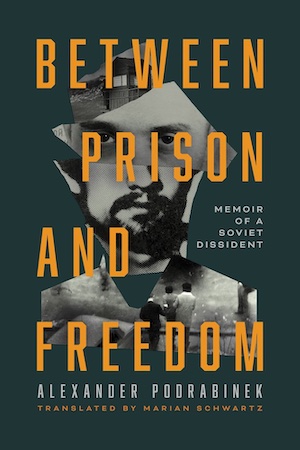
Between Prison and Freedom: Memoir of a Soviet Dissident
Alexander Podrabinek / Marian Schwartz
University of Notre Dame Press
Alexander Podrabinek is a Russian dissident (emphasis on the present tense) who spent five and a half years (1978-1983) going from internal exile to prison camps to labor camps. Much of that time he spent in solitary confinement, largely because he refused to snitch, recant, or accuse in exchange for resettlement in the U.S. or, later, release from jail. To my mind, he sets the bar for resilience and resolve that would, I admit, be far from what I would be able to achieve.
Podrabinek’s main crime, according to Soviet authorities, was having his book, Punitive Medicine (1979) published in the West. It summarized the ample evidence and documentation collected by volunteers—Soviet psychiatric professionals, human rights organizations, and other individuals—all dissidents of the Soviet government. Political prisoners remanded to psychiatric facilities were sometimes heavily medicated, left with little ability to think or act. A person must be crazy to be unhappy to be living in the worker’s paradise.
But before the book was published, Podrabinek had presented his findings in 1977 to the World Psychiatric Association congress. This act first resulted in the WPA condemning the Soviet government for its actions, and second, in 1983, in the Soviet All-Union Society of Neurologists and Psychiatrists withdrawing from the WPA rather than face likely expulsion. (The group was conditionally readmitted in 1989.) The book’s publication further embarrassed the Soviet government, of course.
Soviet citizens’ attitude toward their government began souring early in the post-Stalin period, when it became safer, less fatal, to do so. Khrushchev’s Secret Speech to the 20th Congress of the Communist Party of the Soviet Union in 1956, in which he denounced Stalin’s atrocities, said the quiet part out loud: Although delivered only to Party delegates, the speech quickly leaked abroad, effectively acknowledging to the world that the government had committed many of the crimes against its own citizens it had long denied. Podrabinek, born in 1953, grew up during this period of blooming dissatisfaction among Soviet citizens and disillusioned hardline former supporters.
Summary executions fell out of favor with the government, only to be replaced by bureaucratic repression via imprisonment, psychiatric abuse, surveillance, harassment, internal exile, and selective prosecutions. Inflicting psychological distress became the government’s preferred method of handling dissidents, a distress it hoped would lead to deterrence or, barring that, confession, implication, and imprisonment.
Writers such as Vasily Grossman or Alexandr Solzhenitsyn witnessed many horrors the Soviet government inflicted on its own people—see Everything Flows and The Gulag Archipelago, for example. They were of a generation raised on the promise of communism’s ideals, ideals dashed by Stalin’s purges and imprisonments. And that was a type of moral betrayal the post-Stalinists would not experience, a generation that inherited skepticism rather than idealism.
By the 1960s and 1970s, an informal set of rules of engagement had evolved between the KGB and dissidents. As dissidents learned how to manipulate Soviet judicial procedures, they also developed Western contacts who could immediately notify the rest of the world of legal and humanitarian wrongs inflicted on the dissidents. They developed ironic, patient stances towards the government, its restrictions and contradictions.
Denied entry into medical school for political reasons, Podrabinek chose to work with the ambulance services. With this connection to the medical world, he discovered a dissident community of doctors and other medical personnel. Through them, he began investigating cases of dissidents imprisoned in psychiatric facilities, interviewing them (posing as a relative come to visit), obtaining medical records, and so forth.
Podrabinek was eventually arrested for his activities, given a show trial, and sentenced to five years of internal exile near the Arctic Circle. He complains of winters lasting from October to April with temperatures ranging from -20? C to -65? C. Finding employment is difficult in a small community, and some jobs are denied him by orders from the KGB. His wife becomes pregnant and gives birth. Eventually, Podrabinek is arrested again—in exile!—for crimes against the state. Corrected galleys of the U.S. edition of his book Punitive Medicine were found in their house.
Podrabinek goes through a circuit of prisons (none of them work camps, at first) and holding pens, from pens packed with informers, to those with death-penalty prisoners, to those holding men and women in cells cheek-by-jowl. He refuses to answer interrogators’ questions and distributes among the prisoners whatever gifts of food, money, and cigarettes sent to him by organizations devoted to keeping tabs on Soviet dissidents.
Growing frustrated with their inability to break him, prison officials keep him in solitary confinement for a series of imaginary infractions, a punishment whose components also include reducing the already inadequate food rations doled out to the general prisoner population.
As the conditions of his confinement deteriorate, so does Podrabinek’s health. His weight collapses to about 40 kilos, and he develops tuberculosis. Before that, he endures physical torture (his biceps rather than his wrists are handcuffed, pressed down by a boot to maximize tightness) and temperature extremes both inside and outside of the prison.
Reader, he survives. And continues his dissent activities. Podrabinek’s tone throughout his memoir—conveyed in seamless idiomatic American English—has a quality of bemused distance and irony. Which is not to say that he discusses his torments as a joke. Instead, he combines bare facts with descriptions of his level of hope, and his ability to maintain his sense of purpose prevents him from succumbing to the temptations offered him by prison staff that will ease or end his torment.
Podrabinek currently lives in Moscow. Nothing will protect him if Putin decides to imprison or execute him.
*
Once the Soviet Union collapsed, the center of concern shifted, becoming less interested in directing history than in surviving it.
*
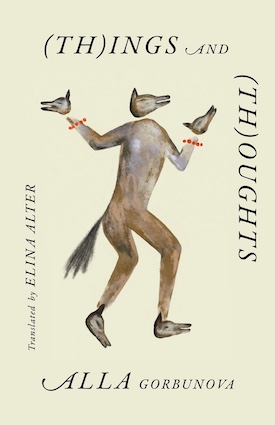
(Th)ings and (Th)oughts
Alla Gorbunova / Elina Alter
Deep Vellum
(Th)ings and (Th)oughts is the second collection of stories by Russian writer Alla Gorbunova to be translated into English, this time by Elina Alter, whose renderings feel natural and compelling.
Written with acidic irony and historically informed disappointment, the first story, “Psychoanalysis in Hell,” introduces us to the daily degradations endured by citizens that we will watch unfold during the following sequences of tales. In this story, a therapist provides the reader—the presumable “you” of this story—a list of guidelines for accepting the fact you’ve ended up in hell, deserved or not. The therapist’s list has supplanted Dante’s “Abandon all hope ye who enter here,” suggesting that just because you’re without hope doesn’t mean you can’t have fun.
Gorbunova’s post-Soviet attitude lacks what might have been her grandparents’ shock at the atrocities committed by Lenin, Stalin, et alia in the name of moral purity. Instead, writers of the 1960s—men and women born during the Soviet era—know no other environment. For instance, “Terentiy’s Guilt” illustrates an effective guilt-based management style designed to assure employees that, no matter what they have or have not done on the job, they are nonetheless guilty of something. (I recently found out there’s a term for this style: involution, meaning, according to Google’s AI, “endless, exhausting cycle of extreme internal competition where employees work excessively long hours and exert maximum effort, but receive diminishing returns or fail to achieve meaningful career advancement”):
In the evenings, the accountant Terentiy had conversations with his feelings of guilt. Terentiy’s guilt asked him various questions.
‘Are you guilty of being late to work?’ Terentiys’ guilt would ask. Terentiy, straining to remember, would discover that no, he had come to work precisely at ten.
‘Not guilty!’ Terentiy would happily reply.
‘Let’s see,’ the guilt would scowl. ‘Are you guilty of coming to work on time?’
‘Yes, I’m guilty,’ Terentiy would mournfully admit.
‘Are you guilty of being rude to your boss?” questioned his guilt.
‘No, certainly not,’ Terentiy would say, alarmed.
‘Then perhaps you’re guilty of being polite to your boss?’ the guilt pressed him.
‘I am guilty, yes,’ Terentiy would mournfully admit.”
And so forth, until every encounter with his boss at work is paralyzing.
“Incidental Pleasures” concerns a man named Vasily, for whom life no longer has meaning. Thus, he resigns himself to committing suicide. However, things that he enjoys—coffee with friends, a good piece of cheesecake, and so forth—things that he enjoys keep cropping up every day, forcing Vasily to perpetually postpone his suicide, until he accepts the fact that life can simultaneously have no meaning and still be enjoyed.
“The Trials of Ivan Petrovich” is a near 50-page sequence of miniatures involving the eponymous character’s ordeals that occur either in (I can’t tell which) a series of dreams or a surrealistic world (such is their pervasive oddity) akin to plights Kafka’s K. might find himself in episodes from “The Outer Limits” as directed by the Quay Brothers.
Offering an amorphous blend of surrealism, dark fantasy, magical realism, irony, and gothic—as related by the Brothers Grimm—Gorbunova’s stories amount to comedic social commentary regarding a cultural foundation built on bad faith. Many of these brief pieces—fables, anecdotes, and sketches—are akin to those you might find in an issue of the experimental literary journal Lady Churchill’s Rosebud Wristlet. Just as overly strict parents only teach their children how to be better sneaks, so do authoritarian systems encourage their citizens to be cleverer: Hypocrisy works best when undetected.
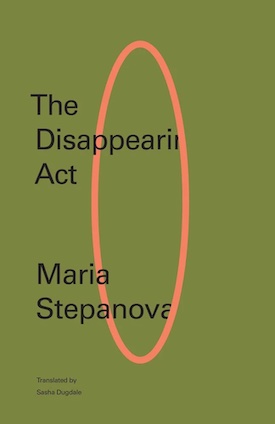
Disappearing Act
Maria Stepanova / Sasha Dugale
New Directions
Maria Stepanova is a novelist, poet, and journalist from Russia who won the 2005 Andrei Bely Prize for her poetry and the 2018 Bolshaya Kniga “Big Book” Award for her memoir In Memory of Memory. Disappearing Act takes place now—Putin has been at war with Ukraine for some time—and follows the thoughts of M, a novelist who, at the beginning, thinks she is on a train to a literary conference.
Having reached the end of her patience with her philandering husband and her imperialist nation, M quickly packs her things and heads to the train station, imagining her destination will be a place where she will be free to feel angry, humiliated, embarrassed, and ashamed. A place she can restart. Once she leaves her country (presumably Putin’s Russia given the novel’s ample allusions), she settles in a city called F, her train stop, after a problem arises with the connecting transportation to the conference, a problem M lacks the emotional energy to work out.
Once M is free from Russia’s grasp, she remains largely passive, taking a let’s-see-what-happens attitude. So, when a stranger approaches her at a café, politely flirts, and then offers to take her to an Escape Room, she accepts, even while thinking to herself of the stupidity of agreeing to be locked up in a room with a total stranger.
When the stranger admits to M that he reads her books—he’s a fan—M becomes angry. She had hoped he was attracted to her as an anonymous woman he knew nothing about; instead he was somebody who already had ideas about her, who had already made assumptions about her.
In a similar way, M is surprised and annoyed at a party where her departure from Russia elicits scolding rather than sympathy. Instead of leaving Russia, they scold her: it is her moral duty to stand witness to what is happening and report on that, despite the risks.
Later, she strikes up a conversation with two young women, circus workers, part of a magic act which has just suffered the loss of the woman whose job was to lie in a box while the magician sawed her in half. She offers to help, and they agree. The performance goes well, and they invite her to join them—it was their last performance in F., and tomorrow they head to a different city.
A circus magic act could be a new start for M, depending on whether disappearance, anonymity, escape, and reinvention require company or accountability.
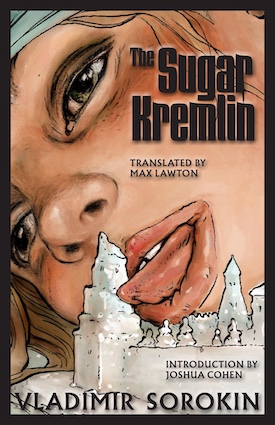
The Sugar Kremlin
Vladimir Sorokin / Max Lawton
Dalkey Archive
The stories in Vladimir Sorokin’s The Sugar Kremlin take place in New Russia. In this near-future Russia, the nation still struggles against internal and external enemies, the external enemies to be killed, the internal to be persecuted, imprisoned, and tortured. Appearing throughout the stories is a sugar Kremlin, a candy replica of the Kremlin everyone loves to suck on, from faceless bureaucrats (business-suited dwarves) to circus staff, from torturers to executioners—anyone and everyone under New Russia’s domain, a place technologically up-to-date yet religiously backward-looking, oriented toward Eastern Orthodoxy.
For me, the stories added up to revealing a joke that forms the spine of the book. The rest of this review should be filed under “spoiler alert,” with two parts.
Part 1: The stories seem to occur in the near future within the same time frame—a span of perhaps several months or a year—with a violent change of government in the recent past. The only story with a date occurs on March 19, 2028—fourteen years after Putin annexed Crimea from Ukraine. The last story reveals that the Sovereign—the otherwise nameless leader of this New Russia—wears the Monomakh’s Cap. Grand Prince Vladimir II Monomakh was a late 11th / early 12th-century ruler of Kievan Rus’, warrior, and saint of the Eastern Orthodox Church. “Monomakh” means “he who fights alone.” Wink, wink.
Part 2: But, as Pete Townshend has written, “Meet the new boss. . .”
__________________________________________
Further Reading, Viewing, and Listening
The books discussed above span nearly 175 years of Russian literature. For more information on the writers, translators, and history behind the books, please check out the following links.
Conversations on Literature and Translation
• Dostoevsky
Michael Katz on translating Dostoevsky Although the episode centers on Crime and Punishment, much of the conversation is about translating Dostoevsky—his humor, repetition, rhythms, moral questions, and Katz’s approach to making those qualities work in English.
• Grossman
Robert Chandler on translating Vasily Grossman Chandler discusses Grossman’s wartime notebooks, his Red Star reporting, Stalingrad, and Treblinka.
Robert Chandler interview: “Grossman wanted the truth” Chandler discusses translating Grossman over four decades, Soviet censorship, Life and Fate, Stalingrad, and Grossman’s moral vision.
• Stepanova
Conversation with Maria Stepanova and Sasha Dugdale (Oxford) Author and translator discuss memory, exile, language, and the challenges of translating a novel that is simultaneously political, psychological, and philosophical.
• Sorokin
“The Translated and Untranslatable” Vladimir Sorokin and Max Lawton discuss the challenges of translating Sorokin’s fiction, the role of the translator, censorship, exile, and Sorokin’s literary career.
Telluria and Their Four Hearts; In a conversation moderated by Mark Krotov of n+1, Vladimir Sorokin and Max Lawton discuss Telluria, Their Four Hearts, the evolution of Sorokin’s work, and the translator-author relationship.
On Authors and Their Topics
• Dostoevsky
“Dostoevsky at 200” A scholarly roundtable marking Dostoevsky’s bicentenary. For readers interested in current critical perspectives of the novel.
PBS: Dostoevsky Behind Bars This documentary follows incarcerated readers wrestling with Dostoevsky’s novels, demonstrating the contemporaneity of Dostoevsky’s understanding of guilt, compassion, and moral responsibility.
• Solzhenitsyn
Aleksandr Solzhenitsyn Center Video Library [https://www.solzhenitsyncenter.org/video-library] An archive of interviews, documentary films, speeches, adaptations, and lectures.
“Writing The Red Wheel in Vermont” A nearly two-hour presentation on the decades Solzhenitsyn spent researching and writing his history of the Russian Revolution, illuminating both his historical scholarship and literary ambition.
Solzhenitsyn’s Nobel Prize Lecture A reflection on literature, truth, and political responsibility, revealing the moral philosophy shaping Solzhenitsyn’s historical fiction. Available here as a free downloadable PDF.
Dialogues with Solzhenitsyn Filmmaker Alexander Sokurov’s extended conversations with Solzhenitsyn offer intimate portraits of the writer.
PBS FRONTLINE: The Homecoming Frontline accompanied Solzhenitsyn on his return to Russia after two decades in exile. The documentary profiles both the writer and the country he returned to.
• Grossman
The New Yorker: “The Unlikely Journalist Who Looked Into the Heart of War” A superb introduction to From the Front Line explaining why Grossman’s dispatches matter, how they differ from ordinary war reporting, and why they remain powerful today.
On the Battle of Stalingrad—PBS Secrets of the Dead: “Deadliest Battle” (2010) Grossman’s reporting deepens when viewed alongside historical accounts of the battle itself. Maps, archival footage, and military chronology document the scale of the catastrophe that Grossman witnessed firsthand. The documentary is also able to reexamine the battle using newly opened Soviet archives and firsthand testimony from German and Soviet veterans.
On Treblinka, Grossman’s report The Hell of Treblinka became one of the earliest comprehensive accounts of a Nazi extermination camp. This documentary focuses on Samuel Willenberg, the last surviving participant in the 1943 Treblinka uprising. Historians including Christopher Browning, Yehuda Bauer, and Michael Berenbaum provide context that complements Grossman’s eyewitness reporting.
• Gorbunova
Words Without Borders: Stories from Ings & Oughts Three stories translated by Elina Alter from (Th)ings and (Th)oughts, plus embedded videos of Gorbunova reading the original Russian. Gorbunova’s wit, timing, and understated delivery become more apparent when heard aloud.
• Sorokin
Russia’s Open Book: Writing in the Age of Putin Sorokin appears alongside several contemporary Russian writers discussing literature under Putin. Stephen Fry hosts.
Vladimir Sorokin NPR’s profile captures Sorokin’s reputation, the controversies surrounding his work, and his reflections on censorship in a concise format.