
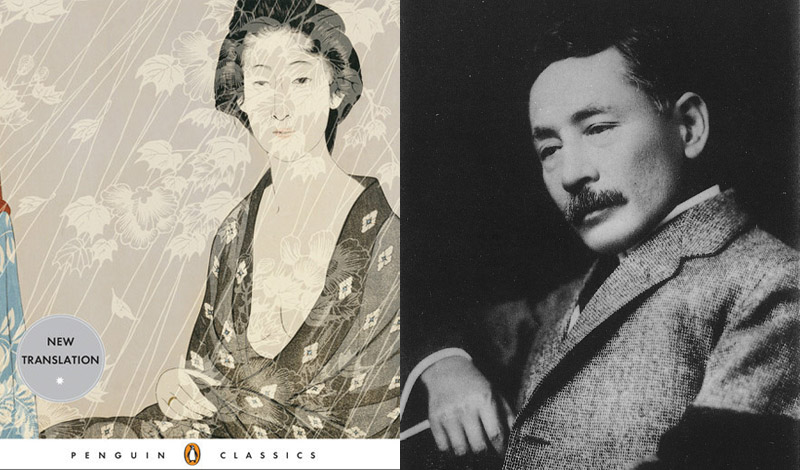
The reading group will meet on Wednesday, September 30 at 7 PM in person and on Zoom for a duscussion on Kusamakura by Natsume Soseki, father of the modern novel in Japan. Books are in stock now and discounted 15%.
A stunning new English translation—the first in more than forty years—of a major novel by the father of modern Japanese fiction
Natsume Soseki’s Kusamakura—meaning “grass pillow”—follows its nameless young artist-narrator on a meandering walking tour of the mountains. At the inn at a hot spring resort, he has a series of mysterious encounters with Nami, the lovely young daughter of the establishment. Nami, or “beauty,” is the center of this elegant novel, the still point around which the artist moves and the enigmatic subject of Soseki’s word painting. In the author’s words, Kusamakura is “a haiku-style novel, that lives through beauty.” Written at a time when Japan was opening its doors to the rest of the world, Kusamakura turns inward, to the pristine mountain idyll and the taciturn lyricism of its courtship scenes, enshrining the essence of old Japan in a work of enchanting literary nostalgia.
“The artist is a person who lives in a three-dimensional world, but breathes the air of a fourth. His duty is to look at the world and see poetry where others see only facts, to see beauty where others see only utility.”
-Soseki
Natsume Soseki (1867–1916) is widely celebrated as the definitive novelist of Japan’s Meiji era and a foundational figure in modern global literature. Born Natsume Kinnosuke in Tokyo, his early life was marked by an unstable upbringing and an exceptional aptitude for classical Chinese and English literature. This academic excellence led the Japanese government to send him to study in London from 1900 to 1903. While his time in England was marred by isolation and financial hardship, the profound cultural clash he experienced became the creative catalyst for his career. Upon returning to Japan, he channeled these anxieties into writing, quickly resigning from his prestigious teaching position at Tokyo Imperial University to become a full-time serialized novelist for the Asahi Shimbun newspaper.
S?seki’s fiction brilliantly captures the psychological toll of Japan’s rapid transition from an isolated feudal society to a modernized, Western-influenced power, blending sharp social satire with a deep exploration of existential loneliness.Though S?seki lived before the establishment of modern Japanese literary accolades like the Akutagawa or Naoki prizes, his legacy is one of the most decorated and enduring in the nation’s history. His early satirical works, I Am a Cat (1905) and Botchan (1906), achieved immediate commercial and critical acclaim for their wit and accessibility. As his career progressed, his writing shifted toward profound psychological depth, culminating in masterpieces like Kokoro (1914) and his highly lyrical, poetic novel Kusamakura (1906), which famously prioritizes aesthetic beauty, nature, and Zen-like detachment over traditional plot. S?seki’s permanent national significance is highlighted by the ultimate cultural honor: from 1984 to 2004, his portrait was featured on the front of the Japanese 1000-yen banknote, cementing his status as an immortal icon of modern letters.