
Lives Out of Sync
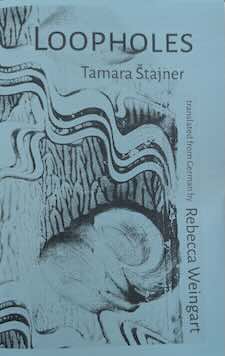
1. Loopholes
Tamara ?tajner / Rebecca Weingart
Toad Press
Tamara ?tajner’s chapbook Loopholes is a cycle of poems devoted to life, love, and loss as experienced by a woman as lover and mother. ?tajner writes unpunctuated poems whose lines flow down into each other, forcing slow readings to find semantic units that syncopate against the rhythm.
The “porto” poems, which begin the cycle, start in an idyllic mood that is quickly troubled: the “flawless a late- / summer midday” is undercut by “screeching” seagulls and a “harsh sun,” quickly leading to a “devastating / stab festering wound / pierced through mauled chest.” The Edenic beach scene is returned to during reflections on the relationship that are the subjects of the “porto” poems. Her memory is at first numbed of sensation—the beach merely a storage area for props—then comes to feel “echoes” of “a vague sorrow,” and finally becomes a bittersweet memory of lovemaking with the man now gone.
The chapbook’s central, eponymous section deals with the consequences of the love affair suggested by the “porto” poems—a baby. “Loopholes,” part i, segues from the lovers’ last coupling—suggested as a crime scene—into a consideration of the developing baby. The “you” addressed by the poem is ambiguous—lover or fetus, fetus as remnant of lover:
… you are a
shadow a chalkoutline when
we lie for the last time before each
other
a chalkoutline at the crime scene on
the edge of the womb…
The third stanza then plays on the sounds of the words wound, womb, and wonder, using their similarity in sound to blur one into the other—the wound: the loss of the lover; the wonder: the baby in the womb. Credit is certainly due to translator Rebecca Weingart for the subtlety of these nuances.
“Loopholes” follows the pregnancy from fetal development to toddlerhood. As the narrator mulls over thoughts of what she will dress the baby in, she thinks of a museum in Berlin she and her lover visited where they saw a painting of a baby dressed the same way. Shared memories and experiences from the past become concrete re-enactments in the future. The blurring of past, present, and future (the loophole) is again suggested by another thought of a painting of children, to which the narrator responds by saying, “it’s you this is you,” the identity of the “you” again ambiguous.
Beyond personal and human history lies a larger continuity: humans and the universe share the same constituent matter. The wonder at the scale implied—the sublime moment—emotionally overwhelms the mother with gratitude, as she thinks while bathing her child:
kiss +
kiss +
kiss you +
don’t stop
kissing your
forehead your hair your
cheeks you smile i smile + regretting
nothing ever.
The sequence doesn’t end well, but it does end with a realization: If a life cycle is a loop, the loop must have a hole.
2. Adrift in the South
Xiao Hai / Tony Hao
Granta Magazine Editions
With 30 years of unprecedented economic development behind it that has transformed a predominantly rural economy into an urban manufacturing and technological power, poetry, novels, and memoirs by some of the workers who contributed to that development are now being published. These are writers with little formal education who have nonetheless found within themselves a tremendous urge for expression and are largely autodidactic. No longer content to be the subjects of history books, they’ve taken upon themselves the task of narrating those histories. The worker-writers I’ve read so far all migrated from China’s countryside to its urban manufacturing hubs. Among their accounts is Xiao Hai’s memoir, Adrift in the South.
As with hundreds of millions of other rural Chinese, Xiao Hai’s hometown presented him with few economic prospects. Recognizing that fact, Xiao’s father set aside a year’s profits from farming (1,000 yuan = ~$150 in today’s dollars) to send him south to work in a factory. Xiao was only 15 (he’s now in his late 30s) and without a middle school graduation certificate when he and a dozen other middle schoolers were shepherded to the factories by a middle school teacher with connections to factory owners. The trip consisted of a 30-hour train ride squatting on the floor and a ride on an illegal bus (whose driver and conductor threaten to rob everyone). A job is finally found for him (he’s underage and without vocational skills) where he works 15-hour shifts six days a week for a few hundred yuan a month, much of which he sends back home.
Born in a rural town to parents who had been landowners, Xiao’s family has been impoverished ever since the Communist Party confiscated their land. The third of four children (he was born in 1987), his birth was contrary to the nation’s one-child policy at the time. During that time, in Xiao’s community, financial penalties were imposed on any family that had more than one child. Medicines, doctor visits, and school tuition were also out-of-pocket expenses for each child after the first. Until he was old enough for school, Xiao lived with an aunt as her child, which helped Xiao’s family with their expenses.
His community is so poor that rickshaws and horse-drawn carts are still common modes of transportation. Electricity did not come to town until 1994. His oldest sister dropped out of school at age 13 and promised to pay for her other three siblings’ college education if they just stayed in school. But keeping Xiao and his brother in school—even middle school—isn’t financially feasible for the family, despite both parents working, so both boys drop out.
Thus begins his odyssey of long hours, bad pay, poor diet, and no privacy. (Factory workers live in dormitories, with usually 8 people per room, no closets or furniture, and communal facilities.) Shifts usually last from 12 to 18 hours, six or seven days a week (depending on production needs). When Xiao starts out, he makes 100 yuan a month. By the end of Adrift, he’s found a few jobs that pay 2,300 yuan a month (i.e., under $4K/year).
Over the years he takes up delivery work, makes popcorn, tries out for the TV show China’s Got Talent (he recites poetry; isn’t called back), butchers ducks, and performs other dead-end, low-paying jobs. Meanwhile, his parents are eager for him to marry, which initiates a series of romantic debacles back home and in the factory. During the past 23 years, Xiao has changed jobs, factories, cities, occupations, and relationships, yet economically he hardly moves at all.
Somehow in the midst of this chaotic but stationary life, his love of poetry is rekindled, and he finds himself spending more and more time furtively writing poetry on the assembly line. After a few years of this, his drive to write poetry overrides his need to make enough money to live. Impoverished for so long, and seeing no prospects for improvement, his adjustment in priorities makes his life more bearable. His poetry writing has a steady outlet online. A life lived with dignity matters more to him than aspiring for achievements beyond his abilities or concerns that have been imposed upon him. (Without a middle school graduation certificate or vocational training, only non-skilled jobs will be available to him.)
One day, he receives a message telling him about a group of factory workers in Beijing who also write poetry and fiction. After just a few email exchanges about this group, Xiao leaves the south of China for Beijing, specifically these people. And that’s pretty much where the book leaves him: A few years into his stay in the Beijing area (including multiple moves and different jobs), Xiao has settled into a life content with the deal he has made with it. He has no romantic partner, has no savings, owns no property, makes very little money from the jobs he finds.
But.
He has a community of like-minded people, can satisfy his need to write, and (currently) has a place to live where he can enjoy both.
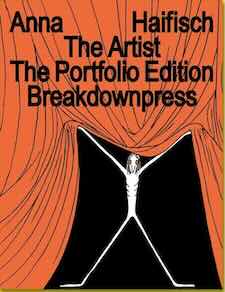 3. The Artist: The Portfolio Edition
Anna Haifisch
Breakdown Press
The Artist: The Portfolio Edition collects the comic strip devoted to the eponymous hero, the Artist. It began as a weekly comic strip and followed the Artist’s personality and career in real time from his years of bitter struggle to years of self-doubt cocooned in success. We witness the usual tropes of artistic struggle: procrastination, depression, obsession (his paintings’ recurring motif is of snakes), and perseverance. After a break in the strip of three years, the Artist returns, economically secure enough to buy new clothes and eat on a predictable basis but now wondering if he might be a fake and whether his material success is what he strove for in the first place.
Drawn with a thin, elongated, ribby body, often looking hastily sketched, the Artist seems a candidate for Kafka’s Hunger Artist. The other characters are also drawn with spare but exaggerated detail, vertically stretched over minimal or blank backgrounds.
The Artist is funny and its observations are tinged enough with specific details to feel lived-in, either by Haifisch herself or through her observations of others. Imagine Charlie Brown incarnated into a gangly, stringy-haired German artist in the 21st century, but alone in a big city. Good grief!
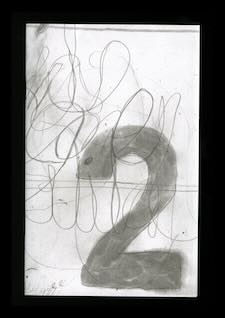 4. Girls Gone Wild 2
Katie Lane
2dcloud
As with her first Girls Gone Wild anthology, Katie Lane’s Girls Gone Wild 2 depicts intimate moments between two people, rendered in grey-washed illustrations of two women talking in a bedroom while one paints or clips her toenails. These scenes capture intimate moments of friendship while grooming—shared gossip, feelings, and laughter—the behaviors that build and sustain emotional and physical bonds between people who care for each other.
Here, the speech balloons act more as negative space counterbalancing the positions of their limbs, torsos, and heads than as narrative that moves the story along: There is no “story.” The small, irregular lettering—hard to make out but distinguishable—makes reading the dialogues more like eavesdropping than an invitation to discover what the women are talking about. (Readers of the interview at the back of the book will find that this interpretation runs contrary to the interviewer’s. Two opposed but complementary opinions of the same material suggest fruitful ambiguity within the material.) I think of the book as a portfolio of illustrations rather than as a short story.
A little more than half of the comic’s pages are devoted to pictures, the rest to an extensive interview with Katie Lane, which meanders as much as the conversations depicted in the body of the book but, for me, is less rewarding than the illustrations themselves.
5. Like Swimmers
Dash Shaw
NYR Comics
Taking place during the pandemic, Like Swimmers is a sister’s account of her younger brother’s life and death. Mackenzie, the older sister, shares her house with her younger brother Howie, a young man in his late 20s precariously employed as a bike courier. Dash Shaw succeeds in prizing verisimilitude from his portrait of Howie, whose personality—convincingly related—is seven parts intelligent, articulate adult and three parts socially inept child. His self-validation comes through his perception of himself as helpful and desirable. It takes little to bait him into believing he’s wanted; he’ll even manufacture the bait himself. A woman need merely acknowledge to Howie that she has received a text message or DM from him.
Anyhow, because it’s the pandemic, many businesses are closed, and many staff work from home. People wear masks when they shop at places designated as “essential services” and keep their distance from each other. Howie also picks up and delivers antidepressants to a woman named Isa, often paying the bill himself even though she’s wealthy. He’s infatuated with her. They seem to get along well although she often suddenly turns aloof in mid-conversation. She’s married to an equally distant husband, a wealthy man named Jasper, head of an art department, a teacher of popular classes—the kind of upright citizen whose word police tend not to question.
After Howie’s murder—we know about his death from the beginning—Mackenzie and Isa meet. Mackenzie is furious over her brother’s murder, especially given that the last time Mackenzie saw Howie alive was when he was pedaling off to meet Isa at a hotel. She blames Isa for Howie’s death and is angry the police seem to be taking no interest in investigating the case. Isa says she wants to tell Mackenzie about her relationship with Howie. In Isa’s telling of the events up to this point—events that Mackenzie did not witness but reconstructed from Howie’s descriptions of them—Howie was a stalker who just wouldn’t stop.
This is a complication in the picture we’ve been developing to this point of Howie, a gentle soul, if a bit askew emotionally. The clues are dropped here and there that maybe Mackenzie didn’t know her brother as well as she thought, but clues with enough nuance and ambiguity to complicate the matter of who killed him and why. For instance, at Howie’s funeral, members of the group he plays four-square ball with show up and invite her to join them at Howie’s favorite bar. She didn’t know he had a favorite bar. After admitting she wrote Howie’s obituary when asked about it, she says she wanted it to capture how naïve Howie was. “Well maybe to you,” one of them says. “You’re his sister.” It’s a throw-away line, with no further remarks.
As a story about a bad relationship gone worse, about a narrator who wants justice for the murder of her brother, Shaw’s narrative succeeds in pulling the reader along. Where it’s less successful is in adding a supernatural element to the plot. The story already has enough human turmoil, duplicity, and delusion in it to propel it from beginning to end.
I’ll be careful describing this aspect of the story to minimize spoilers: Early in their relationship, Isa discovers Howie’s interest in were-creatures—he sees himself as a were-hyena—because he thinks everybody has a beast within them, something ugly and uncontrollable. But if this is so, the creature is not responsible for its actions in following blind instinct. The ending tends to literalize the supernatural rather than retain it as metaphorical exaggeration. Is Shaw introducing determinism as an explanation of human behavior, or dramatizing the human tendency to invoke determinism to evade responsibility? Placing free will and determinism in tension with each other is, here, more a distraction from the story’s emotional core than an illustration of it.
6. Beware the Man Whose Handwriting Sways Like a Reed in the Wind
Anne Carson
New Directions
Poet, classicist, and Nobel Prize winner Anne Carson has a new attribute: Parkinson’s disease. As a writer who favors composition by hand, the degeneration of her neurons has begun to erode her control of her pen. “But scriptural disintegration is just an image of the beginning of a cognitive breakdown whose gradual effects will include disorder, slowdowns and stops,” she notes.
More to the point, this statement sounds like a description of her own work as a scholar and artist, but in reverse: As a scholar of literary fragments from ancient Greece, Carson has had to reconstruct their ideas and feelings from time’s accumulated disorder, slowdowns, losses, and breaks in written knowledge during its transmission from century to century. Now, the erosion of communication is happening in real time to her mind and body, further forcing her into the artistic side of her classicism as expressed in her poetry, in which she treats fragmentation as an expressive condition in its own right.
As usual with Carson, the writing is gracefully rhythmic and allusive, richly drawing upon 5,500 years of cultural history to buttress her ideas and rhetorical methods. Cy Twombly, John Cage, Catullus, Adorno, ancient Sumer, Confucius, and others feature among them. (Her attribution of the essay’s title to Confucius seems to be spurious.)
Most surprising, Carson reports on an exercise recommended for people with Parkinson’s because of its “combination of difficult cardiovascular effort and deliberate focusing of the mind has proven to reduce the symptoms and slow the progress of the disease”: Boxing. Which, at age 76, she has taken up.
7. White Volvo
Erik Svetoft
Fantagraphics
Call it Dada Noir, somewhere near the intersection of The Outer Limits and Sam Spade, near the neighborhoods where David Lynch and Charles Burns grew up—that part of town where being middle class feels unpredictably creepy, where the patina of normality covering sleepy suburbs and workplaces can’t prevent the odor of latent violence and body horror from seeping out. While being funny, too. Swedish cartoonist Erik Svetoft’s White Volvo begins with an explosion in a factory where workers are busy trying to get a mysterious new product to market. The explosion occurs during a plant tour by company executives. Those executives who survive the explosion are hunted down and killed, and investigations begin into the cause of the explosion and the murders of the executives.
I have no idea what I was viewing and can only think of it in terms of a weird, unsettling dream involving chases, murders, double-dealing, and a hybrid creature combining a human head and rib cage with a deer torso and hind legs, its flesh burned off. Even members of a once-famous rock band are asked to help with the investigation, although not by the police. Middle-aged, frumpy, and low-energy, they tackled their job as well as one might expect from such a crew in such a situation.
The confusion of White Volvo is a significant part of its pleasure, a compelling confusion that kicks the reader’s expectations out from under them while maintaining dream-logic coherence. Svetoft’s semi-realistic depictions of industrial environments—buildings, machinery, manufacturing facilities—contrast with the characters’ cartoonish facial expressions, especially those of executives bearing smiles of bovine obliviousness to anything apart from themselves.
As a critique of capitalist desire (if that’s what it is), White Volvo depicts a world of duplicity, violence, and dishonesty in the name of bringing useless products to market for an audience eager to buy them just to be up on the newest trend, whatever it may be, as suggested by the novel’s conclusion. That’s a conventional ending for an unconventional story, but White Volvo is more about the story than the money shot, and Svetoft left me content with that.
8. çSolvej Balle / Sophia Hersi Smith & Jennifer Russell
New Directions
Tara Selter returns in the fifth of seven books making up On the Calculation of Volume, covering years 12 through 29 of her life stuck in a November 18 now approaching its own middle age. Inevitably, Tara notices more that she’s ageing as she develops wrinkles and brown spots on her skin, her hair grays, and her vision blurs. If she ever manages to figure out a way back into the nonrepeating world of the husband she left behind, she will return as a woman old enough to be his mother.
If the ageing weren’t bad enough, so, too, is the evolution of personal tics and habits, the introduction of new vocabulary, a change in sensibility or viewpoint—things we tend not to notice in ourselves or those around us as we age along with them. But a different look and outlook can have an alienating effect on those who haven’t changed—such as Tara’s husband, who, during one of her visits, when she tries once again to explain what has happened to her, has now asked her not to return. Even though every morning with him repeats the morning before, it’s always the first time for her husband, and he remembers nothing of the previous iteration. He is shocked by the changes in Tara’s hair, skin, and speech; the many new friends in her life he knows nothing about and that she goes on endlessly about—all these differences between the Tara before him and the Tara that left home—according to his sense of time—not just 24 hours ago.
After close to 15 years in this cycle of November 18ths the books have been following, the group Tara happens to be living with at the time decides to keep an archive of their doings. This is a privileged time: Everyone’s bank accounts renew at the start of each day and their lodging is free. While food supplies are subject to local availability and dwindle depending on the number of people in a particular place and how long they stay there, driving farther out to supermarkets in the suburbs brings relief. No one need work, but people take up all sorts of tasks to keep busy and out of interest. For those with intellectual interests, it’s a great time to be alive, since they can focus almost entirely on developing and exploring them.
Tara notes that discussions among the archivists have introduced new ways of cataloging and assembling materials. That may be, but do those different forms of classification add to their insights or knowledge about any of those topics? No.
New ways of sorting data don’t have to lead to new knowledge, of course; it’s their choice: these people in their new world are starting not quite from scratch. Their world is more amenable than that described in Lord of the Flies, another place where new rules of all levels and types of organization could be made. In the world of November 18, people may disagree, but fights are unnecessary—the rest of the entire planet can be gone to, if need be. Worries about money, food, transportation, and lodging have been eliminated. People stuck in November 18 meet, fall in love, move in together, and presumably have sex. And yet, no pregnancies occur. And nobody talks about the sterility.
What we are witnessing, even if it’s not framed this way, are patterns of anarchic community and intention forming, dissolving, moving, and changing. But, like the Shakers—a religious community of converts only, since they don’t believe in reproduction—this minority population is due to die out, its existence never suspected by the rest of the planet. Most members of this involuntary cohort have given up hope of returning to normal time.
In the 28th year, Tara moves to a different part of France, leaving behind her job as archivist and the people she met while working there, including two lovers. She notices herself slowing down, her energy dissipating. Tasks that all members of this community once tackled with the energy and hopes of a new world are now approached with the resignation of Sisyphus in the service of routine maintenance. The enthusiasms reserved for goals are evaporating. The characters seem as much at a loss at what to do with themselves as their creator, Solvej Balle, whose premise for the series seems to serve as a trap she can’t work her way out of or through.
At this point in the series—which has been treading water since Book III—a return to regular time would be dispiriting and only further emotionally alienate them from the friends and family who would hardly recognize them, while staying leaves them facing a fate no different from that experienced by any other person who tried living in a utopian community, only to watch it die out. The first two books in the series lit the fuse. Three books later, the fuse is out of sight and has been quiet for so long that it’s reasonable to assume by this point that it has only led to a dud.