
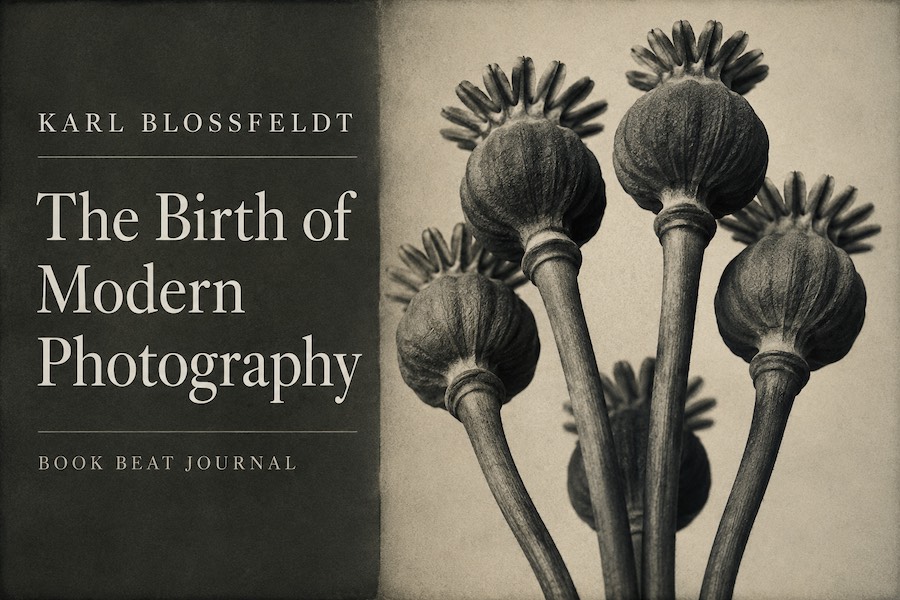
 Karl Blossfeldt: Objective Photography and Natural Form
“It is through photography that we first discover the existence of this optical unconscious, just as we discover the instinctual unconscious through psychoanalysis.”
—-Walter Benjamin, A Short History of Photography
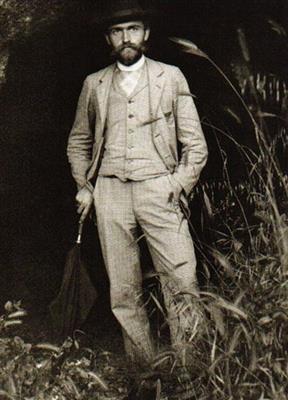
The transition of photography from a pictorial medium into an objective document during the early twentieth century is highly visible in the work of Karl Blossfeldt 1865–1932. Though his photographs are frequently studied alongside avant-garde art movements, Blossfeldt did not train as a conventional fine art photographer. His career was centered on design education, and his photographic catalog was created primarily as a practical teaching tool.
What makes the photographs so remarkable is that they occupy a space between scientific document, design reference, and art. Blossfeldt photographed plants in order to teach his students how to see structure. In the process, he produced some of the most influential photographs of natural form ever made.
 Historical Background and Academic Utility
Blossfeldt trained as a sculptor and modeler and worked in the iron industry before studying at the Kunstgewerbeschule in Berlin. From 1898 until 1930 he taught at the school, where he assembled an extensive photographic archive of plants and plant parts for use in teaching. His photographs were intended to provide students with accurate visual examples of natural forms that could be translated into drawing, sculpture, metalwork, and ornament.
This was part of a larger nineteenth- and early twentieth-century interest in discovering the underlying forms of nature and adapting them to art and design. In the late 19th century, Blossfeldt’s teacher and mentor Moritz Meurer had already explored the relationship between botanical structures and ornament.
Blossfeldt spent much of the 1890s as Meurer’s assistant systematically collecting and studying plants as structural models for design, an idea he extended later through photography.
“Goethe’s Metamorphosis of Plants inspired Meurer as he, just like Goethe, visited Italy to study the vegetation around Rome. Meurer was highly enthusiastic about exploring the shapes of plants to discover inspiration for new art and found in Blossfeldt – who grew up close to nature, a kindred spirit for his undertakings. From 1885 Meurer lead an art school reform that called for the introduction of scientific nature study courses in all German art schools.” -excerpt from Blossfeldt: Meditating Nature, Gallery Dagmar.
Rather than beginning with an artistic interpretation of a plant, Blossfeldt isolated its structure. A leaf, seed pod, tendril, bud, or stem could become a lesson in proportion, rhythm, symmetry, repetition, and geometry. The result is a peculiar reversal: instead of making nature resemble art, Blossfeldt’s photographs suggested that the principles of art and architecture were already present in nature.
Technical Methodology and the Custom Camera
To achieve the level of clarity necessary for his students to study organic structures, Blossfeldt engineered his own large-format cameras. These custom devices featured exceptionally long bellows that allowed him to photograph specimens at close range, magnifying minute botanical details up to thirty times their natural size.
His studio methodology was systematic and uniform. Plants were stripped of non-essential leaves and appendages to focus strictly on structural lines. The subjects were placed against stark black, grey, or white backgrounds to eliminate depth and environmental context.
Diffuse, sharp studio light was used to articulate the exact contours, textures, and edges of each specimen. This rigorous methodology stripped the plants of their traditional romantic or pastoral associations, transforming stems, tendrils, and flower buds into sharp architectural elevations and geometric structural studies.
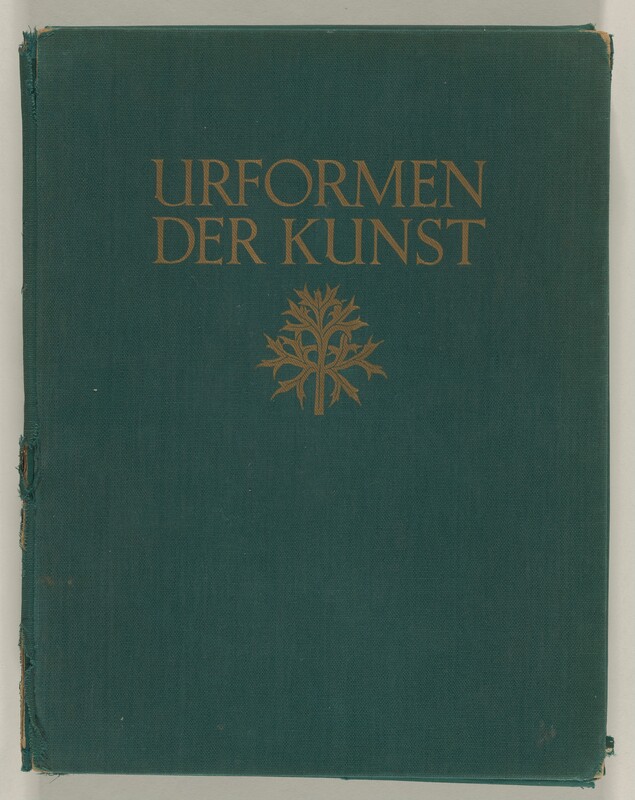
Karl Blosseldt, Urforman Der Kunst, 1928
Photography, Modernism, and the Discovery of Form
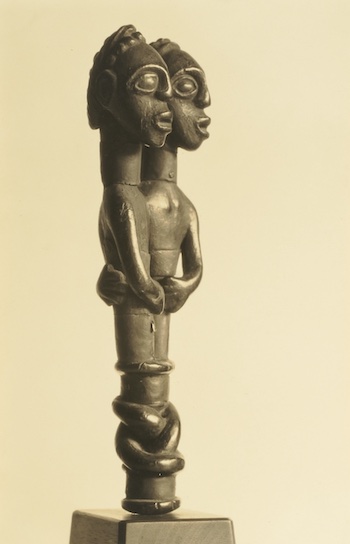
Charles Sheeler, African Negro Sculpture, plate 14, ca. 1919, gelatin silver print, sheet and image: 9 5?8 x 6 1?8 in. (24.3 x 15.7 cm), Smithsonian American Art
Carl Einstein’s pioneering book Negerplastik (1915) marked one of the earliest attempts to understand African sculpture as a major artistic tradition rather than as an ethnographic curiosity. Rejecting the prevailing notion that African art was “primitive,” Einstein argued that it possessed its own autonomous language and had achieved what European modernism was only beginning to discover. As Cubist painters searched for new ways to represent space, he observed that they “necessarily discovered African sculpture, and recognized that it had, on its own, given birth to pure plastic forms.” More remarkably, Einstein insisted that what Europeans regarded as abstraction was, in African sculpture, “a direct experience of nature.” From a formal standpoint, he concluded, African sculpture represented “out-and-out realism.”
Einstein’s ideas profoundly altered the way modern artists and critics looked at form. His early exhibitions of African sculpture in Berlin, followed by Alfred Stieglitz’s installations at 291 in New York, encouraged audiences to see African sculpture and European modernism as participants in a shared visual language rather than as separate traditions.
When Karl Nierendorf mounted Blossfeldt’s botanical photographs alongside African sculpture in Berlin in 1926, this dialogue expanded beyond painting and sculpture to include photography. The exhibition proposed that enlarged plant forms, ritual sculpture, and modern design all revealed common structural principles. Rather than emphasizing differences of culture or medium, viewers were invited to recognize universal patterns of growth, rhythm, and construction.
Walter Benjamin saw the Nierendorf exhibition and became one of Blossfeldt’s earliest champions, first praising the photographs in his 1928 essay News About Flowers and later expanding his ideas in his landmark 1931 essay, A Short History of Photography. Benjamin argued that Blossfeldt’s magnified photographs revealed an entirely hidden universe, one normally inaccessible to the naked eye. Photography, he believed, exposed what he famously called the “optical unconscious,” allowing technology to reveal hidden structures where “inner pictorial necessities jump towards us from every chalice and every leaf.”
George Bataille arrived at a strikingly different conclusion. As Einstein’s colleague on the editorial board of Documents, he reproduced several of Blossfeldt’s photographs in 1929 to accompany his essay “The Language of Flowers.” Rather than celebrating their formal beauty, Bataille saw enlarged blossoms transformed into unsettling, erotic, and almost grotesque forms that subverted conventional ideas of nature and beauty. Flowers, he wrote, are spoiled at their centers by “hairy sexual organs,” while certain orchids appear so strange and debased that “one is tempted to attribute to them the most troubling human perversions.” Together, Einstein and Bataille used Documents to challenge conventional hierarchies separating art from ethnography, beauty from biology, and culture from nature. Photography became not a means of idealizing the world but of exposing its deeper, and often disquieting, realities.
What Blossfeldt ultimately gave photography was something akin to László Moholy-Nagy’s program at the Bauhaus: a new way of seeing. Photography was no longer merely a means of recording appearances but a tool for discovering previously unseen relationships between form, structure, and perception. Design, art, biology, architecture, and anthropology were no longer isolated disciplines but overlapping fields united by a photographic vision capable of continually renewing our understanding of the world.
The book that changed the way photographs were understood.
Urformen der Kunst contained 120 photogravure plates reproducing 164 photographs. Rather than appearing as anonymous classroom documents, the photographs were presented as a coherent artistic vision. Their severe compositions and extraordinary magnifications made the natural world appear simultaneously botanical, architectural, and abstract. Blossfeldt was 64-years-old when this was published and it helped make his work known world-wide.
Karl Nierendorf who presented the work at his Berlin gallery as fine art, wrote the introductory essay. He argued that true fine art is born of a unique human vision, rather than simple replication. He wrote: “What distinguishes works of art from Nature is a result of the creative act: the character of an individual design newly created, not imitated or repeated.”
Urformen der Kunst was published in a first edition of 6,000 copies by the Berlin-based publishing house Verlag Ernst Wasmuth A.G. in 1928, and became an overnight sensation, causing the publisher to prepare subsequent printings and international editions. The book was a bestseller and was followed by Wundergarten der Natur (The Magic Garden of Nature) in 1932, the year of Blossfeldt’s death. Photogravures from the book are not uncommon, later printings are hard to distinguish and sold by print dealers at around $100, per page.
Blossfeldt photographs became part of the emerging international language of modernist photography. They appeared in important exhibitions of the period, including Fotografie der Gegenwart and Film und Foto in 1929, where their precision and apparent objectivity connected them with the New Vision and the growing interest in photography as an autonomous visual language.
The Perleberg American Edition
Blossfeldt’s photographs also circulated in the United States through a less familiar publication: First Forms of Art. Forty Double Plates. Examples from the Living Plant World, published by H. C. Perleberg in Philadelphia sometime between approximately 1929 and 1932.
Unlike the large photogravure volumes published by Ernst Wasmuth, the Perleberg portfolio consisted of forty double plates containing 103 gelatin-silver reproduction photographs. The images were selected from photographs published in Art Forms in Nature, and the plates were also intended for use as visual teaching material; the Perleberg publication advertised slides made from the plates as well.
This distinction is important for collectors. Blossfeldt’s images exist in several different forms: original teaching photographs which are the rarest, negatives and transparencies, photomechanical reproductions in his published books, and photographic reproductions such as those issued by Perleberg.
The photographs may look similar at first glance, but they are not the same object or the same photographic process.
Book Beat and Blossfeldt
Book Beat acquired a set of the Perleberg First Forms of Art at auction during the 1980s. From 1987-2016, Book Beat maintained a small art and photo gallery in its backroom, where we exhibited and sold historical photographs, prints, artists’ books, folk art, and related material.
Over the years we periodically exhibited and sold selections of the Blossfeldt photographs. The images currently offered online are among the last remaining examples from that collection.The photographs bring together several things central to Book Beat: photography, books, design, and the history of the printed image.
Karl Blossfeldt Photographs Available:
Karl Blossfeldt: (vintage gelatin silver workprint) Fiddlehead and Screwtree, 1930
Karl Blossfeldt (vintage silver gelatin photo) Heather, 1930
Karl Blossfeldt (vintage silver gelatin photograph/workprint) Plate 30, 1930
Karl Blossfeldt (vintage gelatin silver workprint) Thistle and Seed Head, 1932
Karl Blossfeldt (vintage silver print/ workprint) Urformen der Kunst , plate 1, 1920s
Karl Blossfeldt Monographs and Reference Books
Book Beat also carries a selection of photographic monographs and reference books documenting Karl Blossfeldt’s legacy. These editions offer a visual reference for lovers of botanical art or photography collectors looking to study his work. These are currently not avaiable online, but we will be adding some to our backroom gallery soon. Please call or stop by or call us at 248.968.1190 for more information.
Karl Blossfeldt: Masterworks, 2017, Edited by Ann Wilde, Jürgen Wilde. Foreword and text by Hansjörg Küster. Karl Blossfeldt: Masterworks presents a remarkable collection of Blossfeldt’s strikingly austere yet poetic portraits of plants, which capture their timeless beauty in intimate detail.
Karl Blossfeldt:The Complete Published Work by Hans Christian Adam (Taschen): A definitive monograph collecting all known published images from his landmark portfolios in a singular layout. This specific edition is currently out-of-print and scarce, but we have a recent trade edition on order.
Karl Blossfeldt: Variations by Ulrike Meyer Stump (Lars Müller Publishers): An authoritative reference exploring his academic teaching methodology and the variations found across his working studio proofs.
Karl Blossfeldt: The Alphabet of Plants (Schirmer/Mosel): A clean, focused volume highlighting his structural methodology and mastery of macro botanical documentation.
Wunder in der Natur (Miracles in Nature): Texts and history surrounding his third volume, detailing the explicit impact of his close-up photographs on Weimar design philosophy.
Karl Blossfeldt, Photography (Hatje Cantz, 1998). The iconic German photographer Karl Blossfeldt’s stunning plant photography is presented here for the first time in an English language edition with beautifully printed duotones that do justice to the work of this turn of the century master. A truly stunning and important book.
Karl Blossfeldt: Working Collages, by Wilde, Ann [Editor]; Wilde, Jürgen [Editor]; (MIT 2001) Featuring 61 newly discovered photographic contact print collages by the early 20th-century sculptor and plant photographer Karl Blossfeldt.