
“i arrogantly recommend…” is a mostly monthly review column of unusual, overlooked, ephemeral, small press, comics, and books in translation by our friend, bibliophile, and retired ceiling tile inspector Tom Bowden, who tells us, “This platform allows me to exponentially decrease the number of views on screens by people who have no use for such things.”
Most books are linked to our Bookshop.org affiliate page, our Backroom gallery page, or the book’s publisher. Support the Small Press! Buy local!
 The Beginnings
Antonio Moresco / translation by Max Lawton
Deep Vellum
As considerable as its avant-garde chops are, Antonio Moresco’s The Beginnings belongs in the European tradition of the sentimental journey from naïve idealist to jaded realist, feeling less like contemporary autofiction than a fictionalized Bildungsroman. Its unnamed narrator goes from seminary school to political oratory to book writing. These are disparate devotions. Each has its own set of ideals, conventions, and modes of communication, and shared values among fellow travelers. The narrative asks what constitute knowledge and understanding, how they are transmitted, and to what ends.
The Beginnings—a 500+-page novel—is the first part in a 1,500-page trilogy. The jaded realism I’m presuming has yet to arrive, should it arrive. In the meantime, this first volume has one of the damndest narrative voices I’ve come across in some time. It pulled me along—no doubt due in no small part to Max Lawton’s translation—wanting to know more. Even though at no particular point in the narrative could I say to myself, Oh, I get it now.
If the narrator of The Beginnings has a predecessor, it’s Benjamin Compson from The Sound and the Fury. Although The Beginnings’ narrator is far more articulate than Benjy, he is just as unreflective—though not due to a mental disability, one gathers—forcing readers to make sense of the behaviors described for themselves.
A couple of scenes in the seminary, for instance, achieve the level of silent-movie slapstick: Two monks engage in fisticuffs during silent time, each trying to maximize the harm done to the other and minimize the sounds made when hit and hitting. Why is this happening?
The seminary’s relationship to its community, the point of the rituals the students perform in the seminary and in the community, what their curriculum consists of and what it seeks to engender—none of that ever becomes clear. But that mystery kept me intrigued enough to puzzle through. Even the abrupt transitions from part 1 to part 2 and part 2 to part 3—from seminary to politics to publishing—I found myself willing to suspend disbelief: “Oh, OK, I guess he’s in a different place now. Maybe we’ll find out how and why.”
Maybe.
Not here.
The narrator’s visual descriptions can also sound distorted in sizes and shapes, as if viewed through lenses that produce odd effects. However, reader beware: I also thought that of the narrator’s descriptions, including, for instance, that of the car he drives when in his political phase—until someone online posted a photograph of a Fiat 300 specifically in reference to this section of The Beginnings. It is an impossibly tiny car, so I’m left wondering if it’s not the prose that’s distorted but my way of seeing.
Looking forward to the second volume, Songs of Chaos, due for release in 2027.
“The Translator’s Voice: Max Lawton on Translating Antonio Moresco’s The Beginnings” (Chicago Review of Books) Discusses Moresco’s place in Italian literature, the challenges of translating The Beginnings, and Lawton’s philosophy of translation.
Storypod interview with Max Lawton (44 min.) A relaxed but substantial discussion centered on The Beginnings and maximalist fiction.
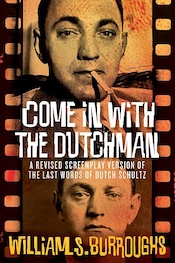
Come in with the Dutchman
William S. Burroughs
Grove Press
William S. Burroughs was an inveterate reviser of his books and stories, so that multiple editions exist of much of his work published in the ‘60s and ‘70s. The restored editions of Burroughs’s work that Grove has published in recent years—Naked Lunch, Nova Express, The Soft Machine, The Ticket That Exploded—aim to create standard versions of his canonical works. The Last Words of Dutch Schultz—one of those works by Burroughs with multiple versions—has been revised, reprinted, and retitled as Come in with the Dutchman.
Intended as a film script, the basis for the story was the dying words of Dutch Schultz, AKA Arthur Flegenheimer (1901-1935), a New York-area Jewish mobster during Prohibition who made his money in bootlegging and numbers running, until he was gunned down by goons from Murder, Inc., acting on orders from the National Crime Syndicate.
Taken to the hospital with multiple gunshot wounds, delirious and receiving regular morphine injections, a parallel to Burroughs’s own heroin addiction, Flegenheimer was flanked in his bed by police detectives during the 22 hours it took him to die, one of the detectives transcribing his every disjointed word and phrase, hoping for clues to the murderer’s identity. (The complete transcript of Arthur Flegenheimer’s statements made in the hospital may be found at Flegenheimer’s Last Words.)
Burroughs saw the transcript of Flegenheimer’s discombobulated speech as a real-life counterpart to the cut-up method he and the artist Bryon Gysin had developed. In the cut-up method, an existing text is arbitrarily cut up and its elements—short phrases—rearranged. Throughout The Soft Machine and The Ticket That Exploded, Burroughs inserts cut-up passages drawn from earlier and later sections of the same novel, giving portions of these novels a deja-vu-like quality.
The structure of Come in with the Dutchman is classical: Beginning in medias res to pique the audience’s interest, then showing how the protagonist got there, after which scenes alternate between the protagonist’s past and present until the two meet, and a conclusion is arrived at. Here: The story begins with Flegenheimer already dying on a hospital bed, is followed by his birth, after which those two storylines coil around each other—Flegenheimer in the hospital and Flegenheimer growing up.
The most “cut-up” aspect of this film script is that it builds entirely upon scenes that, if filmed, would probably only range from 2 to 30 seconds each. Yet film is probably a better medium than writing for exploring the potential of the cut-up method, since moviegoers are long used to quick cuts, flashbacks and flash-forwards. And while the script’s transitions may be quick and abrupt, there is often some element connecting the scenes to each other—a spoken phrase, a look or posture—giving the overall work a seamlessness.
James Grauerholz, the script’s editor, provides a helpful introduction to the story behind Burroughs’s script, an essay that is part bibliographic history, part biography (of himself and Burroughs as it relates to the manuscript), and part bitchy insider score-settling. (Grauerholz was, for over 20 years, Burroughs’s amanuensis, lover, and (eventually) adopted son.)
That said, Come in with the Dutchman is a sensationalist true-crime story in the service of demonstrating an aesthetic technique. Every character—even the historical figures—is delineated in stereotypical gangster tones from old James Cagney films. But Burroughs commonly used genre types in his books as contemporary archetypes to illustrate his mythologies of power struggles, which he was more interested in than delineating psychological urges.
Overall, Come in with the Dutchman is a good introduction for newcomers to Burroughs’s fiction, and long-time fans will be happy to see his script in print again, now in a definitive version.

A Tomb in H-Section
Louis Armand
Equus Press
Louis Armand, an Australian expatriate teaching in art, literature, and critical theory since 1994 at Charles University in Prague, writes novels, poetry, and philosophy, creates collages and mixed media works. A Tomb in H-Section is the fifth volume in his Golemgrad Pentalogy, including The Combinations, Death Mask Sutra, Vampyr, and Glitchhead. As with Alan Moore’s The Watchmen, A Tomb’s chapters alternate between typed-page and graphic narratives, as different storylines circle each other like DNA strands. Unlike Alan Moore, Louis Armand creates his own visuals, and he’s quite the craftsman.
The Golemgrad of A Tomb in H-Section features reappearances from characters in early installments of the pentalogy—N?mec, Offensia, the Professor, the Rat, and so forth—but now returned from the dead to the city of the dead; i.e., Golemgrad.
Long before the novel begins, the city has slid into necrotic decline, largely through the faulty pleasure and power drives animating its inhabitants. But, in their revenant forms, their identities are unstable, and simple binaries like good and evil are shown to have only ever been mirrors of each other. Those binaries have shattered into a porous network of comic book, space opera, and thriller narrative, each commenting on and contaminating the other but never building to an ultimate point. Our world is fragmented and dying, and Golemgrad its epicenter.
One premise of the novel is that if we believe that what we seek is in front of us, we will not find what we seek but will be shaped by what isn’t there, so long as we self-consciously seek. In the case of N?mec, the protagonist, what he seeks is seeking him.
In Armand’s Golemgrad, characters lose their stability of personhood, and alliances are illusory; the occult technologies that resurrect them merely perpetuate civilizational decline. Armand’s Golemgrad is a site of Manichean struggle, in a manner akin to that found in William Burroughs’s dystopic stories, a world in which characters are born in the midst of an ongoing battle between good and evil, its conclusion far from certain.
Given humanity’s tendency to err, especially in the name of power, good characters tend to go bad. The only way out of the Manichean dilemma is not to participate in the drama of competition and reaction.
Although this is the fifth novel in the series, it stands on its own without reference to the others or without requiring knowledge of the others. I’ve read Vampyr and Glitchhead, which also use the characters who appear in A Tomb, but as with any mythological figure, they appear as types doing what they do whatever the context. But by the fifth novel, the mechanisms of power—physical and metaphysical—have become increasingly degraded, ultimately succumbing to the entropy they helped usher along.
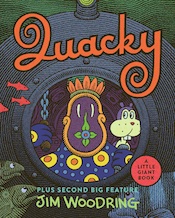
Quacky
Jim Woodring
Fantagraphics
Adults of a certain age will probably fondly recall Big Little Books. Written for kids 7 to 13—the stage when kids start choosing books themselves to read—the books stood about 4.5” x 3.5”, with text on every verso page and an illustration on every recto page, together telling a story (adventure, mystery, or cartoon character-based) about 1.5” thick; i.e., ~300 pages.
Illustrator and comic artist Jim Woodring has decided to tackle the constraints of the Big Little Books—named here LITTLE GIANT BOOKS—using his usual cast of anthropomorphic characters—including Frank, Pupshaw and Pushpaw, and Manhog.
Frank, the Pups, and Manhog live in the Unifactor, a world that is simultaneously creator and creation. Frank—hapless and universal in a Chaplinesque way—often stares in awe of what the Unifactor hath wrought. The Unifactor’s Art Deco architecture—with its Asian and Middle Eastern influences—shares with its plants and animals an inordinate fondness for rounded edges.
Our protagonist, Frank, a bipedal anthropomorphic cat, sports a “trilobular” (Woodring’s word) noggin and two buck teeth. Pushpaw and Pupshaw are his pets—dog-sized but looking more like geometric blocks on tiny legs. Manhog, Frank’s nemesis, is a self-centered, acquisitive materialist, half man, half hog.
Once an old friend named Quacky sends Frank an invitation to come over and catch up on old times, the story starts to get weird. Readers new to Woodring may have thought it was already weird. The Unifactor never fails to surprise, and Frank again must adjust his ways of thinking in an unpredictable world.
The book’s “SECOND BIG FEATURE,” “Cunningham,” published under the pen name Slim Davenport, uses realistic sets and a new set of characters, drawn in a more traditional style of depicting bipedal anthropomorphized pigs in human clothes. Cunningham—“The clever pig who helps all his friends”—receives a call from the police that his friend Hoggy has been arrested “for every crime in the book!” This doesn’t sound like the Hoggy Cunningham knows, so he sets out to solve the mystery.
Frank and Cunningham are opposites, embracing different visions of how to be in the world. Although readers unfamiliar with Woodring’s style may find the illustrations “cute,” Quacky deals with death, greed, and covetousness as well as trust, friendship, and appreciation. Woodring makes serious points with delightful craftsmanship.
Put on your dream hat and take the Jim Woodring studio tour.

Bob and Hilbert / Hilbert and Bob
Bárður Oskarsson / translated by Marita Thomsen
Elsewhere Editions / Archipelago Books
An adorable, charming little book (literally—it measures just 3.5” square) about two friends, Bob and Hilbert—or Hilbert and Bob, depending on how you read the book: Bob’s story begins from one cover; flip the book over, and Hilbert’s story begins from the other. Each story involves one friend needing the other’s help. In Bob’s case, it’s to find a lost carrot; for Hilbert, it’s having Bob drag him home by a string, since he (Hilbert) can now only float in the air. The illustrations’ thin lines and childlike simplicity (Hilbert’s a dog and Bob’s a rabbit, in case you can’t tell) matches the deceptively terse prose (nicely captured by Marita Thomsen’s translation). The stories are short, fun, and silly, and aimed at kids 6-8 years old.
Interview with Bárður Oskarsson Bárður Oskarsson interviews
Drawing / illustration presentations Bárður Oskarsson illustration videos
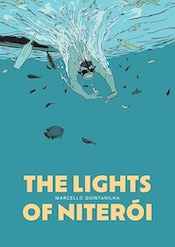
The Lights of Niterói
Marcello Quintanilha / Bruna Dantas Lobato
Fantagraphics
Set in a bay near Rio during the 1950s in Brazil, The Lights of Niterói follows the sometimes-dangerous adventures of two young men, Hélcio and Noel, on a summer afternoon and its consequences. Hélcio is an up-and-coming soccer player, cocky and full of himself. His brashness is less a mark of self-confidence than it is a mask for profound insecurities: his refusal to admit when he’s wrong and his inability to feel good about himself except at the expense of others—such as his friend, Noel, a hunchbacked youth whose intelligence and patience are a much-needed counterweight to Hélcio’s impulse and ignorance.
What begins on a lark to make quick money selling fish in the marketplace ends in a perilous thunderstorm that almost pulls them out to the ocean. Quintanilha’s pacing and cinematic framing are especially effective as Hélcio and Noel—tiny specks in the sea—try to break free of the current pulling them toward open water and make it back to the coast. Hélcio’s fears and frustrations mount as the storm’s intensity mounts, leading to a moment that may be unforgivable for Noel.
Marcello Quintanilha interview

Magadh: Poems
Shrikant Verma / translated by Rahul Soni
Liveright
Magadh was an eastern Indian empire that flourished between the sixth and second centuries BCE before entering a precipitous decline. Shrikant Verma’s poems in Magadh, written between 1979 and 1984, place the Magadh empire in the larger context of Indian history, culture, and mythology, although familiarity with these components is unnecessary to understand and appreciate these poems, since they deal with such universal constants as the rise and fall of civilizations, the causes of those cycles, and their results. Thus, time is also a major figure in these poems. Readers unfamiliar with Indian history needn’t worry. The poems’ emotional force survives even if one mentally substitutes familiar civilizations for Magadh or Kashi; the historical patterns Verma explores are recognizably all too human.
After the invocation that begins the cycle, Verma tells us that “this is not the Magadh / you’ve read about / in books, / this is the Magadh / that you / like me / have lost.” This loss is common to all humanity—death, forgetfulness, and erasure are the fate of all who live and have lived. In his poem “Corpses in Kashi,” Verma asks, “Have you seen Kashi? / Where / corpses come and / corpses go / by the same road. . . // Whoever it was, whoever it wasn’t / did it make a difference?”
The futility of resistance, like the futility of conquest, owes to the work of Time. Verma suggests that the only meaningful response is dharma—the personal choice to behave righteously despite history’s indifference: it’s the only escape from the cycle of eternal rebirth into this hurtful world.
Although the eternal cycle contains plenty of misery and forgetfulness, the traces of past lives that do remain are those produced by “singers, sculptors, poets”—the people who actually create the nations we remember, not their “wealth, armies, ministers” (“Why Not Mithila?”). Verma completes that thought in “Vaishali 2”:
Vaishali is not a city
it is the memory
of those who came
before us—
of those who said
We’ll last Vaishali will last.
And if we don’t?
Vaishali will last.
In these poems, every apparent opposite—arrival and departure, rise and decline, praise and condemnation—turns into its opposite as time shifts one’s perspective.
Rahul Soni interview at Bound.
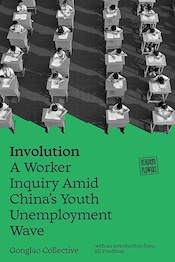 Involution: A Worker Inquiry Amid China’s Youth Unemployment Wave
Gonglao Collective / Eli Friedman
Verso Books
In economics, “involution” may be defined as a self-defeating cycle where intense competition and increased individual effort yield diminishing returns. Instead of leading to overall growth or innovation, participants are forced to work harder and undercut each other merely to maintain their current position, resulting in a race to the bottom.
In May 2020, Chinese Premier Li Keqiang stated that 600 million Chinese—over 40% of the nation’s population—get by on $4K or less a year. Then, in 2021, Li’s boss President Xi Jinping triumphantly declared that China had eliminated extreme poverty!
Turns out, the quickest way to eliminate poverty is to change its definition.
The Chinese Communist Party (CCP) now defines poverty-level wages as about $2.30/day, or about $840/year.
Although China is the world’s newest leader in technological developments, many of those developments include automating jobs formerly done by humans. And despite China’s many dazzling technical achievements and ranking as the world’s second biggest economy, it still has more people than it has jobs for—including those with college degrees.
In 2023, national youth unemployment reached 21.3%, in reaction to which the CCP stopped publishing the statistics for several months until it achieved its goal of reducing unemployment by redefining who qualified for the “youth” portion of the economic category. Such was Beijing’s response to widespread unrest among China’s youth that began in 2022, after the pandemic, when companies began hiring again.
Translated and introduced by Eli Friedman, a Cornell University sociologist specializing in Chinese labor politics, Involution: A Worker Inquiry Amid China’s Youth Unemployment Wave consists of interviews and conversations with eight 20-somethings who describe their difficulty in finding and sustaining employment. Involution developed from a 2023 Gonglao Collective inquiry combining an online questionnaire completed by 220 recent graduates with eleven in-depth interviews, later revised and expanded for publication.
The methods are not those of standard sociology, the participants not randomly chosen or statistically representative. However, certain tendencies and trends became apparent in the overall survey, and interviews focused on those tendencies and trends. Whatever gender and educational balances there may be, for instance, the authors assume that the larger framework nonetheless reveals consistencies among the age cohort reporting.
Besides low pay are long hours. Involution’s interviewees dread “996” jobs—that’s 9 a.m. to 9 p.m., six days a week. But many of these young people don’t want work that absorbs their entire lives, no matter how well they pay. Although young adults want to carve out time they can spend with friends, family, and self, they can only do so by finding jobs limited to 40 hours a week, which are almost uniformly low paying. A life of reduced stress comes at a cost: Forced economizing and an inability to save enough to buy an apartment, marry, and have children. These young people seem fine avoiding a life of acquisition, but they don’t understand why just living must be so relentlessly difficult.
The participants’ individual stories show diverse experiences and responses (e.g., different jobs, coping mechanisms, passive resistance), while converging on systemic themes: hypercompetitive involution, precarity, downward mobility, and the limits of individual effort—themes more and more Americans are becoming familiar with.
As a document of journalism, the interviews bring an immediacy to the issues that statistics leave abstract. Rather than assess a particular policy or set of policies promulgated by Beijing, the collective draws attention to the issues surrounding employment as the workers see them. This approach clarifies those concerns that the government (or collective action) will want to address. Besides, in China it’s far more dangerous to be perceived as telling the government what to do than to draw its attention to extant problems. Capitalism, as currently practiced, is a race to the bottom, as Chinese citizens—newly emerged, many of them, from centuries of oppressive poverty—realize that their years of eating bitter are returning.
Eli Friedman lectures on Chinese Labor