
“i arrogantly recommend…” is a mostly monthly review column of unusual, overlooked, ephemeral, small press, comics, and books in translation by our friend, bibliophile, and retired ceiling tile inspector Tom Bowden, who tells us, “This platform allows me to exponentially decrease the number of views on screens by people who have no use for such things.”
Tom Bowden reviews small press books and comics needing more representation in the book world today. Most books are linked to our Bookshop.org affiliate page, our Backroom gallery page, or the book’s publisher. You can read more columns online at: i arrogantly recomend… Support Small Press! Buy local!
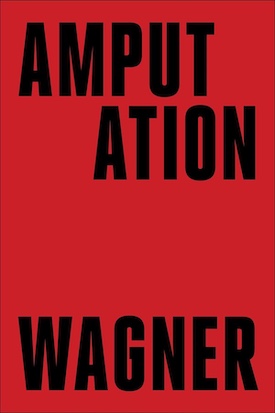 Amputation
Bruce Wagner
Arcade Publishing
Show business kids making movies of themselves
You know they don’t give a fuck about anybody else
—Steely Dan, “Show Biz Kids”
Amputation is a horizontal Towering Inferno, inspired by the January 2025 Los Angeles wildfires, particularly the Pacific Fire where some of Hollywood’s most famous and powerful denizens lived. Events primarily revolve around eight figures in different locations and their points of view, the chapters alternating among them.
Beginning with Stephen Colbert, pinned beneath a pine tree in his yard, Wagner takes a kaleidoscopic approach to the fires, shifting among reactions ranging from indifference to selfish senses of loss to gratitude simply for surviving. Some people, like the actor Steven Guttenberg, help wherever they can—in Guttenberg’s case, helping to evacuate seniors from an assisted-living facility.
Enveloping men and women, rich and poor, all ethnicities, all religions, well-intentioned and ill-intentioned alike is the fire—a disaster in which nature meets The Day of the Locust. The cast is broad—from the famous to the unknown—as is the action—from heroic to shameful.
Rape, theft, murder, and death by fire are elements of this novel, structured much as a film, each chapter a scene in the plot from a particular character’s point of view. Amputation’s chapters are short and its pace is fast. Because it alternates main figures and their surrounding cast, Amputation never settles on a single protagonist or two the audience can develop an understanding of and, as a result, develop more than a general humanitarian sympathy for anyone’s tragedy. And here, so many of the book’s figures use their acts of charity to schmooze, make contacts, and cut deals, manipulating catastrophe to advance their careers.
But I suspect that’s part of Wagner’s method in delineating Hollywood’s aura and the ways in which Hollywood’s aura bends those living within its penumbra of money and power—people for whom there’s no there there. Whether this frustrates readers is another matter, but Wagner seems less interested in individual psychology than in portraying Hollywood as an ecosystem whose inhabitants become little more than walking résumés with story development ideas in search of a paying gig. After the fire, lives go on, their points of view only confirmed by the conflagration.
_______________
Bruce Wagner interviewed. Discusses writing Amputation immediately after the fires, why he included real public figures, and his conception of the book as something closer to opera than political fiction.
Excerpt from Amputation.
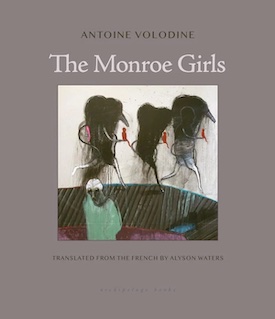
The Monroe Girls
Antoine Volodine / Alyson Waters
Archipelago Books
Antoine Volodine’s novels take place in an amorphous, dreamlike setting two hundred years or so in the future, a post-apocalyptic future with strange contours, a setting Volodine calls “post-exotic.” In The Monroe Girls—whose eternally dark and rainy weather seems straight from the set of Blade Runner—the narration alternates between a hospital inmate’s first-person narration and an omniscient narration following a government agent.
The hospital inmate, a man named Breton, is as unreliable an unreliable narrator as one could hope for. Or perhaps his presumed unreliability encourages readers either to doubt him or to imagine circumstances in which everything he reports is literally true because he is schizophrenic.
The government agent, Kaytel, is assigned to interrogate and torture Breton who is one of few people who, because of whatever chemical or nuclear warfare may once have occurred, developed the ability to read the thoughts of the dead. For months now, when the novel begins, Breton has been drugged and attached to high-tech gizmos that allow him to see different parts of the city the sanitarium is in, Baltimore(!).
In this grim setting, Breton has been asked to keep monitor a group of dead women sneaking into the world of the living, to create political havoc.
At this point, I’ll make a general observation: Rigid ideologies, secular and religious, tend to be eternally on two war fronts: the external enemies and the enemies within. In The Monroe Girls, the struggle has ceased to be against outside enemies; history has contracted until ideology survives chiefly by purging its own adherents. In this dystopian dream future, the battle is down to exterminating the enemies within, even if that means bringing back the dead to help do it.
What is the goal? To return to some imaginary True Path. The program specifics are never laid out. “The party comes first” is a confession of eternal faith. For me, the level of intolerance and intransigence towards others, as suggested by these Party members and defectors, amounts to very black comedy, although not a knee-slapper. Almost no one is untouched by duplicity, denial, and betrayal—either at the hands of others or as survival mechanisms for themselves.
In this post-apocalyptic world, whose population is rapidly dwindling, only members of the Party, the police, and people hospitalized for various reasons are left behind. And the battle to return the Party to its true path must go on.
Alyson Waters’ translation of this dreamworld into idiomatic English is spot on and natural sounding.
_______________
Excerpt from The Monroe Girls. Includes an introductory appreciation by Will Chancellor explaining the qualities that constitute Volodine’s distinct “post-exotic” world.
Antoine Volodine interviewed about heteronyms and post-exotic literature: Evergreen Review
From Nowhere, an interview with Voldine in The Paris Review.

The Gaucho Martín Fierro and Martín Fierro’s Return
José Hernández / G. J. Racz
Oxford World’s Classics
Gauchos—in their mid- to late-19th century heyday—were itinerant ranch hands, herders, and horsemen often employed and socially despised by wealthy landowners. An olio of Spanish, African, indigenous peoples, and their variations from what is now Argentina and Uruguay, they had too much otherness for a society concerned with lineage.
José Hernández, weak and prone to illness when young, often assisted on his father’s ranch, where he witnessed gauchos first-hand, saw how they worked and lived. He eventually founded a newspaper in which he denounced the Argentine government for its treatment of gauchos.
First published in the 1870s, The Gaucho Martín Fierro and Martín Fierro’s Return together form a sort of epic poem about the emergence of the Argentine nation after its independence from Spain, amid the political and military struggles that followed, as experienced by those who lived on Argentina’s peripheries under the thumbs of the wealthy and politically connected. It is poetry best imagined as accompanied by a guitar. (Martín Fierro has been set to music.) Built upon folksy rhymes and simple diction, the songs tell of wisdom learned from direct experience, much of it brutal and unnecessary.
His guitar tuned and ready, Martín Fierro tells of how he was forcibly conscripted into the army for three years, during which time he and his fellow gauchos were provided minimal amounts of food and clothing and—because he was conscripted rather than enlisted—no pay. After three years of risking his life for the benefit of others without compensation, he goes AWOL back home. In the intervening years, however, his home has been torn apart, his common-law wife gone with another man, his livestock sold to pay their debts, and his young sons gone looking for work as field hands.
With nothing to keep him at home Fierro starts to roam and soon finds trouble in the form of a bar fight with knives. He doesn’t look for trouble, neither does he shrink from provoking it. In a land without law or only arbitrary law at best, one’s reputation may be the only thing a person has.
After two bar fights in which Fierro stabs his opponents to death, he finds himself assailed by an angry posse. During the scuffle, in which Fierro is greatly outnumbered, one of the posse, a man named Cruz, is so taken by Fierro’s bravery and still that he switches sides to defend Fierro. The pair win the battle, become friends, stack the bodies they’ve slain into a tidy pile, then ride off into the sunset.
That night at camp, Cruz and Fierro take turns singing songs about their lives and hard times. Knowing the law will soon be after them, the pair light out for Indian territory instead of staying among Europeans where they are known murderers. Theirs is a choice between Scylla and Charybdis, since Indians are portrayed by Fierro as murderously hostile to all non-indigenous people. Thus ends the first book.
It’s a plain-spoken account of a rough life almost entirely deprived of creature comforts and even a modicum of respect from anybody. And it usually begins in childhood, in a state of destitution, often with only a mother or no parents at all. It portrays a world where life is shaped less by law than by force, poverty, and circumstance.
The second book, Martín Fierro’s Return, begins some years later to tell us what became of Fierro and Cruz. Still in canto format, Fierro recounts their harrowing adventures in Indian territory, the acts of brutality they endure, and the occasional moments of grace they enjoy.
Fierro eventually returns to European-held territory—it’s been ten years since his tale of woe began—and finds that his crimes have been forgotten, if not forgiven, and that the law is no longer interested in him.
While back among his people, he and his two sons happen upon each other at a gathering of gauchos. In song, they tell him what happened to their mother and what each endured since being separated as waifs. Woes are like snowflakes: made of the same materials but infinite in variety.
In Argentine literature, Hernández succeeded in transforming gauchos from figures dismissed as lawless vagabonds into one of Argentine literature’s great victims and heroes: suffering and oppressed but maintaining his dignity and self-respect.
Hernández ties the two volumes together in a pleasing and satisfying way, with the appearance of two other gaucho troubadours and a singing contest between Fierro and one of them. The gaucho life being what it is, even campfire songs can lead to trouble.
_______________
Borges on Hernández. In a 1964 radio lecture, Jorge Luis Borges discusses Hernández’s poem, its place in Argentine literature, its politics, and even recites passages from it.
Martín Fierro sung in Spanish.

The Dark
Leonid Andreyev / L. A. Magnus + K. Walter
Itna
First published in Russia in 1907, Leonid Andreyev’s The Dark—presented here in L. A. Magnus and K. Walter’s 1922 translation for Virginia and Leonard Woolf’s Hogarth Press—is an account of a suicide bomber’s final night before a planned attack. The young terrorist named Alexis, age 26, decides that, before he dies in the planned explosion, he will lose his virginity.
Alexis has been on the run for several sleepless nights. The authorities are aware of him, his group, and their planned assassination attempt, but have lost track of Alexis.
Alexis reasons that a brothel won’t be surveilled as a common spot for his group of murderous idealists, and thus he will remain hidden. At the brothel, he chooses a woman named Liuba, and they go to her room. Readers have been prepared for the fact that this transaction may prove more difficult for Alexis than it is for eager participants. Within the first few pages of the novella we are told that Alexis’s anarchist fervor is such that not only has he “saved” himself to preserve his ideological purity but he also finds the idea of sex physically repulsive. Thinking about sex reminds him of the aftermath of a bombing he participated in. The idea of losing his virginity “was unpleasant, as might be any other obnoxious incident which must be endured”:
Once, when assisting in an important act, in which he played the part of a second bomb-thrower, he watched a horse which had been killed with its hind parts burst open and the entrails exposed; this incident, its filthy and disgusting character, and its needlessness, gave him a similar sensation—in its way even more unpleasant than the death of a comrade from an exploding bomb.
Once together in Liuba’s room, Alexis decides that after a couple of sleepless days on the run, he’d rather sleep. He takes off his shirt and shoes but leaves his pants on. Even seeing Liuba’s bare arms embarrasses him. Instead of enjoying being paid for doing nothing, Liuba begins scolding Alexis.
Most of The Dark’s action occurs in this room, in which Liuba and Alexis play a psychological contest over values, social standings, hypocrisy (there’s something noble about voluntarily dying for a cause but shameful in having been forced into a life of sexual servitude). The sinister cat-and-mouse exchanges, the sense that both are arguing about and referring to something greater than themselves that exceed what their mere words indicate, reminds me of Jean Genet’s play The Maids, although Andreyev’s concerns are ethical, not identitarian and theatrical.
The nexus of idealism, fallen practicality, and the gap between what the law says versus how it is enforced converge in Liuba’s room. Whether the novella ends in moral redemption or deeper corruption depends on the principles by which one judges them. Andreyev asks whether devotion to an ideal can survive genuine confrontation with another human being. Its conclusion reminds me of that to Roberto Bolaño’s story “Last Evenings on Earth,” which ends the moment before the building narrative tension (violently) resolves itself.
_______________
Leonid Andreyev bio and bibliography.
BBC documentary: The Russian Revolution of 1905.
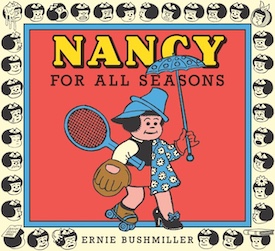
Nancy for All Seasons
Ernie Bushmiller
Fantagraphics
Collecting daily strips from 1951-1952, Nancy for All Seasons shows Ernie Bushmiller in full stride, nearly 20 years into “Nancy.” Visual jokes, puns, shenanigans, resourcefulness, cleverness, sass, and smart-assery fill the pages as Nancy and Sluggo negotiate their rocky relationship, look for odd jobs, take walks, play pranks, act sneaky, disobey adult orders, and so forth.
It’s especially Nancy’s feisty stance towards life’s challenges that makes her so fun to watch. She’s an active agent, somebody who fights back; she’s nobody’s passive object.
And she’s 8 years old.
Read in that contemporary light, Nancy can easily be read as the picaresque adventures of a proto-feminist, but not one who was ever merely a “type.”
To explore what made this girl tick, Bushmiller pushed the boundaries of his medium, the newspaper gag strip, by refining it to its essential visual elements and setting them in place like a mouse trap leading to the “snapper”—Bushmiller’s term for the visual punchline. His comics weren’t just jokes illustrated, his illustrations were the jokes set up by the words.
Bushmiller would go from (comic-strip) realism to surrealism in mid-panel if it serves the joke.
Essential works in the history of popular cartooning, as funny and compelling as ever.
_______________
Bill Griffith on Bushmiller and Nancy:
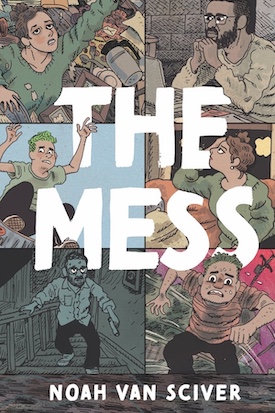
The Mess
Noah Van Sciver
Fantagraphics
Noah Van Sciver’s latest graphic novel, The Mess, is propelled by a series of contrasts: one house is filled with love, the other with hate; one home rejected its daughter; the other cannot release its lover, who died there; one is estranged, the other hungry to connect. There is endurance and resignation, clear-headed acceptance, and hope masking delusion.
A middle-aged woman named Erin Messina returns to her father’s home to claim what she wants of its contents before the bank takes possession of it. Estranged from her father, a hoarder, she hadn’t been to the house in half a lifetime. Her son—15-ish, say—never met his grandfather. Not having any emotional connection to the house, Jackson, her son, would rather skateboard than help her sort through heaps of useless stuff. Two things make Jackson’s stay in the dusty old house tolerable: The possibility that his grandfather owned a drawing by Picasso—which, if true, could substantially help the family’s finances—and the fact that he meets two local skateboarders.
Older and better skateboarders than Jackson—they’re on the verge of an endorsement deal—the twins deign to allow Jackson to hang out with them. Jackson’s techniques improve, and the twins introduce him to pot, which he is reluctant to try at first, but the pull of adolescent rules of social engagement will have its way. Still, that’s fine until they also show Jackson their interest in breaking and entering. Armed.
Across the street lives a man whose house has become a frequent target of vandalism over rumors that he killed his roommate in that house and got away with it. His story eventually intertwines with Erin and Jackson’s.
Although the environment and events feel grim, few matters are sure things in The Mess. Van Sciver’s characters are too nuanced and his freedom from generic plotting is too great for the story to become predictable. His pacing and framing of the events are excellent. Van Sciver knows how to tell a compelling story. Do the characters get what they want—and, if so, at what cost?
_______________
Noah Van Sciver interview
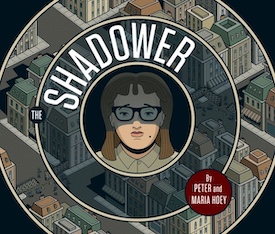
The Shadower
Peter and Maria Hoey
Top Shelf
Peter and Maria Hoey once again combine meticulous design with uncanny storytelling in this political thriller.
Nadia is a young actress in an unnamed town in an unnamed country where a devastating civil war has come to an impasse. Nadia’s city has been divided between rival political and military factions. Plots and counterplots are carried out, terrorism enacted by both factions.
Nadia’s father was an actor, theater director, and acting coach. A member of one of the political factions, he was killed in a bombing that targeted his theater when she was much younger. Now older and a professional actress herself, her acting talents are evaluated by members of her father’s political party, and she is given an assignment—she realizes she’s not being “asked”—to play the part of a waitress who works at a café regularly attended by a shady character named O’Brien with ties to the crime world and the politics of the opposition party. Nadia simply needs to attach a small recording device to the bottom of a samovar that will sit on O’Brien’s table.
From here, the story reveals levels of duplicity and vengeance, political and personal. Nadia is supposed to replace a friendless, nebbish woman, a role she finds absolutely taxing at the end of the day, keeping to herself, seeming meek but dutiful. At night, alone, she feels she must remain in character. Will she become the kind actress so invested in her character that she becomes that character? Is she turning into what she didn’t know she always was? Or is something else going on?
Appropriate for the The Shadower’s urban, militarized setting is its rendering in dour tones of grey, brown, and olive drab. They structure their pages with panels made of circles, squares, and rectangles—they look like patterns of architectural arrangements, sometimes spreading across facing pages. Like Chris Ware, the Hoeys show a preference for geometric forms and a simple palette. In the case of The Shadower, their use reinforces the emotional effects of living in a regimented, surveilled society. Are we seeing a face through a circle or a gun barrel? Nadia’s environment is permeated with the ominous.
Light and shadow within the panels are used to guide the eye across the action and join the panels of single pages or cohere facing-page spreads. Giving their images hints of depth and texture is the Hoeys’ use of closely stacked and shallow horizontal ripples across the panels that colors are laid over. It’s a very nice but subtle effect. The pages are a pleasure simply to look at, even before reading.
_______________
Interview with Peter and Maria Hoey:
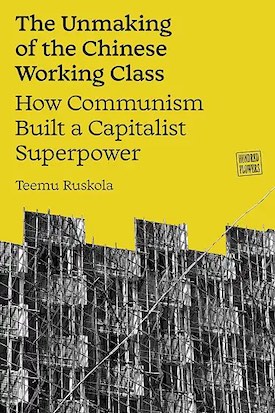
The Unmaking of the Chinese Working Class
Teemu Ruskola
Verso
Teemu Ruskola is a legal scholar at the University of Pennsylvania, who specializes in comparative, international, and Chinese law. Although Ruskola backs his analyses with plenty of scholarly sources, his book remains accessible—even engrossing—to lay readers curious about life for China’s rural population. By examining China’s rural population through the lens of law, Ruskola shows how property rights, labor law, citizenship, and legal status shape their lives.
Ruskola frequently compares what British peasants endured during Britain’s long enclosure movement with that endured by China’s rural inhabitants in just a few decades. First, for the Chinese, the state reorganized agriculture into collective ownership, from which each family had use rights—never enough in itself to sustain a family—and a stake in the common share they worked with the rest of the community. Of the farmland held in common, a certain percentage had to go to the government, the rest the community could do with as they chose. Thus, each community had a vested interest in reinvesting profits to improve living standards. When industrialization came, the communities became owners, operators, and profit sharers of their factories. They could put money into schools, provide clinics, and develop local infrastructure. They worked and lived together and had secure employment.
In the 1980s and ‘90s, rural communities began developing township and village enterprises (TVEs), in which a community owned and worked in local factories for producing marketable goods. Beijing gave these enterprises significant leeway in experimenting with ways to sustain their communities economically, with potentially significant gains for townships and villages that made good decisions, and disasters for communities in which leadership was corrupt, inept, or simply mistaken. In the aggregate, however, life in the sticks began to improve.
Ever since Mao, China has divided its population into two legal categories—urban and rural—which creates two categories of employee—worker and peasant. In some periods of its history, the national government assumed that rural populations and their collectives were self-sufficient. So, unlike urbanites, whatever extra value peasants were able to wring from their production was not in addition to what the state provided. It was to make up for what the state did not provide.
To raise the capital required for economic development, local governments, municipalities, and the national government came to depend upon income generated by land conversion and land-lease revenues. Peasants dispossessed of land by these acts often left their home for work in urban factories in cities where they are only ever migrant workers.
China’s hukou—a document showing a person’s legal residence—is the mechanism Beijing uses to keep the population separated, control migration, and create different legal categories of people. Without legal residence, workers lack rights of citizenship in those cities, rights that come to municipal taxpayers in the cities in which they are registered to live.
A peasant who comes to, say, Shanghai to work in construction generally will not have access to civic services legal residents of Shanghai enjoy: free K-12 education for their children, inexpensive health care, access to libraries, or other municipal benefits and facilities. Obtaining residence can be difficult, depending on the size of the cities and their needs for development.
Without farmwork or other industry to sustain them at home, many rural couples move to the cities while leaving their children behind—children ranging from 2 to 18 years—sometimes left with grandparents, often without any supervision and sometimes little to no money. Some of the work is seasonal, allowing them to stretch their income by farming back home.
Why do this to peasants? Ruskola argues that these policies were not simply ideological. They also reflected China’s determination to industrialize as rapidly as possible despite having limited capital. Cheap labor became one of the country’s principal comparative advantages.
Forty, fifty years ago, China was a much poorer country. Much of it remains relatively poor. As former Premier Li Keqiang observed in 2020, roughly 600 million Chinese survived on about 1,000 yuan (roughly US$140 at the time) per month. China could offer labor at costs few countries could match because the nation was still poor and they had hundreds of millions of potential employees. Capitalist producers, always looking for a good deal, moved their operations to China, and the U.S. entered its post-industrial phase, in which low-paying service workers have replaced unionized factory workers.
Americans tend to have misconceptions about what it means to live in “communist” China and “live off the state.” To begin with, Beijing does not provide the kind of broad unemployment welfare many Western readers assume. In fact, President Xi Jinping has warned against the purported evils of “welfarism” in terms any American conservative would echo: it fosters laziness over self-reliance. And yet, rural workers have gone from having land they could do with as they saw fit to sustain themselves to having to sell their labor in places where they have no legal residency, receive no civic benefits, and no prospect of guaranteed work.
It seems to me that the short-term benefits enjoyed by capitalists operating in both the U.S. and China at the expense of its most vulnerable workers are not sustainable, and certainly unacceptable in countries able to produce millionaires and billionaires. And yet, they endure.
For readers interested in getting beyond stereotypes about what life is like for members of the class Communism was intended to address, Ruskola does admirably well in pointing out the advances, retreats, freedoms, and restrictions facing rural citizens and their role in the global economy.
_______________
Interview with Teemu Ruskola
Chinese migrant workers and labor conditions: