
Dispatches from the Avant-Garage: Rebecca Kosick and Ken Mikolowski on the Alternative Press
Rebecca Kosick and Ken Mikolowski will discuss the history and legacy of the Alternative Press, along with a look at local artist presses currently working today at Book Beat on Sunday, July 26, from 5-7 PM.
During the second hour we will take a break and open a discussion with other small local presses working today. Among those attending is Daniel Eller who has published fine press photobooks and is producing a series: The Ledger Photo Journal coming out in the fall.
Brea Harris is a poet and creator of Intersectional Press.
Zan de Pery was a former student of Ken Mikolowski and founder of Keith LLC Press.
Mikolowski and Kosick will have a second appearance at MOCAD on Thursday, July 30. Kosick’s new book,Dispatches from the Avant-Garage: The Alternative Press, recently published by Wayne State University Press, offers a detailed look at the Detroit-born letterpress project founded by Ken and Ann Mikolowski and its wide-ranging network of poets, artists, and correspondents.
 Questions were sent to Kosick and Mikolowski by email about the Press’s origins, its relationship to Detroit and Grindstone City, its connections to Mail Art and intermedia, and its continuing relevance for independent publishing today. Their responses appear below, with Kosick’s answers first.
Signed copies of Dispatches from the Avant-Garage are now available in store or online through the Backroom Gallery. Illustrations are from Mail Art and postcards found at the Ann and Ken Mikolowski Alternative Press archive at the University of Michigan Special Collections.
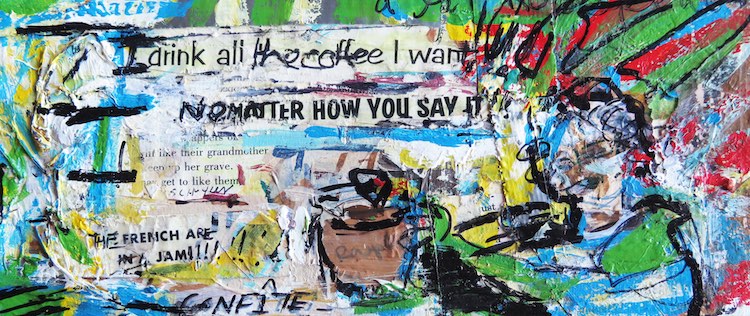
Cay Bahnmiller and Gordon Newton, Mail Art envelope to Ann Mikolowski
Origins, Place and Production
At the Hatcher talk and in the book, you mention the Artists Workshop as Ken’s inspiration for starting the Alternative Press. He also mentioned how he tried to give away poems in front of the Detroit Institute of Arts before he began mailing the poems. Ken briefly mentions the Waldrops as a letterpress inspiration. Maybe I missed it in the book, but I was wondering: at what point did Ann and Ken decide their letterpress was going to be a mail project?
It became a mail operation fairly early on. I believe the more formalized subscription packets started in 1971, but before that, Ken and Ann would mail prints around the country for free, including to bookstores. At the same time, they were also giving them away to friends, collaborators, and unsuspecting museum-goers outside the DIA.
Ken mentions that Ray Johnson was a visitor to Grindstone City. Was he also a subscriber to the Alternative Press? Was Ken aware of Correspondence Art before he began AP?
Yes, Ray Johnson visited Grindstone City and afterward made a print for the Alternative Press entitled “Peter Beard’s Silhouette Surrounded by Ten Michigans for the Alternative Press Tenth Anniversary” (1979). The archive has subscription records for some of the years of the Press’s operation, and I don’t see Ray Johnson listed as a subscriber for those particular years, but there are records of his correspondence with Ken and Ann. For instance, there is a letter he writes to Ann after his visit to Grindstone City, where he thanks her for a small grindstone she had given him. He writes that he is going to take the grindstone to the deafblind sculptor, Christopher Cook, with Johnson saying he was planning a performance for the blind. In another case, Ken and Ann Mikolowski’s names appear on a 1987 flyer of Johnson’s that was sent out to his correspondents with the label The New York Correspondence Academy Detroit May 23-June 4 1987. So, the Mikolowskis had an ongoing collaboration with Johnson that spanned many years and was productive for all parties.
Ken and Ann were both involved with Mail and Correspondence Art, though as Ken says in the interview included in the book, this was somewhat independent of the Alternative Press. That said, I see the Alternative Press as overlapping significantly with these movements, which also had their heyday around the 1970s. All were driven by an approach that cultivated aesthetic collaboration at-a-distance and operated outside of established institutions like galleries or mainstream publishing. But I also reflect a bit in the book on the ways the Alternative Press differed from Mail and Correspondence Art, for instance through their emphasis on letterpress, and through the editorial framework that Ann and Ken oversaw. Still, there is much common ground, and the Alternative Press is really remarkable in its embrace of these practices from the perspective of poetry, especially.
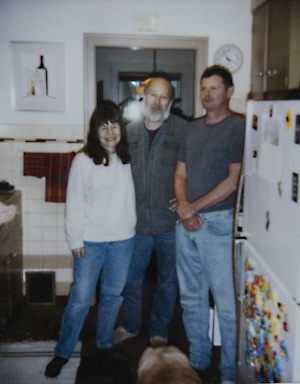
Ann and Ken Mikolowki with Gordon Newton
Ken and Ann worked out of both Detroit and Grindstone City. How did these locations help shape the content, production, and ethos of the press?
These locations impacted the Press substantially. Both places gave them space to work, which is essential to letterpress publishing. In Detroit, this took the form of a basement in a large house, and in Grindstone, the ground floor of an old general store. To do letterpress, you need enough room to house the printing presses themselves, but also everything that goes along with them—enormous cases of type, ink, rollers, paper, and so on. Having the right kinds of spaces gave them the ability to run the Press at home and to work around all their other commitments, like raising a family, working as an artist and poet, commuting, being generous friends, and generally living their lives. In Detroit, particularly, their house also became an important meeting place for artists and poets in the city, and for those visiting Detroit from around the country who would stay with them on their travels. These social elements of their environments show up in the Alternative Press too, which is a project that grew out of, and showcases, the Mikolowskis’ community and the artistic friendships the couple maintained over the years of the Press’s operation.
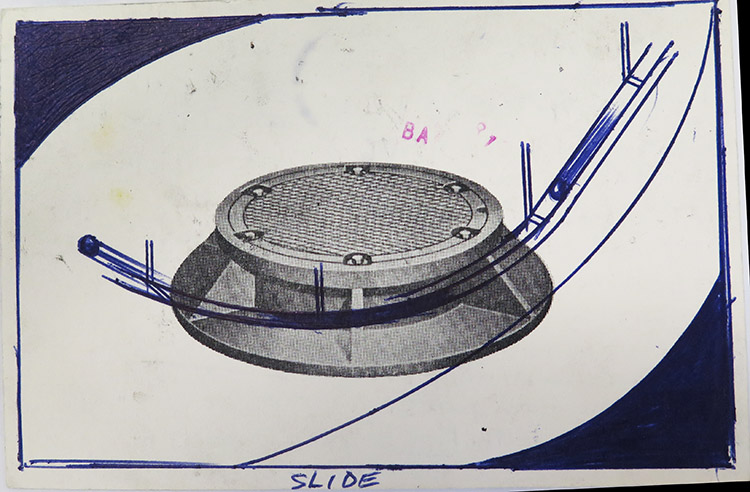
Gordon Newton, Alternative Press postcard
Your book makes clear that Ann Mikolowski was the typesetter and designer for the press. Her personality and aesthetic are infused in the material. Can you explain further Ken’s role in the press as a connector? Was he also the printer?
They each did a bit of everything, although Ann was of course the one who did the design and visual artwork they included in their prints. Ken told me she also took the lead on typesetting, though he did set type as well, and printed. Ken was the primary letter-writer, communicating with contributors and subscribers, which was no small feat! Theirs must have been the most active mailbox in all of Detroit, and Ken kept up the professional and interpersonal correspondence that was the backbone of building that network. Some of this moved over to email in the latter years of the Alternative Press’s life (so, in the 90s), but before that, it was through the mail, and Ken describes devoting great effort to the letters he wrote to poets and artists they worked with.
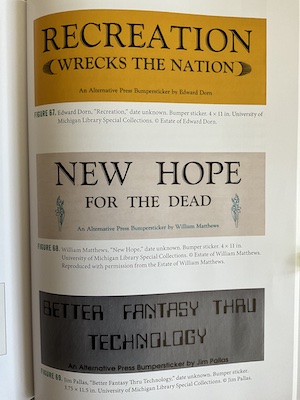
Bumper stickers from a page in Dispatches from the Avant-Garage/ From top: Edward Dorn, William Mathews, Jim Pallis
Detroit’s Sonic and Industrial Influence
Detroit has a strong identity tied to industry and sound. Do you see a relationship between the city’s industrial history and the aesthetics or rhythms of Alternative Press production?
Yes, definitely. As far as music goes, I talk in the book about how the Press’s early years were connected with groups like the MC5 and the Stooges. And the aesthetic confluences that are typical of the Alternative Press—which published poetry, but also visual art, and a number of works that reference music, like Kofi Natambu’s “Sonnymoon for Us All” broadside—are emblematic of a wider cross-pollination of artistic genres in Detroit at the time. You can see this, for instance, with groups like the Detroit Artists Workshop as well, which included visual artists, writers, and musicians among its affiliates. And practitioners of each art form were engaged with the others, learning from each other, feeding off of each other, and collaborating at the cutting edge of artistic production in the era.
This is true for the Press’s relation to industry as well. For one thing, the Mikolowskis’ ability to buy a cheap letterpress was a result of industrial transformations to commercial printing that took place over the course of the 20th century. As professional print shops gained access to faster, computerized tools, letterpresses became obsolete for most commercial purposes. But, as we’ve already discussed, letterpresses and the various other elements they required to print were enormously heavy and took up a lot of space, so they weren’t easy to get rid of. As a result, lots of hobby printers and small presses were able to get access to these machines and their tools for very little cost. I talk in the book about how the Alternative Press was part of a wave of small publishers during the era who took up letterpress, in part due to these industrial transformations.
In terms of the auto industry, the Alternative Press’s bumper stickers probably best illustrate the Press’s links with their home in the motor city. Almost no one else was printing poetry bumper stickers at the time, and they are a perfect format for a press from Detroit. As I talk about in the book, bumper stickers are also very much a product of their moment. They arose as a result of industrial developments in the postwar period, including new kinds of adhesives and neon inks. And then they spread through the culture, following the expanding interstate highway system and the growing adoption of the personal automobile. I really enjoy picturing people reading a poem by Diane di Prima or Robert Creeley—maybe without realizing it!—on the back of the car in front of them in traffic.
Intermedia & Print Culture
Figures like Dick Higgins framed “intermedia” as a crossing of disciplines. The Alternative Press itself was intermedia, but how did that translate into print—and what artists or poets especially worked with, or brought out, this feature of the Alternative Press?
That’s right: Dick Higgins reintroduced this term, which Coleridge had also used, in the 1960s, and was interested in the “fusion” of different media into emergent new categories that, at the time, included things like Happenings and Postal Poetry. I think you see an intermedia character in all of the Alternative Press’s work, because each postcard, bumper sticker, bookmark, or broadside functions not just as an autonomous poem with an illustration accompanying it, but as an integrated object in which all parts—verbal, visual, material, etc.—fuse together to make something that is unique to that format. One example that I include in the book, but didn’t have the chance to talk about there, is Anne Waldman’s poem “Girls.” The poem, from the 1970s, talks about the luck of girls living “by water,” “in a forest,” or “deep in a valley” and laments the sound of “a motor idling despondently” outside the poet’s window, which, as the poem implies, is located in an urban environment. The poem ends, “I hate it, girls / I hate that motor.”
I love this poem, and what the Mikolowskis do with it. It is published around the time of the “back to nature” movement, following the uprisings of the late 1960s. The Mikolowskis print it on this brown postcard, in blue ink, and the text of the poem shimmers like a lake among dunes. They also include this little image, which I suspect was a found item, of three girls sitting on a dock with their feet in the water. But, in the image, the girls depicted are from an earlier era, wearing swimming caps and the more modestly cut bathing suits of the 1930s or ’40s. The image was so well selected, setting up this kind of generational shift that the poem also touches on, where the boomers are breaking with the world their parents built and seeking out new models for living. And as a postcard, the print will go on to move through the very world it interrogates, traveling across urban and rural spaces. There are so many examples like this, where the Mikolowskis use all the components of their prints—from the visuals, to the colors, and the print supports themselves—to extend, complicate, or nuance what’s happening in the text of the poetry itself. In most cases, poems were submitted as just text; then they took on this more intermedia character by the time they were put into print.
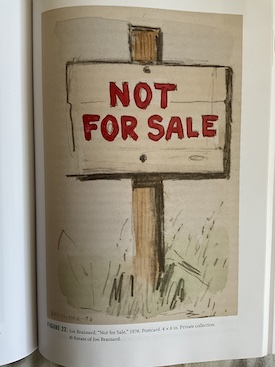
Joe Brainard postcard 1976
I liked how you brought up the press’s influence on poets and artists—as editors, which was unusual in poetry journals—and also the influence of artists on the press, stressing this as mainly a community/collaborative project. Do you have any favorite examples of this feature?
My favorite examples are the cards referred to as the “Multiple Originals”—these were postcards, in sets of 500, that the Mikolowskis printed for poets and artists to complete. The Mikolowskis would print the backs, saying, for example, “An original postcard by Alice Notley,” but the fronts would be blank for the contributors to fill in. Each card would go on to display a one-of-a-kind work of art. These were highly collaborative—between the Alternative Press and contributors, but also among the poets and artists who took on the challenge. They often involved friends, family members, even other Alternative Press contributors in their making. This occurred in part because the task of creating 500 unique works of art is a monumental one. And some contributors, like Notley, Donna Brook, and Faye Kicknosway, did even more than that—1,000 or even 1,500 original postcards!
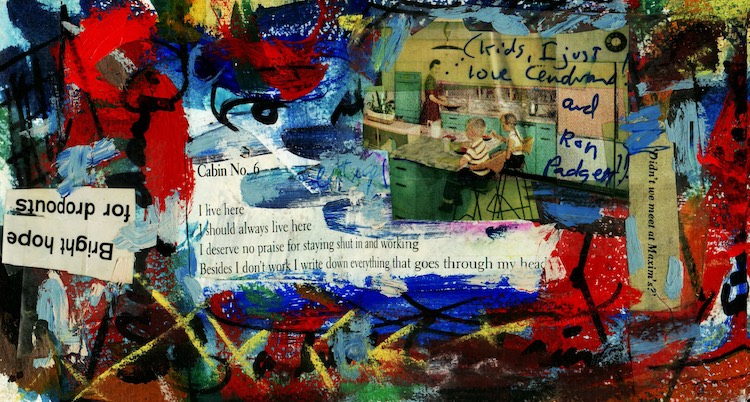
Cay Bahnmiller Mail art to Ann Mikolowski
I’ll take this chance to talk about another example I love that I didn’t have much time to dwell on in the book. This is a postcard called “Dear Alice” that reads, “The reason I love you so much is be-cause you’re very beautiful and kind. I also appreciate your intelligence, though what ‘intelligence’ is I’m not sure, & your wit, which resembles nothing I’ve ever thought about. Your loving husband, Ted Berrigan.” The poem is reproduced in a text-only format in Ted Berrigan’s collection A Certain Slant of Sunlight, which was based on the postcards he had made for the Alternative Press. There, the only remaining traces of the postcard show in the poem’s line breaks, including inside “be-/cause.” These breaks match where the postcard’s edges had cut off the writing in the Alternative Press version. But, on the postcard itself, there’s more—for instance, there is a frame around the “Dear Alice” part, and following Ted Berrigan’s name, it is signed “Alice Notley.” And the poem, which is handwritten in the Alternative Press version, is clearly in her handwriting on the card. So Notley either transcribed it or, in fact, wrote it herself, attributing it to Ted. This kind of playful, familial collaboration really shines through on the card in ways that aren’t evident in other print formats. I love that so many people in the Alternative Press’s circle were taking advantage of these kinds of humorous collaborative opportunities that the Mikolowskis’ postcard project makes possible.
Legacy & Contemporary Relevance
In today’s landscape of digital publishing and renewed interest in zines and artists’ books, what aspects of the Alternative Press model feel most urgent or instructive? Are there lessons from Detroit’s scene that resonate with current independent publishers and artists?
Publishing models like the Alternative Press’s are more important than ever. We’re seeing a turn back toward handmade and DIY printing now. In the early days of the internet, digital spaces were understood by many as promising, even utopian, extensions of the kind of analog networked activity that characterized things like independent publishing and Mail Art. But today, after so much corporate capture of digital spaces and the increasing onslaught of machine-“written” content, more and more people are returning to DIY print publishing. This gives them greater control over the means of production and the messages they may want to convey. I think those of us interested in human artistic collaboration can take so much from the Alternative Press’s legacy. Their dedication to maintaining lively communities of artists and their bold and unapologetic publishing of materials that forwarded liberatory politics is inspiring. Just some of the examples I could name would be publishing John Sinclair’s writing while he was incarcerated on politically motivated charges, or the Press’s ongoing celebration of queer sexuality, or its critiques of U.S. imperialism and the war machine. So much of this resonates still today. I think it’s also important for young people to know that they don’t need an institution, or an established cultural power, to grant them permission to make art. In the spirit of the Alternative Press, just gather your friends and start making.
Rebecca Kosick June 11, 2026
Questions for Ken Mikolowski
Were the postcards the first printed works you did—and why postcards?
We did printed postcards very early on. We liked the functional aspect of postcards.
How did you first meet Ray Johnson, and did you know of his work prior to 1969? What do you remember about his visit to Grindstone City?
We did not know Ray Johnson prior to starting the press in 1969. But not long after, we sent him some things, and he sent us some of his photocopied art in return. That started a regular exchange.
He and his nephew drove up to Grindstone City from Detroit in the spring. We picked asparagus for lunch, and on their way back to Detroit, they stopped at a Big Boy restaurant and picked up a printed advertisement of asparagus that Ray later painted over and sent on to us. It was the “asp” that killed Cleopatra.
At the Hatcher talk, I thought you mentioned the Alternative Press had 100–125 subscribers, so why were the postcards printed in editions of 500?
Not sure I said 100–125, but then I might not have heard the question right. At our peak, we had around 300 paying subscribers. The rest of the edition was sent out in exchange to other presses, poets, and artists. We kept 25 for our files. Hatcher Library received 10 of each.
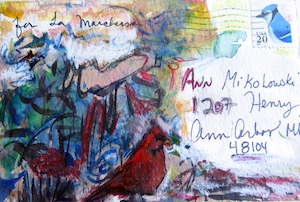
Cay Bahnmiller postcard to Ann Mikolowski
Can you talk about the relationship between Ann and Cay Bahnmiller? Was that unique, or did Ann maintain close correspondence relationships with other artists?
Ann and Cay were friends. They sent each other all kinds of items. They started a correspondence of secret intrigue that resembled a kind of mock spy network. It was amusing to them and they kept it private that way. Ann also corresponded with others but not in that intimate manner. [ For more info see: Helsinki Task Force]
You mentioned that Walter Hamady published your first poetry book. What was the experience like working with him, and was the Perishable Press a possible influence on the Alternative Press?
Walter Hamady and I were both students in Keith Waldrop’s class at Wayne. We did not work together because he moved to Madison, Wisconsin, and we stayed in Detroit. He did make paper for my book from two pairs of my old jeans, though.
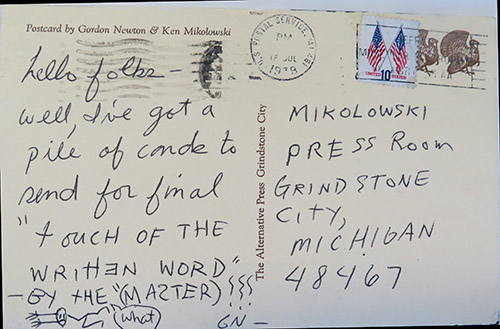
Gordon Newton postcard to Ken Mikolowski 1978.
Our two presses were quite different in their formats, but we respected what each other was doing.
I’ve been fascinated by your short and humorous poetics. What led you to this? Do you also see a connection between conceptual artists like Ed Ruscha, Fluxus, and word artists like Barbara Kruger and Jenny Holzer?
My short poems came about through years of hand-setting type. I felt the shorter, the better. You mentioned Ed Ruscha, and we did exchange our printed work for his. We admired Barbara Kruger and Jenny Holzer but had no exchange with them.
Do you like how Dispatches from the Avant-Garage turned out—and was there anything not included that you felt needed more coverage?
I think Rebecca Kosick did a thorough job of representing The Alternative Press archive. Not sure what else could be explored.
What do you feel is the legacy of the Cass Corridor movement?
Detroit’s Cass Corridor was a vital part of Detroit’s history, and I believe it still has a large influence on contemporary artists and publishers still working in the city.
Ken Mikolowski
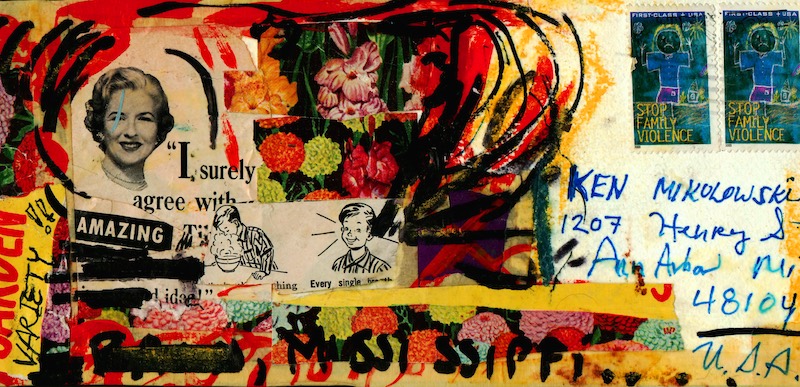
Cay Bahnmiller envelope to Ken Mikolowski