
I arrogantly recommend… is a monthly column of unusual, overlooked, ephemeral, small press, comics, and books in translation reviews by our friend, bibliophile, and retired ceiling tile inspector Tom Bowden, who tells us, “This platform allows me to exponentially increase the number of people reached who have no use for such things.”
Links are provided to our Bookshop.org affiliate page, our Backroom gallery page, or the book’s publisher. Bookshop.org is an alternative to Amazon that benefits indie bookstores nationwide. If you notice titles unavailable online, please call and we’ll try to help.
Read more arrogantly recommended reviews at: i arrogantly recommend…
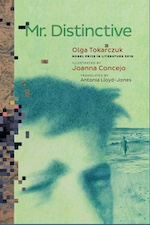 Mr. Distinctive
Olga Tokarczuk/Antonia Lloyd-Jones, Joanna Concejo (Illustrator)
Seven Stories Press
A short cautionary tale (translated by Antonia Lloyd-Jones) about narcissism in general and its sub-genre, the social-media selfie in which over-abundance (which social media specializes in) is the great leveler, taking that which is distinctive and homogenizing it into a new mediocrity: the by-product of a society in which people can get what they want, assuming they have the cash. And people want what they see other people have. Beautifully illustrated by Joanna Concejo, whose images perfectly match and subtly underscore the story’s moral for adults—an excellent, successful collaboration in which the work of each participant highlights the significance of the other’s contribution.
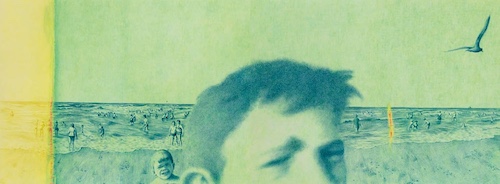
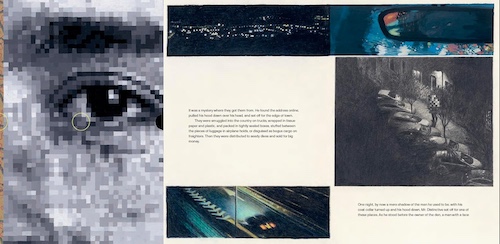
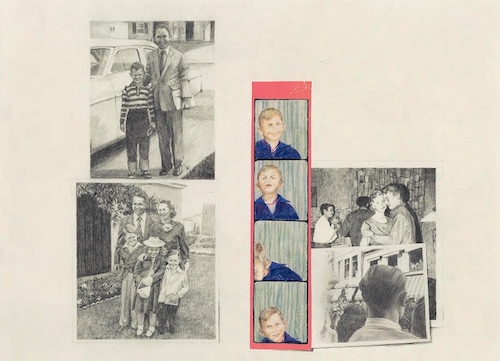
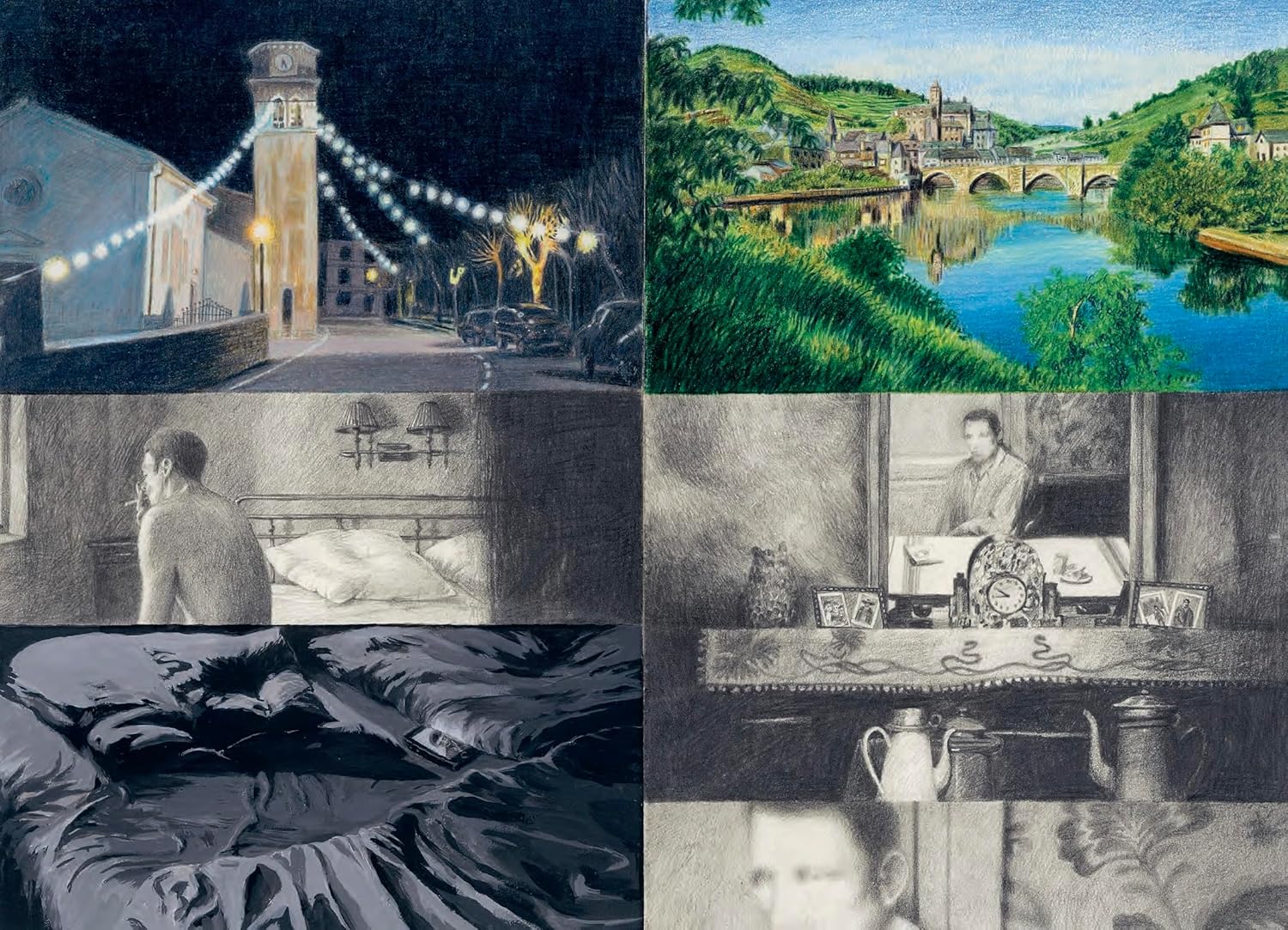
Unruly Books is a new imprint from Enchanted Lion, a publisher of original children’s books and books in translation. Also consisting of picture books, Unruly Books is instead targeted at teens and adults, to create a space where the picture book can truly break out for older readers, where it can expand and flourish as the boundless storytelling medium that it is.” Furthermore, “The importance of narrative picture books for adults and teens lies in the fact that there are things we apprehend that we cannot comprehend, and that what art shows forth is a wild excess of meaning. It is pictures that present us with what is not reducible to a single meaning or understanding, pictures that put us face-to-face with mystery.”
 Q&A with Claudia Zoe Bedrick, the publisher, editor, and art director of Enchanted Lion Books, an award-winning, independent publisher based in Red Hook, Brooklyn.
TB: “Picture books” and “graphic novels” seems to imply different audiences: picture books are for children too young to read or just emerging as readers; graphic novels are for teens and adults who want longer, more complex narratives. How do you distinguish picture books for adults from graphic novels for adults?
CB: Our contention in forming our Unruly imprint is that picture books are not an age group at all, but a unique, combinatory medium for telling stories. Picture books are not graphic novels, as each engages a different form of visual storytelling. So picture books for adults and graphic novels for adults are different ways of combining images and words to tell stories. Of course, there are hybrid forms for children and adults that might combine the conventions of comics, which mark the graphic novel, with picture book illustration, which uses the compositional space of the book in a different manner from panels and bubbles and graphic novel conventions.
TB: What issues or topics for older readers do you think might be better or best expressed through the medium of picture books?
CB: I don’t think there are any themes or topics that cry out for the picture book format. Rather, all themes and topics are welcome, but need be in dialogue with a visual narrative or even a non-narrative but visual, conceptual world to constitute a picture book. What I do think is that the experimental, poetic, unique space that is the picture book, where words and pictures are in dialogue with each other as in no other form, comes as an invitation & a catalyst for stories to be told in the musical, multidimensional, and visual ways that can only happen in the picture book. This comes as a great enticement to artists, poets, and writers, as you might imagine.
TB: What led to the moment where you decided or received an insight that picture books for older readers wasn’t just a novelty idea for publication but perhaps something vital missing for contemporary readers?
CB: Unruly is very much an experimental imprint and unruly it is. Not all of the books we’ve published are actually picture books and we’ve been a bit unruly in what we’ve acquired. It’s not even clear that the imprint will survive. As for the idea for the imprint, we discuss many ideas in our office and we have been pondering the picture book as a medium for a long time. The book that launched the imprint is The True Story of a Mouse Who Never Asked For It. It’s the retelling of an old Spanish folk tale about a cat and a mouse, so it seemed like we were doing a straight up picture book, but then the illustrator, Violeta Lopiz, attached a silent visual coda that transformed the story from being about a cat and a mouse to being about a female artist who has clearly been abused (a deep theme of the folk tale) and is pulling her life together. The violence that has happened is there in the color red, as it is in the folk tale portion of the book, but it’s also now present in the cutting off of hair, and the cleaning up of a room in which something violent has clearly happened. It was this silent code that made us decide to launch Unruly, since it was clear that we weren’t going to publish the book, which requires a mature understanding of life experiences, for children under our Enchanted Lion imprint. Our readers trust us. Many in our community have bought almost every book we’ve published, so we weren’t going to suddenly publish a book that just isn’t made for children and offer it as such. So it was this book that gave us the chance to push the boundaries of what a picture book might be even further and to launch into more unchartered and experimental territory.
TB: How many titles a year do you hope to publish?
CB: One title a year.
TB: Thank you, and good luck!
 Tales from Dreamland
Ed Valfre
Wolves, astronomers, toy robots, humble dogs, and lost socks are some of the subjects of dozens of biographical vignettes accompanying photographs in Tales from Dreamland. Tales acts to spark their readers’ imaginations—primarily young adults in their teens and twenties—readers who have perhaps succumbed to cynicism and a blasé attitude toward life (especially in the hearts of disillusioned romantics). The spark asks readers to look again, to think again about the immediate world around them, and imagine potential stories that explain what we see and why and how it came to be or what it’s trying to tell us. Matching story to photograph—black and white, sepia-toned, full color (often with shocks of gold)—the vignettes serve as acts of hope by those who either feel hope is for other people or need a booster shot. Valfre includes among his photographs a dozen or so unpaired with a story. Although Valfre doesn’t explicitly invite readers to do so, implicit with the book’s theme the invitation is there. Tales from dreamland would also serve as a great series of writing prompts with examples for creative writing classes and for individuals who want to kick-start their imaginations. It only takes a spark to reach the possibilities of dreamland.
 The Book of Denial
Ricardo Chávez Castañeda / Lawrence Schimmel (text) and Alejandro Magallanes (illustration and design)
The narrator of The Book of Denial is a school-aged boy whose father writes horror stories. For reasons unknown to the boy, his father has not written anything in over a year. But one night, he overhears his parents talking in bed, his father says that, as distraught as he is, there is a story he must tell. The boy is so excited by the idea of a new story from his father, that the next day he sneaks into his father’s office and opens his notebook, where the boy finds this:
The hand of an adult is the size of a child’s face, so the executioners of children need no weapons. The children are made to face away from them, and the executioners approach from behind. All they have to do is place their hands over the children’s faces, as if covering them with a scarf, gently protecting their little mouths and faces from the cold. Then, the executioners need only press down with their hands, until the children are suffocated.
That’s as far as the boy can force himself to read before closing the book in shock. Later, in school, during History, the class is introduced to various historical events in which children—by the dozens, hundreds, and thousands, are killed by hand by adults, often their own parents. The teacher assures the class that this is History, after all, and these terrible events are far in the past.
But are they?
Ricardo Chávez Castañeda proposes a different way of approaching the problem of living in a world—in places such as the United States, for instance—where the matter of child murder (and other injustices) is allowed to perpetuate by an indifferent culture.
 The True Story of a Mouse Who Never Asked for It
Ana Cristina Herreros / Chloe Garcia Roberts (text) + Violeta Lópiz (illus.)
Little Mouse is an industrious, fastidious she-mouse with goals, one of which is to build a house for herself. She knows exactly what she needs and how to get it, and her house—formed from a hollowed cabbage—is soon built. However, other creatures begin commenting on the fact that the Little Mouse has no companion. And so, the story transitions here from one that might be read to a child as a lesson on the rewards of self-discipline to one read by young adults as a cautionary tale.
The creatures that pass by Little Mouse’s house—donkeys, ducks, and cats—also propose marriage to her. Little Mouse’s criterion for marriage is that whoever proposes to her must be able to sing, too. Readers, however, may think to themselves (especially after Little Mouse chooses a purring cat as her mate) that perhaps Little Mouse’s criterion for marriage isn’t the same as the criterion for long-term compatibility. And when trouble comes to the couple, it initiates a string of obligations to other creatures neither cat nor mouse expected.
 You Can’t Kill Snow White
Beatric Alemagna
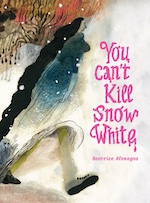
Thanks largely to the efforts of Walt Disney, the folk tales collected and published by the Brothers Grimm over 200 years ago, many people think of their tales as analogous to Aesop’s moral lessons in which frightening situations involving mortal terror are treated as minor irritations easily overcome, and the foreboding sense of peril due to a lack of awareness on the protagonist’s that a caregiver is always nearby to protect them. Beatrice Alemagna spares us such nonsense and returns us to the Grimms’ original version of Snow White, depicted in garish, ugly tones and stabs of running color that perfectly mirror the butchery-minded psychology of her stepmother, an unloved and unlovable beast resentful of the stepdaughter born with attributes the stepmother will never possess. Yes, Snow White is revived by a handsome prince, as in the Brothers Grimm version, and she marries him. Her evil stepmother comes to the wedding celebration, where she—as in the Brothers Grimm version—invited to perform a dance Disney chose to ignore. Because it’s not really a story for children.
 Precious Rubbish
Kayla E.
Fantagraphics
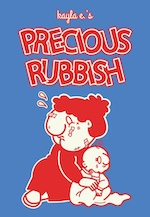
Nearly each of Precious Rubbish’s 200 pages could be read as an SOS to Protective Services. Recounting her upbringing, Kayla’s life was dangerously chaotic. Transitioning between households (her parents divorced when she was 3), Kayla found herself trapped between living with an alcoholic, mentally ill mother, and on the weekends visiting her incestuous brother and indifferent father. Not surprising, then, to see that she also discovered alcohol at a young age, which helped her cope.
Rather than a chronological account of her life, Kayla presents episodes and themes, usually reduced to one or two pages in stylized images that suggest a strong influence of Chris Ware, author of Jimmy Corrigan—some of his pacing, and layouts; the use of a consistent, limited color palette (primarily red, blue, and yellow); and forms simplified to basic geometric shapes (although without Ware’s obsessive mathematical precision). Of particular note is Kayla’s development of the technique Ware used in his stunning “Thrilling Adventure Stories,” in which two disparate storylines, told simultaneously, are shown to be about the same topic, one storyline metaphoric, the other literal. But scattered among the pages of horror and grief are lines from poems by the likes of Rilke, e. e. cummings, and other artists, given a full-page, their emotive effect for conveyed via font design manipulation—expressing the hope that allows a person to endure, survive, and change.
 Anthropomorphic Japan: The Insects
Vintage illustrations compiled by 50 Watts; collages by Samplerman
50 Watts Books
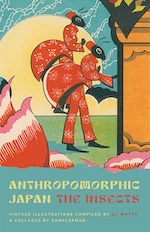
The second installment in 50 Watts’ Anthropomorphic Japan series, The Insects similarly culls images from popular Japanese books and magazines, from 1920-1948, but not presented chronologically—it’s not an academic study. Collated among the vintage images are contemporary re-mixes of them by the collagist Samplerman. The difference between the two sets of images is that Samplerman turns up the weirdness a notch, giving a sense of working within the spirit of the tradition.
 Bugs are everywhere—especially ants (diligent workers of course), beetles (for strength associated with samurais), dragonflies (courage), and grasshoppers (good luck)—as soldiers, workers, musicians, samurai, problem-solvers, socializers and friends, represented in a frenzy of contexts and situations. Images from over three dozen artists are represented here, making it a concise introduction to popular illustration in Japan during the first half of the 20th century.
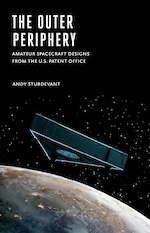 The Outer Periphery: Amateur Spacecraft Designs from the U.S. Patent Office
Andy Sturdevant
50 Watts Books/Birchwood Palace Industries
A gem of a book—well designed and succinctly edited—The Outer Periphery contains of dozens of designs for spacecraft from 1960 to 2024. The patent applications come largely from engineers, some working in the aerospace industry and including plans from a former astronaut who walked on the moon. The patent applications come from the U.S., Russia, Japan, Puerto Rico, the Philippines, and Hong Kong, and all were either granted patents or received approval for patent rights upon receipt of additional paperwork. (In the case of a couple of plans presented here, the final paperwork was never filed. Instead, the applications seemed to be put out there for the public good, in case anybody wishes to further pursue the crafts’ development.)
Often included are thumb-nail bios of the applicants and some of the abstracts from the applications, none of which are more abstruse than that submitted for the Space Based Magnetic Vortex Accelerator and Methods of Use, “having one or more sections of magnetic material configured as a conduit with a flightpath therethrough for the spacecraft, a magnetic coil field generator electrically connected to said one or more sections of magnetic material configured to generate a space based magnetic field via said one or more sections of magnetic material, a power plant electrically connected to said magnetic coil field generator, said power plant generator, one or more magnetic field receivers affixed to the spacecraft, said one or more magnetic field receivers configured to magnetically engage said space based magnetic field.” But that one is an outlier.
Andy Sturdevant, who compiled these illustrations for patent applications, takes delight in their ways of depicting the ideas explained, from noting trends in lettering and numbering on patents, which tend to fall into two categories: those for the design of a spacecraft shape and those for spacecraft function (i.e., how the mechanism will work). The Outer Periphery also has a chapter on design John Quincy St. Clair, responsible for six patent applications collected here, including one for a Full Body Teleportation System.
Clearly a work of work of joy and care, The Outer Periphery is great for artists, designers, illustrators, and, well, engineers fascinated by untried ideas.
 Plastic Soul
James Nulick
The Fellow Travellers Series
Taking place in the near future, when CRISPR gene manipulation has been mastered, Plastic Soul describes a techno-dystopia outfitted in cheering, yet subtle, color and fabric combinations. The source of the action takes place at the Chrysalis Institute, an organization specializing in providing clones of their clients that can be delivered “aged” to the client’s preference: A 16-year-old version of themselves? 22? Clones arrive with the client’s own lifetime of memories and knowledge and can be modified to include additional abilities. On a darker note, clients can also request a life-termination switch for their clones be installed.
The book’s four sections include two by two different clients; one primarily from one of the doctors at the institute, including case studies; and one from a clone’s point of view. Plastic Soul explores the moral rights claimed by each.
Although Plastic Soul deals with clones and Philip K. Dick’s Do Androids Dream of Electric Sheep/Ridley Scott’s Blade Runner deal with robots, all three works provide these avatars of technology with human memories, which in turn imbues them with a soul that demands self-determination and agency. When souls in fetters meet people with a level of knowledge and money that assumes kowtowing on the part of others toward them, trouble begins. The narrative James Nulick’s Plastic Soul transcends the genre trappings of escapist SF, convincingly conveying the real needs of all people, including the need to be understood, accepted, and respected as fully human.
 Diabelli
Hermann Burger/Adrian Nathan West
Wakefield Press
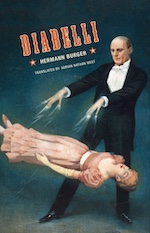
Diabelli is the second work by Hermann Burger to be published by Wakefield Press and translated by Adrian Nathan West (a third work has been published by Archipelago). Burger was an Austrian author who committed suicide in 1989. In the four short stories comprising Diabelli, our narrators are vividly articulate and markedly neurotic. Not neurotic in the jittery, comically self-abasing manner of, say early Woody Allen, but with the assertiveness of narratives by Robert Walser undercut by the narrator’s self-doubts, second guessing, and confidence only in the fragility of his state of being.
Beginning with “The Orchestra Minion: An Application Letter,” in which an applicant for a go-fer position with an orchestra (fetching scores, reeds, and other performance-related tasks) describes his understanding of the job’s responsibilities with a mix of humbleness, boasting, and self-abasement. (Think of stories by Robert Walser, such as Jakob van Gunten, whose narrators also mix insolence with groveling.) The last story, “The Laughter Artist,” is presented by the most psychological damaged of the book’s narrators, who, for the first 20 years of his life, is subjected to incestuous “experiments” upon him by his mother, a physician. (His father, an undertaker, is largely absent and indifferent.)
Diabelli’s narrators seek—unsuccessfully—to rationalize, come to terms with, their inability to triumph over the emotional harm done to them, although they are able to recognize the source of their torment. Like the people whose careers tend toward administrative titles, as detailed in the Peter Principle, there’s a sense, especially in “The Orchestra Minion,” those most suitable for a job are those persons least qualified to perform their requirements, a sense that their worthlessness makes them most worthy, as self-fulfilling prophets who can’t let Mother down.
 Augenblick
R.G. Vasicek vs. Kenji Siratori
Independently Published
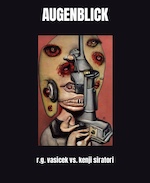
Augenblick—German for “moment” (or, in art-theoretical circles, “the decisive moment”)—is a hefty contribution to an emerging genre of what co-contributor R. G. Vasicek likes to call “lo-fi samizdat / fiction” and “anti-memoir” (See the Q&A below.) For narrative voice, think of Jack Kerouac and William Burroughs with occasional grumpy asides from Céline:
Here I am again, writing, why? Because there is nothing out there. I just got back. And as I suspected: Nope. Nothing. A vast wasteland of loneliness. Despair. A perpetual construction site. A war pit. Everything is in ruins.
The Amerika Vasicek and Siratori project is one of solitude: Augenblick’s narrator wanders around an anonymous urban landscape, connected to no one but the various and almost unanimously anonymous women he fucks (anal, thank you). If the industrial landscape described isn’t in decline, it’s at least having difficulty engaging in first gear. Vasicek and Siratori’s prose, however, has the energy and hallucinatory feel of automatic writing—alternatively spontaneously playful and (semi-seriously) reflective on life, writing, and creativity. There is no plot and no characterization.
Even the frequent sex reported in Augenblick is stripped of its erotic potential: About all we know of the narrator and the women he fucks is the frequency and orifice involved—it’s practically a parody of pornography, which underscores the alienation expressed in the descriptions. Despite the sense of urgency the novel succeeds in conveying, despite the earnestness of its argument that the art and writing can be about anything so long as the presentation is honest and authentic, the narrator’s rhetoric belies his solipsistic stance. (My comments are given in brackets.)
I am something of a detective. I remember everything. A notebook is indispensable. Everything goes into a notebook. The price of a slice of pizza. [Not given] The license plate of a Ford pickup truck. [Not given] The temperature in Fahrenheit at 5:15pm on the 3rd of October. [Not given] The feelings I feel when I can no longer feel. [Not described]
Thus, we have a narrator who tells us the type of information he records while withholding it from us! On the other hand, the list-making of data points suggested in the above quote doesn’t get at the non-quantifiable senses the narrator challenges himself to hunt down:
The writing of exploration can only be in the poetry of souls beyond reptilian, born from dangerous destruction or pornography, the fluidity of experience was there … it’s urination, it’s the beauty of the mind.
Does the narrator contradict himself? Very well, he contradicts himself. Other writers who try out new forms have similar results.
 Q&A w/ R.G. Vasicek
René Georg Vasicek describes himself on his website as “a lo-fi samizdat artist & machine elf in NYC.” He has authored or co-authored at least a dozen anti-novels and anti-memoirs, including [interface], MACHINE, and The Defectors. He explains his method, below.
TB: Could you define for me some key terms related to this work and your approach to writing? What is “lo-fi samizdat”? “Anti-memoir”? What does this mode of writing allow you to do or communicate that traditional narrative forms don’t do as well, if at all? My understanding of “otaku” is as a person with intense interest in a topic—“nerd” might be the U.S. slang equivalent—but I sensed you use “otaku” with a different meaning in mind.
RGV: “Lo-fi samizdat” is a label I started using to describe a particular mode of writing & publishing that rejects the corporate-state apparatus of the Big 4 or 5 (or whatever it is nowadays). And even many of the bigger smaller presses fall into the trap of the trap. As I get older, I get crazier. And I want my writing to echo the madness. As an artist, I want maximum freedom. We are “unofficial writers.” We are creating a Second Culture & a Third Culture. Sometimes I design my own book covers. Sometimes I am DIY. I will do it myself, if I can. I have no interest in gatekeepers. I read the Kafka parable “Before the Law.” I am fast & I am furious. I will not wait. Wait for what?
“Anti-memoir” is a more precise description of what is really going on in the human mind. You say: “I remember.” And I say, hogwash! It is all perception & hallucination & fantasy & everything else. “Anti-memoir” also suggests the narrator is NOT me. Again, incredible freedom. Bataille’s war notebooks speak of a “voyage to the end of the possible of man” … & that is what I want to explore, limit-experience. And I, too, prefer the privacy and intimacy of a notebook … think of Kafka’s diaries & Wittgenstein’s notebooks. Right now, I am reading Ludvik Vaculík’s A Czech Dreambook (1979), a sort of “tell-all” about the Czech & Slovak dissidents in the late 70s…and it strikes me as an “anti-memoir.”
I cannot speak to the usage of “otaku” as it is beyond my ken. Better to ask Kenji. My collaboration with Kenji Siratori came about by accident. In early February of 2K24, I sent Kenji a short text called “Echo Chambers” (1302 words) for a possible project. Kenji e-mailed back if I had more texts like it, maybe we could make a bigger project. I said I had “a machine full of texts.” I sent Kenji 60K words. Kenji added 68K words & Voilà… Augenblick exploded! 126,000 words. 755 pages. I was blown away by how Kenji fused the texts. The only way I can describe it is a bizarre cosmic act of torsion, a spiraling vortex. Even now, when I read Augenblick, I no longer know who wrote what.
TB: How did your collaboration with Kenji Siratori come about? Who wrote which part(s) of Augenblick? It reads seamlessly to me, so that I can’t detect any change in narrative voice. What do collaborations allow you to do that is harder to achieve, if at all, on your own?
RGV: Collaboration is a further means to create (unleash?) a “narrator” that is beyond control. There is also great risk in collaborating with another writer. They might say something you would NEVER say! Kenji Siratori is an unpredictable artist. Think of Antonin Artaud or Andy Kaufman. And now Augenblick is “beyond” me or Kenji or you. And the reader, too, becomes a third collaborator. And the machine becomes a fourth collaborator. And spacetime becomes a fifth collaborator. And the word “collaborator” is a loaded one in Prague & elsewhere… with its associations to “collaborators” with the Nazis during the Second World War & the Czechoslovak secret police of the 1950s & 1960s & 1970s & 1980s & beyond. Yes, risk. Collaboration is a risk. Collaboration is a secret. Collaboration is immoral. And that is terrifying & exciting!
TB: You’re originally from the Czech Republic, right? What brought you to the U.S., and what keeps you here, despite all the anti-immigrant now going on here?
RGV: I was born in Austria shortly after my Czech parents defected following the 1968 Soviet-led invasion of Czechoslovakia. What keeps me in Amerika? Great question. Believe you me: the irony that I might have to defect back to Czechia is not lost on me.
TB: I sense in Augenblick that you’ve read the Beat—Burroughs, Ginsberg, Kerouac. If I’m right, what is it about their styles and narrative voices you find compelling? Who else either influenced how you go about writing or that you appreciated for their approach, style, and insights?
RGV: Yes, Burroughs & Ginsberg & Kerouac (“the Wizard of Ozone Park”!) & many others are writers who inspire at least half of Augenblick. Just yesterday, by chance, I drove past Kerouac’s old house on Cross Bay Boulevard on the way to Rockaway Beach. Speed…those writers had speed… Kerouac’s furious typewriting…& Burroughs cosmic wormholes & collages via the cut-up method. Sometimes I call myself a “machine poet” because I too want to howl…a machine howl in cyberspace. I see a lot of parallels between the Beats & the younger “cybernetic writers” emerging out of the hellhole of the pandemic. Writers like Zak Ferguson from Brighton, UK, who I collaborated with on an earlier book called 404 Error, have this wild, frenetic energy on the page. Zak has nothing to lose…because there is nothing to lose! No money $ in lo-fi samizdat. Do it because you are alive! Zak experiments with fonts & image-text collisions. And now Zak is making experimental horror films about serial killers named Bradlee (2025). Zak ran an influential & now-defunct press in the UK called Sweat Drenched Press. Samizdat comes & goes…& that’s okay.
TB: In addition to yourself, who are some of today’s writers and publishers that you think are doing interesting things?
RGV: Equus Press in Prague is doing exciting underground things. I had the great fortune to read live from Augenblick and 404 Error at the Prague Microfestival in late October of 2K24. The organizers of the PMF include David Vichnar, the publisher of Equus Press, & the Australian ex-pat Louis Armand (in Prague since 1994) who is a fantastic poet & writer & thinker. His novel Breakfast at Midnight , which I recently read deserves far more eyeballs. His latest book A Tomb in H-Section has wonderfully wacky, vivid & luminescent comic-book elements. In Prague, I also met the poets Tyko Say & Sandra Pas?awska of Object:Paradise, a poetics & performance collective which really captures the zeitgeist of the artistic underground in the Žižkov neighborhood of Prague. Read the Object:Paradise manifesto! And Czech out the punk band David’s Sister.
TB: Do you have other works slated for publication soon?
RGV: If summer writing goes well & Rick Harsch likes it, I might have an experimental book called Hooligan coming out with Corona\Samizdat, a funky little press out of Izola, Slovenia.
DIFFICULT LITERATURE: SCHATTENFROH AND ATTILA
For over a century now, the literary avant-garde has often consisted of works so different from following the conventions of traditional storytelling they force readers to figure out how to read them, an effort that will reward readers with a new way of understanding other people’s feelings and points of view, or of conveying or re-creating a sense of the zeitgeist or experiences. For instance, the first 90 pages of William Faulkner’s The Sound and the Fury are told from the point of view of a mentally retarded 33-year-old man with the expressive abilities of a three-year-old. Piecing together what is happening—and, often, when it is happening—is difficult for the reader, who relies on a three-year-old’s vocabulary to piece together the story. Faulkner has done nothing to make the reader’s task any easier. Despite being a novel Oprah Winfrey chose to discuss on her TV show, The Sound and the Fury may have sold well, but I wouldn’t be surprised if no more than 1% of Oprah enormous audience stuck with the novel to figure out what was happening. Most readers, however well motivated, steer clear of such books. A boost of 1% in fan membership of difficult literature would be huge.
In terms of marketing, only 3% of works in translation account for books sold. A book that is both translated and difficult makes up an even smaller percentage. Difficult literature appeals to readers who are deeply interested in the narrative form and the ways in which it can be expanded, torqued, and tweaked (or twerked!) to more precisely convey the range of human experiences and emotions. Some avant-garde techniques have integrated seamlessly into storytelling conventions: Few audiences are confused anymore by flashbacks, either in films or books. Others haven’t: Few audiences have yet developed a tolerance for, say, works by Gertrude Stein, even though her narratives largely consist of common one- and two-syllable words.
The economics of publishing difficult literature are best left to publishers who either don’t know or don’t care about the economics of publishing. And thank God for them. Two current publishers—Deep Vellum and Open Letter (recently made an imprint of Deep Vellum)—have seen fit to publish in translation this year two tremendously ambitious but intimidating works: Michel Lenz’s 1,001-page Schattenfroh and Aliocha Coll’s far shorter but far more difficult Attila. (Schattenfroh was to be published in part with funds from the NEA. The publisher of Deep Vellum, Will Evans, had to launch an emergency fund raiser for the book after Trump ordered their funding cut.) For both books, the writing and translation are of the highest caliber. Neither will be fully understood or appreciated by a single reading. They are written less to entertain than to engage with, time and again. So, in that regards they’re better intellectual and financial investments than a trashy beach read.
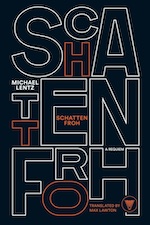 Schattenfroh
Michael Lentz/Max Lawton
Deep Vellum
A story is not a line; it is a richer thing, one that circles and eddies, rises and falls, repeats upon itself.
—This Strange Eventful History, Claire Messud
Michael Lentz’s Schattenfroh is a formally innovative and challenging novel in the manner of 20th-century avant-garde Modernism. As with such Modernists as James Joyce and T.S. Eliot, Lentz demands of his readers a deep familiarity with Western culture and literature, embedding their writing as they do with allusions to and unidentified quotations from (without the quotation marks) established works familiar to those with a classical education. Additionally, their works present new ways of conveying thoughts and experiences—ways that de-familiarize familiar knowledge and feelings to force seeing those qualities in a new light, allowing them to be experienced freshly rather than in manners that, through established acquaintance, have lost or diminished their emotional impact, or that have passed by under cover of anodyne conventional understanding.
What follows is less a critique of a novel than a setting out of its elements and their relation to each other. At 1,001 pages (Lentz’s criterion for the novel’s length, even in translation), Schattenfroh has far too much going on to be digested in a single reading. My hope is that a description of some of its elements will help first-time readers will make the reading less disorienting and arouse less concern about where it’s going and what it’s leading toward.
A helpful comment about Schattenfroh from Lentz, in an email exchange with a translator named Andrei, provides a toe in the door, which has been set ajar by an index to the novel’s references in its center (a kindness neither Joyce nor Eliot was willing to grant their readers):
At first, I wanted to write a novel about psychiatry. Then I wanted to write a novel about the Stasi. Then a novel about totalitarianism. Then a novel about my father. But all of that seemed too conventional or predictable to me. I soon came to understand Schattenfroh as a narratological experiment. I was interested in construction techniques like metalepsis or mise en abyme, as well as forms of paradoxical narration that are often associated with them. I needed a framework that could encompass the aspects of father, psychiatry, totalitarianism, etc., all in one. I also understand Schattenfroh as a historical novel.
(Three definitions for readers unfamiliar with the terms of rhetoric Lentz uses: Metalepsis is “a figure of speech where a word or phrase, often from figurative language, is used in a new context, essentially creating a ‘metonymy of a metonymy.’ [Metonymy is the substitution of the name of an attribute or adjunct for that of the thing meant, for example, ‘suit’ for business executive, or ‘the track’ for horse racing.] It can also involve shifting between narrative levels, blurring the lines between the world of the telling and the world being told.” Mise en abyme is “a literary or artistic technique where a work of art or a narrative contains a self-referential copy of itself, often within a mirror-like structure.”)
Thus, one way to interpret Schattenfroh is as a presentation of the primal psychological relationship between father and son, which arches over all themes of authority, patriarchy, totalitarianism, and the cultural channels through and in which they’re expressed and experienced: home, church, government, and work. Schattenfroh is a historical novel because it sets these themes within the context of 500 years of (mainly) Germanic history. Throughout these 500 years, the narrator, Niemand (Nobody), his father, mother, his father’s assistant, and a few others recycle their conflicts (with modification to keep up with the current technology).
The overall effect is of suffocating cruelty. One of the most brutal of Schattenfroh’s scenes is an extended, multi-page description of a torture-unto-death devised, of course, by the Church. The description both exemplifies the cruelty inherent to authoritarian rule, and the complicity of aesthetics in mediating its cruelty. Lentz just about reached the limit of what I could take with his descriptions, and I say that here as a reader of books by Peter Sotos, in particular, and the writers typically published by Infinity Land Press and Amphetamine Sulphate, in general.
Other recent novels have used a disembodied spirit/soul/consciousness to tell stories of historical significance, especially repetitious events of extreme cruelty enacted in the name of benevolent good: The Czech writer Daniela Hodrova’s City of Torment, which deals in part with Prague’s rule by Nazis then Soviets; and the Polish writer Olga Torkaczuk’s Books of Jacob, which crucially features a disembodied witness to the saga of Jacob Frank and the Jewish converts who followed him. Two generations ago, the history of 20th-century cruelties might be treated with the tucked-in rage of black humor of, say, the Czech writer Josef Skvorecky’s The Engineer of Human Souls, based on his experiences growing up first under Nazi occupation then Soviet occupation: Their ideologies were indistinguishable. Perhaps something in the Central European psyche has changed so that history’s ironies, repeated so often and with such hideous results, have gone well enough beyond “second time as farce” that they’ve returned to outrageous tragedy.
Schattenfroh said the following to me: You are the result of your perceptions and not the other way around, without your perceptions, you wouldn’t even remotely exist. You shall learn to be immersed and see a seeing, of which you could otherwise only dream, here images are automatically transferred into script, your seeing shall not know that it is seeing, the script shall not know that it is writing, the reading shall not know that it is reading.
Who or what is Shattenfroh? The mind’s conscience, consciousness itself? The narrator seems, in part, to be trying to achieve an alternative to Descartes’s mind/body duality. The mind, as a by-product of the brain, receives all it knows through sensory input. Knowledge is embodied sensory input analyzed by thought. Shattenfroh is the book we read, it is the book in the process of being experienced and lived, it is embedded, direct knowledge of cultural experience. (Epigeneticists —those who study of how behaviors and environment can cause changes that affect the way genes work, without altering the DNA sequence itself—may have more to say about this in the future.) Schattenfroh can be imagined saying in unison with Joyce’s Stephan Dedalus, “History is a nightmare from which I am trying to awake.”
Max Lawton provides the novel’s masterful translation into English, sustains the narrative’s engaging (even when repellant) and forward-moving chain of events. A first reading provides only a view of the lay of the land—its characters, themes, and events affecting all levels of society. The narrative can be disorienting, as time, place, and character can slowly or abruptly change, requiring a vigilance on the reader’s part that can be demanding. Although the novel’s format is not divided into chapters and lacks “* * *” type transitions, it does have paragraphs, and it does have conventionally punctuated sentences. In Germanic tradition, the paragraphs can easily run a page or two longer, or longer.
Additional readings will presumably reveal a logic or method behind the order in which historical events and objects are scrutinized. Throughout Schattenfroh are descriptions of various works of art, readers (such as myself) who find ekphrasis of an object harder to appreciate than that object itself, may want to avail themselves of guide to the objects mentioned in the book at the blog The Untranslated. Written by one “Andrei,” who reads eight different languages, Andrei first reviewed Schattenfroh in 2019, when it was only available in English. (Max Lawton, a translator of contemporary Russian and German literature with a penchant for unconventional and impolite works, fell in love with the novel, and a series of dominos fell into place leading to Schattenfroh being translated into English.) Andrei’s “Visual Guide to Schattenfroh” shows all the art works mentioned in Schattenfroh but also, because of that, includes some spoilers.
Had I but world enough and time, I would have immediately begun re-reading Schattenfroh to better appreciate its depths and insights. Schattenfroh is a wonder of technique and cultural meaning every bit as solid and fragile as a sculpture by Da Vinci. Its appearance marks bravura performances by Lentz and Lawton, with special thanks to Will Evans at Deep Vellum, the publishing house who NEA grant to publish Schattenfroh was rescinded by the authoritarian Trump regime. (Private doners ended up picking up the tab.)
ATTILA! ATTILA!
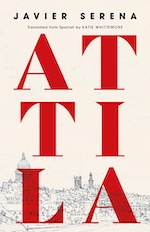 Attila
Javier Serena/Katie Whittemore
Open Letter
We’ve all probably found ourselves, at one point or another in our lives, teetering at the edge of a self-selected rabbit hole, a rabbit hole that our preliminary investigations of suggest could engulf us—heart, mind, and soul—for the rest of our lives, were we willing to submit to the claims of an idea to their end. What are these claims that take hold of creative people in the arts and sciences? What effects do they have on those they possess and those friends and family members of the possessed, the collateral damage of lives lead without compromise? This is what Javier Serena sets out to explore in Attila.
Serena’s Attila is a response to the Attila of Spanish novelist Aliocha Coll, a novel not published until after Coll’s death, a novel whose completion paved the way for Coll’s suicide, they only way out of the rabbit hole he had dug for himself. Serena’s Attila explores the obsessive mindset not from the point of view of the artists possessed but of a friend watching another friend slowly self-destruct. Serena’s Alioscha (the spelling difference is Serena’s) finds the idea of getting a job to support himself outrageous—even his time belongs to his novel, including times given to eating, bathing, socializing. As with the real Aliocha, Serena’s Alioscha has stacks of manuscripts that remain unpublished: no one understands them although they can tell the works have an artistic integrity. It’s one thing to encounter a code written in an unfamiliar language. It’s another when the code is written in the language you speak—the code’s words and phrases make sense on their own, but, collectively, the semantic content seems to disappear when the phrases are added together.
Charles Bukowski once titled a book You Get So Alone at Times That It Just Makes Sense. Alioscha seems to have gone unpublished so long, and has seemed unpublishable for so long, that any attempts to publish something by him are looked at by Alioscha as either an unwitting compromise on his part to contemporary tastes or disposable trash (they’re both the same in Alioscha’s eyes). Alioscha writes for an audience of one—himself—which is what authors are told to do. But Alioscha writed for himself in a way that simultaneously and hermetically seals it. No one else seems to understand what he long ago gave up trying to explain.
Alioscha…long had the custom of devising an elaborate cartography of his books, differentiating the main scenes from the secondary ones and highlighting the most poetic passages, just as he always handwrote the first draft in his old-fashioned penmanship, only typing the final text later, once he’d achieved a clean manuscript. He told me more than once he’d spend a whole morning on a single sentence, changing every verb and every adjective time and again, endlessly trying out new solutions, only to opt for the original version, unable to move on if a single word wasn’t to his satisfaction. He worked so much and with such devotion and felt such a sense of responsibility that he could go weeks without leaving his room, barely getting up from his desk, engaged in battle with some lethal paragraph. Not one day went by when he had a single minute to spare, he claimed.
His obsession with creating something new that simultaneously converses with the classics succeeds only in alienating him from his father and the woman who would be his lovers. (He obsesses over his idealized notions of female beauty and attitude, too, during the few spare hours a day his writing allows him.) He has created a way of life for himself that allows no going back.
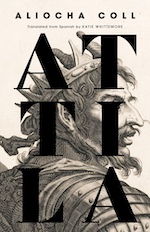 Attila
Aliocha Coll/Katie Whittemore
Open Letter
So, what about the real Attila by Aliocha Coll?
Attila begins in the manner of a tale from ancient Greece, with an apostrophe—not to the Gods to help the teller’s memory—but to Laocoön, who tried to protect his sons from the wrath of the gods who sent sea snakes to kill him and his sons. What the tragedy of Laocoön has to do with what follows is a matter I didn’t catch.
The novel is heavily sprinkled with obscure terminology related to plants, animals, human physiology, architecture, and more. Why Laocoön is invoked is not clear (nothing of Attila is clear), and yet, this extended apostrophe provides the novel’s clearest prose.
Attila joins in ancient Rome two figures from other eras: Attila the Hun, of course, from Hungary, who raided and weakened the Roman Empire but never defeated it, as implied in the novel; and Cervantes’s Quixote (early 17th-century Spain), presented here as Attila’s son (minus armor, donkey, sidekick, or personality resemblant of Cervantes’s creation). Quixote’s love interest is a woman with the unpronounceable name of Ipsibidimidiata, who neither existed nor has a nickname.
I’ve also considered the possibility that Coll’s Attila may, at points, be an exercise in asemic writing: Rather than present a script that correlates to specific semantic content, Coll’s prose sometimes only looks as if it might include semantic content. What we read as metaphors stretch the limits of analogy, literal and figurative, and sentences that make sense alone don’t when combined with other sentences in the same paragraph. Attila may be read as an expression of exuberance on Coll’s part for literary archetypes, stories and histories that weave together into a single ur-culture the mythological, iconic, and legendary. It’s an approach counter to that taken by Lewis Carroll’s Dutchess—to paraphrase, “Take care of the sounds, and the senses will take care of themselves.” Readling Coll aloud may make for euphony but not clarity.
The earth contracts. It doesn’t sublimate. It buries itself. It withdraws from all borders, gaseous, liquid. It withdraws from its objective and withdraws from its ocular, it corners itself and screams at its image. Its unperishing image of a perished past, interposed, rash and flattering, yet resigning from all fractures, between a subjunctive future of imperfection and the present of perfect perishability. Its oscillating and taunting image of its time in its time for its time. Against himself it vibrates with itself. With itself it vibrates against itself. In time. Quickly. In its time. Contiguously. To the other. Time of the indigo trunk.
The level of diction isn’t the problem. A dictionary can handle cases of word meaning. But the content? How does the Earth bury itself? What are gaseous and liquid borders? What is the earthy’s objective? And so forth. It assumes a readership possessed of a certain, unclear knowledge, a common knowledge shared between reader and writer, a common knowledge so fundamental—as fundamental as knowing the sequence of numerals after “1”—as to eliminate the need for even rehearsing a few known facts to ensure everyone is up to speed. Attila replaces high-Modernism (secret decoder ring required) with hyper-Modernism (build your own decoder ring, parts not included).
Here is another example, made up of two sentences. The first sentence almost makes sense. The second sentence—which purports to explain the reason for the first—doesn’t:
What begins with the flesh ends with the flesh, and from a comedy that is performed, life comes away, total, detached from its smallest division, perfect life detaches from its own defect. This is why you cannot visit her most concrete rhythm, for you belong to the length of history, not its width, you belong to history for its folds of creation, not the folds of no return.
It’s like reading a syllogism with its middle term missing. That the reader is required to know. How the reader tracks down that middle term is another matter.
Coll wrote only four novels in his life, Attila being last, after which submitting to his agent, he committed suicide at age 42. Perhaps a way to understand Attila, to find a point of entry into it somehow, would be to have his previous three novels translated into English—give us more of him. Perhaps from seeing how he deals with theme, character, and incident in other examples by him, his method may be discerned. As with Schattenfroh, a first reading is a survey, the second and following readings will require lots of notetaking.
A special acknowledgement of appreciation must be made to Katie Whittemore, who translated both Attila‘s. It’s hard to imagine the stamina required to render in poetic terms what you don’t understand yourself. Whatever the literary translation corollary to peripheral vision is, Whittemore has it. And thanks, too, to Chad Post at Open Letter for making the gutsy decision to publish these books in the name of literature rather than commerce.