
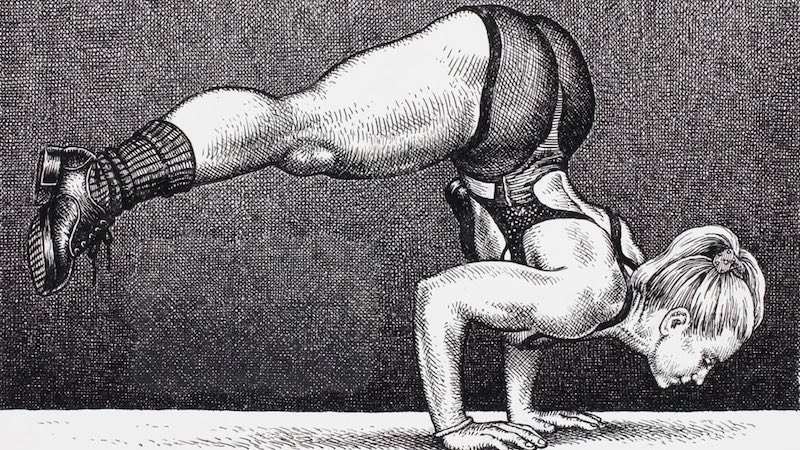
R. Crumb illustration from Art & Beauty
i arrogantly recommend…#72 is a mostly monthly review column of unusual, overlooked, ephemeral, small press, comics, and books in translation by our friend, bibliophile, and retired ceiling tile inspector Tom Bowden, who tells us, “This platform allows me to exponentially decrease the number of views on screens by people who have no use for such things.”
Links are provided to our Bookshop.org affiliate page, our Backroom gallery page, or the book’s publisher. Support the Small Press! Buy Small, Buy local!
Read more arrogantly recommended reviews at: i arrogantly recommend…
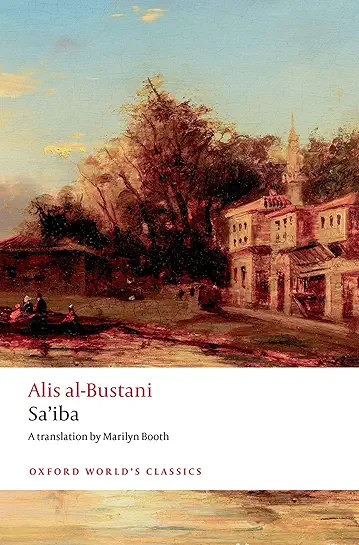 Sa’iba
Alis al-Bustani / Marilyn Booth
Oxford World’s Classics
Sa’iba is the first known, published example of extended fictional narration by an Arab woman, first published in 1891, when Alis al-Bustani was 21. The youngest of eleven children, al-Bustani was raised in Beirut by accomplished parents who were influential educationists in the region. The text of Sa’iba is short (64 pages) but is accompanied by an introduction by the scholar and translator Marilyn Booth, two appendices, and extensive footnotes, all of which provide cultural and familial history, context, influences, and significance as it relates to al-Bustami and her fictional world.
Although the issues raised by the novel—such as women’s rights, including self-determination—were debated throughout the Middle East during the time of its composition, al-Bustani sets the novel in Istanbul, providing a geographical (and thus psychological) cushion between it and where her audience lives, making it safe to discuss, since it then becomes a novel about what is occurring “over there.”
The protagonist, Sa’iba is a young woman from an upper middle-class family. The family has progressive values for the time, and Sa’iba has been well-educated. Having progressive values does not mean her parents have turned their backs on tradition. Consistent with the combination of time, place, and cultural values of the novel’s setting, Sa’iba has been betrothed since childhood to her first cousin, Farid.
As the novel begins, we learn that Sa’iba has declined marrying her first-cousin for someone else. Instead, she has committed herself to a man named Lutfi. While both Farid and Lutfi also come from well-to-do, upper-middle-class homes that provided them with access to a good education, Farid, unemployed and only 17, has already spent most of his inheritance on gambling and other habits of dissolute living (except for drinking, in a rare concern for Islamic law); whereas Lutfi, who is in the military, uses his money to buy a house, furnish it, and hire servants. Sa’iba herself, as a child of progressive parents of a certain income, also enjoys a good education, studies seriously, and has a disciplined mindset that makes Lutfi’s marriage proposal more attractive than Farid’s presumed claims upon her, even if he is sincerely in love with her, too. Delusionally so.
Sa’iba and Lufti wed. Enraged, Farid enlists the help of two allies: Sa’iba’s maid and Boulos, a con artist. Marjana, a former slave who continues living with the family she has been a part of her entire life (as apparently did many people of the Ottoman Empire who were legally free once slavery was abolished). Marjana promises Farid to help him compromise Sa’iba so that Lufti will divorce her. Boulos—much more cleaver than Farid—helps Farid devise and fulfill his schemes to place Sa’iba in a situation in which she will be divorced and socially ostracized unless she marries him.
Even though Lutfi has the eye of an innocent toward his love, he also has a naif’s sense of honor and dignity; namely, he takes statements from others he trusts at face value. Thus, he is inclined to believe rumors rather than his own experiences after he begins receiving anonymous messages implying that Sa’iba in being unfaithful to him—for in this culture, women are presumed guilty by their mere existence. Even devoted lovers find their interpretations of their own experiences twisted by this cultural assumption. Can it be overcome so that Sa’iba’s reputation remains untarnished, and with it Lutfi’s own standing within the community when confronted by accusations of infidelity against his wife?
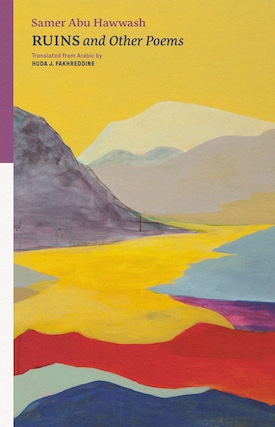 Ruins and Other Poems
Samer Abu Hawwash / Huda J. Fakhreddine
World Poetry Books
Palestinian poet Samer Abu Hawwash writes about losses suffered and endured since Israel’s Nakba against them. Taken away from the Palestinians—land, homes, folkways, community but not yet hope, despite the desolate spread ahead of those left behind.
There, on a land, we were told was not our land,
under a sky, we were told, was not our sky,
my people life their death.
My people write the names of their children
on arms and legs, so they can find them
later among the massacred. —”My People”
Families bear almost unimaginable grief. In “The Final City,” a grandfather mourns his granddaughter, presumably killed by a bomb:
In the ruins of this final city,
in this night of nights,
by your small bed
torn apart by a monster. . .
With these scarce hands I cradle you.
I embrace you and lift you up
as far as my heart can reach.
How light you are now, my little one, and how heavy this air.
How heavy this body
that once belonged to you.
The main poetic sequence is the titular Ruins, a three-part memorial devoted to a beloved homeland turned into a hellscape that nonetheless resists the disaster befallen his people, irrevocably tied to a particular land:
These stones won’t speak
and they won’t go away,
but the light will persist, falling
on the absent, the broken, and the devoured,
as if an immortal wolf
gnaws and gnaws
at what’s left
of this wall,
returning it
to the primordial howl.
Clear-eyed, restrained, and dignified, Abu Hawwash’s witness to atrocity is beautifully rendered by Huda J. Fakhreddine’s translation.
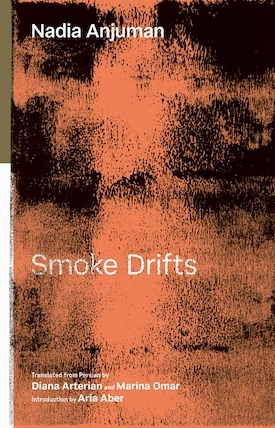 Smoke Drifts
Nadia Anjuman / Diana Arterian + Marina Omar
World Poetry Books
Nadia Anjuman was born and raised in Afghanistan during the Taliban years, studied literature in secret (under the ruse of attending a sewing circle, one of the few activities for women the Taliban allows), briefly attended university while the Taliban’s power was low, and was murdered by her husband. The Taliban insisted that Anjuman’s father forgive his daughter’s murderer so that he could be released from prison and raise his child, who was less than a year old when its mother was killed.
She was a prodigy who began writing poetry in her teens, her first collection published when she was only 20. Her second book was released shortly before her murder. Smoke Drifts brings together the poems from those two books, Flower of Smoke and A Basket of Doubt. “Prison” describes a common reaction by women to the oppressive Taliban regime: Escape.
Anyone who has feathers and the strength
flees in an instant—she spreaders her wings
and shoots from this nameless place like a bullet. . .
If you have no wings
go on foot
If you have no legs, leap into the dark
You must plunge into the sea
You must ask the wind
On any path that can lead away from this prison
you have to escape
you have to escape
If the horror of living under the Taliban hasn’t lasted centuries, just knowing what has come before and what will come after, just enduring a lifetime is enough. “Bitter Stories” describes that condition:
Bitter stories,
you have made homes of our hearts for a lifetime
These sorrowful eyes, these sallow cheeks
are the grim marks of your presence
Branches of sorrow,
a hundred springs come and a hundred autumns go
buds wither with scorched hearts
a hundred blockages clear and a hundred caravans pass
Pharoah dies and Nimrod’s tale ends
yet you are still green and fresh
as if just sprouted from the dirt
Translators Diana Arterian and Marina Omar do admirably well at crafting living poetry that breathe into the mind’s ear a presence that became tragic when any sense of hope she once held was taken once her soul departed her body.
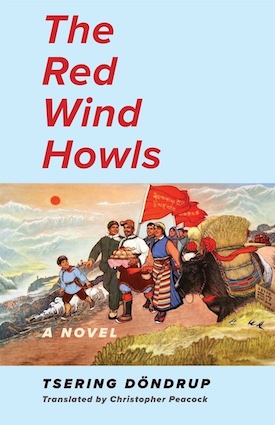 The Red Wind Howls
Tsering Döndrup / Christopher Peacock
Columbia University Press
In 1958, the Chinese Communist Party slaughtered over 120,000 Tibetans in a region called Amdo where an uprising occurred against the Party’s attempt to uproot and eliminate the people’s traditional ways of life and religion as nomads and Buddhists. Another 50,000 citizens of Amdo were sent to labor camps, where the majority died serving their 10-year sentences. Mao’s directed mass-murder in Amdo remains, today, illegal to discuss in mainland China. The fact that so few people from Amdo survived has helped ensure that Tibetans and Chinese alike have forgotten the uprising, assuming they have heard of it at all.
Tsering Döndrup, born in 1961, grew up in Amdo, where the slaughter was fresh in the minds of its citizens, since every family there was affected by it, and they still suffered at the hands of violent government-supported intercessions into daily affairs by vigilante groups set up to enforce Mao’s policies and invent enemies to persecute locally. The events comprising the uprising and its suppression were recorded by Döndrup in interviews he held with survivors as background notes for The Red Wind Howls.
The novel’s protagonist, Alak Drong (which means something like “Minister Yak”), begins the tale with his release from labor camp and his memories of the events leading to his imprisonment, and the Maoist revolutionaries who forced him to denounce his faith as a practicing Buddhist monk. No one is safe from being targeted by self-appointed guardians of the revolutionary light, and everybody eventually succumbs to betraying others—even kin and spouses—if it means another day of life for themselves. On the one hand, everyone is a hypocrite. On the other hand, suicides claim as many as 10 souls a day, apart from those who die of malnutrition, overwork, exhaustion, and beatings.
Outside of the labor camps, mass starvation is rife throughout the region.
For the first few years of Alak Drong’s imprisonment, much of the labor is devoted to deforesting the region. The government assumed that the forests could be transformed into farmland for barley. But barley and other crops do not bear fruit (or grow particularly well) a mile or more above sea level. (The camp where Alak Drong works, in the Tibetan Plateau, is 11,000 feet above sea level.)
During Drong’s sentence—as citizens are arrested, sent to camp, returned home, re-arrested and “struggled against” (i.e., beaten and tortured by their neighbors), and sent to camp again—mutual trust among neighbors is replaced by calculation. While a person might enjoy the opportunity to avenge himself against someone who wronged him in the past, the opportunity for revenge is often only temporary, and fortunes turn again.
Out of the labor camp, back home, Drong’s community under the thumb of the CCP with its rigid, unrealistic agricultural production goals and sense of ideological purity, his situation isn’t much improved, although nutritional levels are marginally better and the work less battering. Mao is dead but the CCP is still in power. And it doesn’t apologize to anyone.
Although Döndrup was already an established, well-regarded author when the novel was published in 2006, he could find no publisher willing to risk publishing. So he published it himself. Using the fact that the self-published version lacked an ISBN, the CCP first banned the book, then upped the ante by revoking his passport (he can no longer leave the country), reducing his salary (forcing him into early retirement), and prohibiting him from accepting further literary awards. He has published additional works since The Read Wind Howls, but the punishments remain in place.
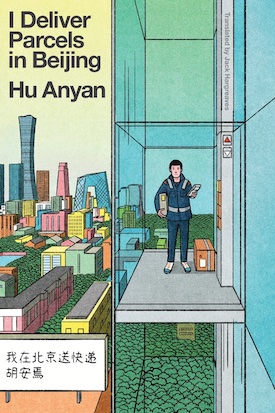 I Deliver Parcels in Beijing
Hu Anyan / Jack Hargreaves
Astra House
Hu Anyan’s account of his life as a gig worker in China shows that, yes, there’s employment enough for anybody who wants work, but for unskilled workers that employment is precarious and remunerative enough for subsistence-level living. Apart from the ability to live with one’s parents when times are difficult and personal expenses could stand a further round of cuts, China offers no safety net, no unemployment checks.
When I Deliver Parcels in Beijing begins, Hu is working 26 days a month, 11 hours a day, to make 270 yuan a day, or just under $40. Breaking his costs down—set fees and penalties—Hu calculates that taking time to eat lunch or urinate serve only as drags on his income, so he forgoes them. Wages earned by package-delivery workers in Beijing, per package: 32¢ (contract workers without benefits) and 26¢ (company employees with benefits)—if the packages are undamaged when they arrive and if the people who ordered them don’t ask to return them. Damaged packages must be paid for by the courier. The decision to return a product may occur only after the person has opened and unpacked the parcel (while the courier stands and waits). Once rejected, the courier must repackage it the same way it came out—all time out of the courier’s schedule, eating into the ability to make the next 26¢ or 32¢ of the day’s wages. Sometimes customers expect couriers wait a half hour or more in the lobby before leaving their apartment to retrieve their package. And of course the courier doesn’t make any money while sitting around.
Although Hu doesn’t have a college education, he makes use of his literacy. During the first downtime he’s enjoyed for years, after one company he works for goes belly up, he reads translations of Robert Musil’s The Man without Qualities and Joyce’s Ulysses, which certainly demonstrates one aspect of his tenacity and self-discipline. Later, he falls in love with such 20th-century American realists as Hemingway and Carver.
After moving to Shanghai from Beijing, Hu works in a high-end bike shop owned by a woman who know nothing about bikes but has two bike technicians who do. Compared to his work as a courier, the bike shop is easier and the pay is better and consistent—even if he is still working 12-hour days, six days a week. Unfortunately, the shop owner is flighty, indecisive, argumentative, and alienating, so her employees don’t stay long and sometimes steal bikes to act out their anger. After a year of what is ultimately an untenable situation, he leaves.
After turns as a gas station attendant, stock boy, and so forth, he and friend open a clothing business, doing well enough to open two locations. But after two years of confinement to a windowless shopping mall, working every day of the week, Hu decides he’s had enough. But during the slow hours of those two years, Hu continues reading and takes up writing—evening submitting short stories to publications, some of them even published and paid for. During the pandemic he gets serious about writing, and the rest is history. His story is now available in at least 16 other countries. One hopes he now has enough money to engage full-time with his avocation.
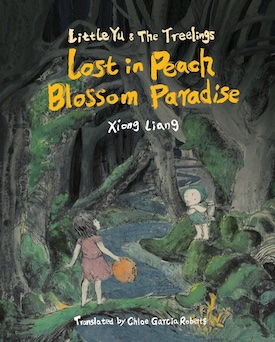 Little Yu & the Treelings: Lost in Peach Blossom Paradise
Xiong Liang / Chloe Garcia Roberts
Elsewhere Editions
Peach Blossom Paradise has been a part of Chinese legend for centuries. In the original tale, a lone wanderer explores a cave whose entrance he discovered at the base of a mountain in the midst of a forest. As it turns out, the cave extends through the mountain, to the other side, where it opens upon an Eden-like area whose people have no sense of war, hatred, division, or lack of necessities. This is Peach Blossom Paradise, a place where peach trees are always in bloom, signifying spring, re-birth, newness and the purity that comes with.
After some time living among the people of this paradise, the traveler decides he must return home. The inhabitants of Peach Blossom Paradise warmly see him off but beg him to not tell anybody about the place, which would be ruined if trampled by an endless stream of visitors. Although the traveler promises not to tell, of course he breaks his promise and tells everyone he can upon his arrival home about his discovery.
The good news is that nobody has discovered the cave at the base of the mountain the traveler walked through, even though they have tried again and again over the centuries.
Little Yu is a young girl who sets off to discover Peach Blossom Paradise. Her first hint that it may be near occurs when Little Yu notices peach blossoms floating in a river that runs through the forest she is exploring. As it turns out, her explorations are series of tests the Treelings have devised to keep away strangers. The Treelings—short people, smaller than Yu—are the descendants of the original inhabitants of Peach Blossom Paradise. Yu finds herself tested for qualities of bravery, resourcefulness, wits, and courage.
The final test she must pass is to blend in so well with her surroundings that she (with the assistance of a Treeling) can sneak past the Hidden Master and enter Peach Blossom Paradise. Although the book doesn’t say so explicitly, native Chinese speakers will recognize that the qualities in a person that allow them to enter Peach Blossom Paradise are those that a Buddhist must practice to reach nirvana and thus become a Buddha. A Westerner might be content to describe Little Yu’s actions as becoming one with nature.
Author and artist Xiong Liang has won multiple awards for his works, has seen movies made of some of his books, and had his books displayed in Japan and Britain as examples of international children’s stories. Poet Chloe Garcia Roberts has a knack both for producing excellent translations and finding excellent storytellers to translate, as with her translation of Feather by Cao Wenxuan and Roger Mello, which won an Outstanding International Book award in 2019, which I reviewed several years ago.
 The Narrow Road of Oku
Basho / Meredith McKinney
New Directions
The Narrow Road of Oku is Basho’s travelog from 1689 combining terse narrative description with haiku and haikai regarding the portion of Japan’s coastline he followed, accompanied by his disciple, Sora, who also contributes some poems. Over the course of five months, the pair traveled along the almost-inaccessible northernmost portion of Japan, enjoying and carefully noting the flora and fauna, visiting current and ruined temples and castles, climbing mountains, fording rivers, discovering ancient writing on monuments, not infrequently brought to tears as they are spiritually overwhelmed by their sense of place within historical and cosmological continuity.
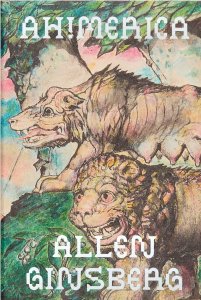 Ah!merica
Allen Ginsberg
Isolarii
Taken from lectures at the Naropa Institute given by Allen Ginsberg between 1974-1997, Ah!merica delineates a line of poetic influence from William Blake to William Carlos Williams—with frequent reference to Walt Whitman. From sources of poetic inspiration to expressions of that inspiration, Ginsberg looks for the least self-consciously wrought works, works that capture a sense of spontaneity and naturalness, qualities Ginsberg associates with honesty and authenticity. Discipline teaches us which of the lines written transmit what was seen versus what we think we should see: the poetic consists of the emotional truth.
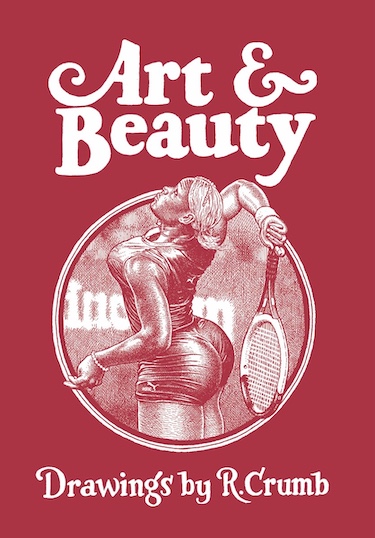 Art & Beauty
R. Crumb
Fantagraphics
Gathering all three issues of Art & Beauty, this magazine was R. Crumb’s ode to traditional realism in illustrated renderings of the human form, accompanied by quotations by artists and art historians, presented in Crumb’s fine lettering. His source material includes live models, in situ sketching, photographs he’s taken, been given, or clipped from magazines, most featuring the same sturdy, big-boned gals he’s favored his entire career. That pantheon now includes the tennis player Serena Williams, whose image is the book’s cover, and weight lifters. No comic exaggeration, only pure adoration for the robust female figure. No stories, just beautiful women from their teens to their 60s. Some nudity, no sex.
Although Crumb’s technique is impeccable and his homage to female bodies sincere, Crumb being Crumb can’t but help include side winks toward the audience, conjuring the anodyne prose of figure-drawing books that mimic highfalutin aesthetic discussion in the name of Art to distract from their images’ clearly erotic potential, as if settling theoretical disputes is the prime force of creativity. Thus, we have Crumb ventriloquizing in a caption to an image, “Despite the relentless drive toward elimination of the object in modern art movements, the female form continues to demand attention”—a demand rewarded by Crumb’s depiction of a woman’s buttocks mounting a bicycle seat. Mr. Snoid would appreciate the juxtaposition.