
 i arrogantly recommend…#72 is a mostly monthly review column of unusual, overlooked, ephemeral, small press, comics, and books in translation by our friend, bibliophile, and retired ceiling tile inspector Tom Bowden, who tells us, “This platform allows me to exponentially decrease the number of views on screens by people who have no use for such things.”
Links are provided to our Bookshop.org affiliate page, our Backroom gallery page, or the book’s publisher.
Read more arrogantly recommended reviews at: i arrogantly recommend…
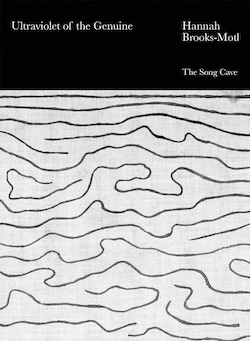 Ultraviolet of the Genuine
Hannah Brooks-Motl
The Song Cave
Hannah Brooks-Motl’s spare and accessible poetry presents verse as an extension of nature and spirit, eschewing monied materialism and the scientific method for taking delight in what has already been given to us. Many of Brooks-Motl’s lyric poems (there is one prose poem) consist of lines one to three beats long in straight columns, word groupings that emphasize an image or idea. But she also likes to cast long lines across the page showing how free verse can look as an additive to the poem’s semantic content. (But even these long lines often include caesurae of one to three beats.) Either way, she tilts toward the concrete. Here is the volume’s last poem, the fifth entitled “Poverty Mountain”:
Sleep in a field
Take off your clothes
Psychically
That’s probably
What heaven means.
Direct contact with nature—sensual pleasure translated by the mind into psychic contentment. Although she asserts that “ecstatic personal austerities … make up Art’s heart” (“Poet Dilemma”), the emotional registers I read in these poems is more meditative silence than Whirling Dervish. (The possible exception may be “Ants,” a five-part poem on a species of ant able to protect its colony by exploding itself when attacked by would-be invaders.)
Hannah Brooks-Motl’s poetry treats lyric form as a site of quiet communion, favoring in her language concreteness and attentiveness to nature over abstraction or reification (and thereby falsely simplifying the experiences). Across alternatingly spare and expansive lines, her poems translate sensual contact with the world into meditative unity with the contemplated.
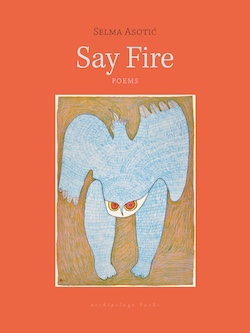 Say Fire
Selma Asoti
Archipelago Books
Selma Asoti, originally from Sarajevo, poetizes, in Say Fire, of the siege of that city that occurred during the early 1990s and after the conflict, measuring the harms inflicted and their lingering impact on survivors. She comments on her father and an uncle, men who don’t talk about what they did to protect themselves and their families to survive, which are juxtaposed with poems about being a lesbian in the US, looking for dates with the weight of survival, menace, and coping as her baggage.
In her prose poem, “Uncle,” she writes,
I imagine three hooks in the hallway. On the first a winter hat, on the second a coat, and on the third, a pineapple grenade hanging by the trigger. I imagine his broad shoulders and the grey hair at the back of his head as he approaches and takes first the coat, then the grenade, then the hat. As he turns to face the door on the left I see his profile, the stutter of capillaries under his ear.
That’s not how it happened.
That line—“That’s not how it happened”—ends several poems here, undermining the sureness with which matters are related—did these events, then, not happen, happen other than as reported, happened but are denied by survivors? One poem, however, of a nature similar to others does not have that line. Is this what really happened, then? But the outcome of that poem are similar to the poems whose events are denied having occurred. At any rate, while citizen-soldiers returned their guns after the conflict of Sarajevo, they didn’t always return the grenades they were given: the consequences haven’t yet played themselves out.
The consequences of living under siege never ends, even after the siege has. As Asoti? writes in “Lessons from war,”
it never ends. some other names
are now bleeding on CNN’s chyron, instead of your burning house
the screen shows a man giving his child
to a soldier. his hands are the hands of your father,
or the father of your father, same difference.
you are somewhere, among the blessed, on some square
you sip an espresso, the woman next to you says
how awful, your contempt blooms precious and pure.
Pity is impotent to change the past, present, or future. What Faulkner noted of his fellow Southerners’ dispositions holds true for Asoti?’s Sarajevo: “The past is never dead. It’s not even past.”
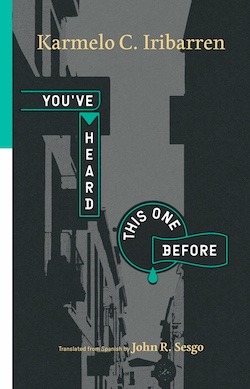 You’ve Heard This One Before
Karmelo C. Iribarren / John R. Sesgo
World Poetry Books
Compiled from his 15 poetry collections in Spanish, You’ve Heard This One Before marks Karmelo C. Iribarren’s first collection in English and John R. Sesgo’s first book of translations to be publish, established and rising talents joined to make a remarkable book. I read the poetry before Sesgo’s introduction (which is helpful in delineating the aspects of Iribarren’s poetry lost in translation), and thus was not surprised to find listed among Iribarren’s English-language influences Bukowski, Bukowski’s hero John Fante, and Raymond Carver (erring more toward Carver in his sense of form and punctuation).
Iribarren’s lines are spare, language vernacular, and topics mundane: observational, epigamic, and ironic, as in his “98 Degrees in the Sun”:
Today
I’d rather be
in a frosty city
up north
—or more precisely,
in a typical bar
on the square
of such a city—
watching everybody run past
shivering under umbrellas,
with you, making plans
to spend the summer
somewhere warm.
Bohumil Hrabal, the Czech writer, wasn’t a poet, but his concerns were often similar to those expressed by Iribarren: Enjoying lazy days alone and with friends, an admiration for cats, the confusions of love, emotional weather reports, and so on.
Here’s one for commuters, “Rush Hour, Highway”:
I’ve been looking
at the highway
for a few minutes now.
There’s a traffic jam, as always
at this hour.
I picture
the weary faces,
frazzled
nerves,
worn-out patience
ready to burst.
I wonder
how many are heading home
quite simply
because there’s nowhere else
to go.
Strongly recommended.
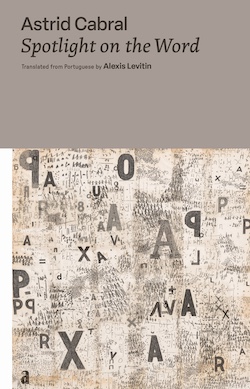 Spotlight on the Word
Astrid Cabral / Alexis Levitin
World Poetry Books via Asterism
Brazilian poet Astrid Cabral’s poems about poetry, which make up the contents of Spotlight on the Word, are simultaneously poems about being in the world, how to listen, watch, and feel. They describe the limits of language—not every experience has its verbal correlative—and their gestures toward transcendence and self-knowledge. “Poetry Asks for My Hand” illustrates this condition:
Poetry asks for my hand,
whispering close to my ear:
pick up pen and paper. Take off
your clothes, they get in the way.
Throw out that daily mask.
Let’s go to the realm of the rare
by the impassable ways
of the buried labyrinth
where your bonfires burn
and shadows in sorry huddle together.
Freed, come now to forge a path into
the jungle, to plumb the river’s depth,
to penetrate caverns and stars.
Afterwards, contemplate the page:
there, in words, they will be,
your heaven and your hell.
In conjunction with the role of the word in shaping meaning, Cabral also acknowledges (like John Cage) meanings found in and expressed by silence in the book’s second half, a condition often overlooked by language-hungry poets. Here is “Silent Language”:
The word of the deaf-mute
nestled in the gaze
flows discreet, unspoken,
never behind a back or shoulder blade.
And so it casts its filaments,
weaves and interweaves warp, woof, weft,
and gets to join in the general game.
The word of the deaf-mute
ignores the gift of sound
and relies on the subtle dance.
Ethereal design of fingers
the casting of arms in arcs
a face of expressive features
reveal all that is hidden.
Not every word is born
in the hollow of the throat,
the space between the lips.
Many spring to sight
from the signals of an entire body.
Alexis Levitin brings to his translations of Cabral’s poetry a naturalness of expression and observation that makes me eager to see Cabral’s earlier works, which she’s best known for, that focus on Brazil’s natural habitats and environmental degradation.
 The Folded Clock
Gerhard Rühm / Alexander Booth
Twisted Spoon Press
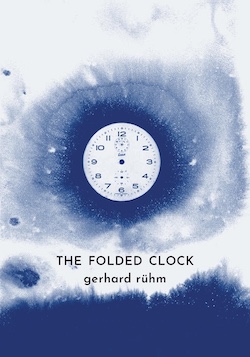
The avant-garde poetry of Gerhard Rühm (b. 1930, Vienna) combines elements of concrete poetry, performance art, and audio collage—with, in The Folded Clock, a focus on numbers. As Rühm states in the postscript,
the number, at least as far as structure goes, is the common denominator of all the sundry forms of art. . . everything visible and audible … can be traced back to purely numerical relationship and can therefore also be translated from one dimension to another.
Thus, The Folded Clock includes poems comprised of random numbers from 1 to 100 and poems scored for recitation of word and number combinations—pieces that seem to be oriented toward sound quality rather than semantic content. Conceptual art plays a roll here, too: “time poem,” if recited to Rühm’s specifications, takes a year to declaim, with the last 30 seconds of the year being the longest stretch of recitation at any previous point in the poem.
There are also silly prose poems like “climate change: a joke that gets out of hand”:
someone who dies of the heat meets someone whose died of the cold. the former’s got a question but doesn’t have any air. the latter might respond were it not for his mouth frozen shut.
two others who died of the heat meet two others who died of the cold. both of the former have questions, but don’t have any air. both of the latter might respond were it not for their mouths frozen shut.
And so forth up to a million.
My favorite, though, is “mortal intercourse,” which concerns the interconnected lives of four people who are identified only as the first, sixth, tenth, and eleventh. Here are two stanzas; nice bit of soft-shoe with the punctuation:
the first appraises the sixth,
who goes without the tenth,
who recognizes the eleventh.
the eleventh takes care of the first.
the first discusses the sixth,
who desires the tenth.
the tenth opts for the eleventh,
who nourishes the first.
Includes collages and drawings. I’m sure this will become a classic of avant-garde poetry. Hats off to Alexander Booth for this fine translation.
 The Death of a Greek Lover
David Plante
NYRB Poets
Although the book’s title, The Death of a Greek Lover, suggests both anonymity and body count, its emotional depth and range focus on a specific man with whom the novelist and poems David Plante shared his life for 40 years. The title reflects the poems’ emotional restraint and Plante’s intention to give classical form in memorial to a significant personage, his lover the poet Nikos Stangos.
Plante sets his love and life in Greece within the historical and mythological continuity of the landscape and the figures that shaped and haunt it. The overall effect is cumulative; no one poem stands as a signpost tied to another signpost with lesser poems between them. Each poem embodies an aspect of the whole, a belief in underlying, eternal love. Here is one of the book’s untitled poems:
Do it, believe in the Gods, that they
Calm the wild wind ravaging the fields,
That they make dark rain
Cease for sunlit ploughing
And turn the heat of summer
Into air currents that flow about the trees,
And for belief in them a beaker of water
Drawn from their river Hades
Will bring a dead man back to life.
 Stories, Tales, & Fables
Marquis de Sade / R. J. Dent
Contra Mundum Press
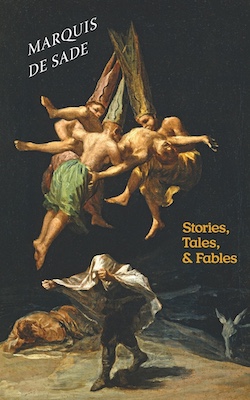
R. J. Dent’s translation of Stories, Tales, & Fables is an excellent introduction to the Marquis de Sade—not just his fictional persona, but the person himself as revealed in his essays and assessments of his works by other writers (without the distraction of weighty scholarly apparatus and throat-clearing). The eponymous stories, tales, and fables that comprise the bulk of the book are consistent in their narratives with the obsessions of Sade’s lengthy novels, and, although written while Sade was imprisoned, feature amiable narrators of good wit and taste, as well as a flair for irony. He was the O. Henry of his day.
Sade was an admitted libertine: He felt that consenting adults ought to be able to do with themselves as they saw fit. Troubles arose, hypocrisies grew, marriages failed, and crimes were committed when natural urges were suppressed, including those of minority or esoteric pleasures. Yes, Sadism as we understand it today occurs among the stories, tales, and fables, but it is inflicted on the antagonists, the hypocrites who inflict upon the world, expect of others, standards other than they themselves live. The punishments don’t incur sexual pleasure—they are doled out because someone else was denied sexual pleasure. (Sade himself was forced into an arranged marriage with a woman he was no attracted to but whose sister he was—an affection that was shared, and punished.)
The rights of libertinage extended, for Sade, to hetero- and homosexual women and homosexual men, and the relationships they chose for themselves. Consensual, mutually desired sex is presented as the hottest sex there is.
Of the essays by Sade presented here, “Some Thoughts on the Novel” shows Sade at his discriminating best, a man who took advantage of the superb education his background afforded him rather than piss it away as an expectation of a privileged life. He is indeed a man of wealth and taste, well-grounded in not only Greek and Roman classics (including not a few now relatively forgotten), but also up to date on authors throughout Europe during his own time as well. He evaluates rhetoric, plot, convention, and character. An astute reader, he has discerned from literary history what a compelling narrative requires and has attempted, at least, to apply it to his own fiction.
This anthology ends with essays on Sade (with varying degrees of appreciation) by such writers as Apollinaire, Èluard, and Anatole France, providing biographical and bibliographical background on Sade, if only touching lightly upon the complex issue of Sade’s various imprisonments over 32 years.
 A Plan to Save the World
Hassan Akram / Ibrahin Fawzy
Sandorf Passage
Hassan is a boy growing up in Iraq during times of war—at one time with neighboring Iran, another with the U.S. His father is a drunken wife-beater, his mother a tireless but compassionate workhorse who adores her husband. Hassan witnesses or knows of friends and family members killed by the fighting, of people driven mad by endless strife or to pitiful lives because of hidden homosexual desires. He tries to comfort those he can with his child’s kindness while he develops plans to save the world (his world at least) from its misery.
Whether Hassan realizes it or not, he mimics state security behavior when he secretly records family conversations after his father gives him a tape recorder for passing the fourth grade. Like any other kid his age, he’s simply interested in finding out what adults say in when children are in bed. A new tape among appears among his recordings one day, labeled like his other tapes but with different handwriting. The recording turns is from his recently killed Uncle Safi who wishes to keep in contact with the boy from the afterlife. (Hassan is the only family member who won’t become hysterical knowing Safi’s spirit wishes to keep in touch.)
His country perpetually at war, his family with dwindling resources to feed itself, and his inability to save the world, confirm Hassan’s decision to run away from home, taking the family chicken with him to protect its life. He hopes that by confronting life alone in Basra, he will gain the experiences he needs to save the world.
In its 100 pages, the author Hassan Akram paints a vivid portrait of daily life among a community of people just trying to get by while beset by mortal forces beyond their control. Uncle Safi even tires of the afterlife.
 On the Calculation of Volume, Book IV
Solvey Balle / Sophia Hersi Smith & Jennifer Russell
New Directions
New Directions continues bringing out its seven-volume translation of Solvej Balle’s On the Calculation of Volume by Sophia Hersi Smith and Jennifer Russell, a work that took Balle over 30 years to write, presumably because she had to figure a way out of the trap she set for the volumes’ protagonist, Tara Selter, a bookseller caught in a seemingly eternal repetition of a particular November 18. By the end of Book II, Tara discovers she is not alone, that there is another person also stuck in the same day. And the two of them discover there are even more than just the two of them.
By the mid-point of Book IV, the known character count for the Calculation series is in the several dozens, with reports of clutches of additional people, as witnessed by some of the new characters, who made their way to the mansion holding the cast of characters from Book III, having seen posters around various European cities aimed at people stuck in November 18.
Despite several dozen characters and incipient conditions for a new society (which haven’t yet morphed into another Lord of the Flies), the group makes no advances in determining a way out of their situation—or give much thought to the matter. Implicit in their actions—which focus on discussions related to how they should manage themselves as a group—is the sense that they have given up on trying to escape their condition. Perhaps this is how the Woman in the Dunes from Kobo Abe’s novel came to accept and prefer the situation she once tried to escape: any hell can be adapted to, so long as the rules are clear.
Still, as the ever-enlarging group stumbles toward creating a new society, one may wonder what prevents disagreements from evolving into discord, schisms, and violence? Apparently, it’s because they have all the material comfort they could ask for:
Who was pressuring us? No one. Where were we going? Nowhere. What was expected of us? Nothing. We weren’t living in a world of collisions and obstacle courses; we weren’t opponents or stepping stones or helpers or pawns in each other’s games. There was no need to assert ourselves, perform, posture, pic up the pace, cross any finish line. We lacked for nothing, there was no need to fight for jobs or prestige or higher pay. We didn’t need to flaunt our status or wealth with cars and mansions and gadgets or designer clothes, because anyone could have the same.
Their shared November 18th is a kind of Eden, then, one that encourages its members to re-consider and re-evaluate their lives, goals, and values. Still, they wonder, do they share characteristics that may account for what happened to them?
Most of us had parents who could be described, in one way or another, as average middle-class Europeans or immigrants from other continents, well-educated, often from larger cities, neither wealthy nor poor. There were still no chimney sweeps or stockbrokers, though there were bricklayers and teachers, librarians and city managers, there were politicians and artists, a train conductor and a lone upholsterer.
Surprisingly—it took me until Book IV for this to dawn on me—so thoroughly secular are Balle and her characters that none of them see metaphysical or religious aspects to the condition they now find themselves living in.
Balle ends Book IV with a cliffhanger, as she did with Book II, by which time everyone has experienced the events of November 18th for nearly ten years. Tara’s husband, Thomas, calls her. This means that the day Tara had spent with him over and over again earlier in Book I—the day when a particular bird would chirp at a particular time, the furnace turn on and off at the same times, as did the rain, and so forth—for Thomas to suddenly call Tara on this day after almost ten years means that his routine suddenly has a wrinkle in. And now he’s worried about her, Tara. Could she please come home?
We’ll see about that.