
I arrogantly recommend… is a monthly column of unusual, overlooked, ephemeral, small press, comics, and books in translation reviews by our friend, bibliophile, and retired ceiling tile inspector Tom Bowden, who tells us, “This platform allows me to exponentially increase the number of people reached who have no use for such things.”
Links are provided to our Bookshop.org affiliate page, our Backroom gallery page, or the book’s publisher. Bookshop.org is an alternative to Amazon that benefits indie bookstores nationwide. If you notice titles unavailable online, please call and we’ll try to help.
Read more arrogantly recommended reviews at: i arrogantly recommend…
 The Four Deportations of Jean Marseille
Laura Lampton Scott and Peter Orner (Eds.)
McSweeney’s Publishing
The Four Deportations of Jean Marseille is the first installment of a new nonfiction series from McSweeney’s called Dispatches, consisting of first-hand accounts from around the world of lives in turmoil because of government (in)actions and dysfunctions. The Four Deportations is taken from brief messages recorded on Marseille’s cell phone, sent to editors Laura Lampton Scott and Peter Orner from October 2022 to February 2024, describing daily life in current Haiti (anarchy and murder with no functioning government). Raised by an immigrant mother in Florida but kicked out of the U.S. for selling drugs in his teens, Marseille’s English skills allowed him—before conditions in Haiti grew to what they are today—to serve as an interpreter and taxi driver for reporters covering the country. Otherwise, Marseille—along with his fellow Haitians—ekes out a living by selling trinkets and food on the street.
Resilient and resourceful, always on the hustle to make a little extra cash, at one point in his life, Marseille was doing relatively well by chaotic Haitian standards: He owned a house and could feed his family. But in 2021, after Haiti’s president, Jovenel Moïse, was assassinated, rival gangs in Port-au-Prince ended all semblance of a functional national government.
In the fallout of the disorder, Marseille’s son, Diego, age eight, was kidnapped and held for ransom. Word got out that Marseille had received an inheritance after his mother in Florida died. Suspicions would have arisen anyhow: He was working less and eating more—behaviors his neighbors noticed. His inheritance was $7,800, and kidnappers got all but $800 of it. Soon after he retrieved Diego from his kidnappers, the same gang kicked him out of his house, forcing the family out onto the street.
Every day, Marseille fears being killed for any reason or no reason at all. His sleep is poor, and where he is allowed to stay changes from day to day. Sometimes a person offers him a shack to stay in; often, he must sleep on the street. Another citizen of the streets gives him a blanket to cover himself with at night.
He eventually scrapes together enough money for a visa to enter the Dominican Republic on the other side of the island. He finds a job paying $80 a week working 10-hour days at a call center for Medicare supplementary insurance. He has a small place to stay, but he has two of his children with him, including Diego. His wife and three of his daughters, however, are still in Haiti, slowly trying to amass enough money to pay for visas (about $650) each. After one of his daughters is gang-raped, however, Marseille does what he can to illegally smuggle her in the Dominican Republic.
While Marseille would rather be back in Haiti—a place that, despite everything, he loves very much—he finds in the DR’s amenities a small kernel of stability that meets minimum standards of decency, despite the racism, resentment, and abuse shown against Haitians in the DR:
The Dominican Republic is a much cleaner place. Trucks pick up trash in the morning. It’s a beautiful place. It’s got big malls, you can go to the theater, there are yellow lines on the streets. It’s got electricity in the houses. It has a working internet system. The weather is different between Haiti and the DR. It’s very, very hot in Haiti because there aren’t trees. Electricity is another thing about the Dominican Republic that I like. There’s always less electricity in Haiti.
(Marseille’s comment about Haiti’s lack of trees isn’t an exaggeration: Haiti has been largely deforested to make charcoal from for heating and cooking. Although Marseille doesn’t mention it, Haiti also lacks a sewer system.)
I wish I could say that The Four Deportations is about redemption after decades of trials—Marseille is in his early 50s—but Haiti is too poor for even that.
The revived Hanuman Editions returns this year with five new titles and one reprint from the original series, all maintaining the tiny 4”x3” format of the originals, which were published in India in the same size as religious pamphlets, easily fitting into pockets, taking an hour or less to read.
 Kafka & I
Can Xue/Deanna Ren
An essay and two short stories by Chinese author Can Xue (whose name often comes up during Nobel Prize season) in tribute to Franz Kafka, whom Can sees as “the most feminine-minded of male writers” for his ability to “immerse himself…deeply in female desire…” Following her explanation of when she first read Kafka and how the experience changed her understanding of herself as a writer, are “Brunelda’s Song” and “The Return of Glory” (with the stories by Kafka they are inspired by), stories informed by Kafka’s world view, but not in mirror imitation of them. The brief volume makes for a good introduction to Can Xue’s other works of fiction, by showing her disposition toward works by a better-known writer, providing an understanding of the skewed irrationalism of Can’s works.
 Fuck Journal
Bob Flanagan
In addition to publishing new works by avant garde artists for the re-started press, Hanuman Editions also reprints one title from the first series to accompany each batch of new works it publishes. Fuck Journal is the notorious classic and BDSM erotic literature: A year’s diary for every time he and his dominatrix, Sheree Rose, had sex. Upping the ante as Rose’s submissive is Flanagan’s cystic fibrosis, which eventually killed him. Not for minors!
 The History of the Dolls and What They Did
Jesse Ball
A two-part allegory on women’s cruelty to women, starting in childhood. Over an afternoon, two girls play with their dolls (and vice versa) in ways reminiscent of The Outer Limits’ creepiness, the emotional cruelty of Edward Albee’s early plays, and the power politics of role reversals in Genet.
 Space Opera
Georgi Gospodinov/Angela Rodel
Space Opera is Bulgarian writer Georgi Gospodinov’s libretto about Adam and Even on a trip to Mars. Selected as the winners of a competition to find a couple that could stand being together the longest, the opera places Adam and Even in the tight confines of a small space capsule, where they will spend every moment of the next 500 days together, alone. Or so they think. Accompanying them are hidden cameras beaming images of the couple back home for a paying audience privy to their spats and sex. Also with them is a fruit fly, substituting for Eden’s snake. With echoes of the COVID pandemic and corporate dystopia.
 Love Never Dies
Eka Kurniawan/Annie Tucker
Mardio is 74, retired, and living alone. He never married because the girl of his dreams—whom he first encountered when he was 14 and she 10—chose to marry someone else. His delusions—that a tragedy will drive Melatie back to him—seem charmingly sad until we hear Melatie’s side of the story—not of a love unrequited but as a stalking undeserved, especially after it continues decade after decade. What becomes of an obsession after its object is unretrievable, gone?
 Mishima’s Head
Mario Bellatin/Shook
Mexican author Mario Bellatin recounts the life of Japanese writer Yukio Mishima after the beheading that completed his act of hari-kari. He often finds himself invited to Paris to give talks; he barters for an antique Datsun he has no intention of buying (he drives a Mitsubishi given to him for the exclusive rights to his beheading story); applies for funding to buy a “professional head” from the money collected to pay survivors of thalidomide (application rejected); and so forth. In search for a proper replacement for his head, Mishima consults various artists, including mask-and helmet-makers, and decides that the replacement might be better handled as a community project, “to make a public garden from the hole.” Or maybe something else. What’s a writer to do?
 Good Night and Sweet Dreams!
Teddy Goldenberg
Kuš!
A collection of funny and absurd illustrated dreams, including a botched demo of laptop push-button comic-making app, prisoners afraid of ghosts shun one of their own for meanness, garden toilets and performance art, and so forth, rendered in a plain, faux-naif style apt for capturing the energy of the dreams’ spontaneous changes and momentum.
 We’ll Never Be Fragile Again
Thomas Moore
Amphetamine Sulphate
Thomas Moore’s new short novel, We’ll Never Be Fragile Again, is about a middle-aged gay man trying to find contentment. The narrator is shy, filled with self-doubt and anxiety, although less given to self-abasement as the narrator of Moore’s earlier novel, Forever. Like his friends, the narrator of Fragile steadies himself with a warm bath of drugs and alcohol. Unlike his friends, he is not constantly glued to either his phone or game console. These innovations serve only to further distance his acquaintances from either other, upping their collective anxiety and making their exchanges feel forced and artificial.
Contrasting with these observations are his memories of a former lover, a short-term relationship that, for the first time, allowed the narrator to accept the fact of his homosexuality, allowed him to realize it is the only community that can understand and help him, which in turn almost allows the narrator to accept himself—unless. Unless it’s just a story he tells himself.
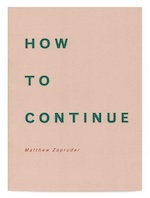 How to Continue
Matthew Zapruder
The Economy Press
Poet Matthew Zapruder’s newest chapbook, How to Continue, collects five interconnected poems written in the spirit of the Turkish poet Nazim Hikmet’s “Things I Didn’t Know I Loved,” written in 1962 on a train to Moscow after being imprisoned for 28 years. The following lines capture Zapruder’s gratitude for the simplest of things (serving, too, as a nod to Neruda):
I would like to be sad about childhood
one last time then forget
but first I have to know
I can make just one thing
I could hand to god and say
here’s your light back
A gentle affirmation much needed in days like these.