
I arrogantly recommend… is a monthly column of unusual, overlooked, ephemeral, small press, comics, and books in translation reviews by our friend, bibliophile, and retired ceiling tile inspector Tom Bowden, who tells us, “This platform allows me to exponentially increase the number of people reached who have no use for such things.”
Links are provided to our Bookshop.org affiliate page, our Backroom gallery page, or the book’s publisher. Bookshop.org is an alternative to Amazon that benefits indie bookstores nationwide. If you notice titles unavailable online, please call and we’ll try to help.
Read more arrogantly recommended reviews at: i arrogantly recommend…
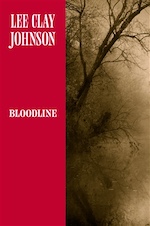 Bloodline
Lee Clay Johnson
Panamerican
Bloodline is Lee Clay Johnson’s excellent sophomore novel about a Southern patriarch/con artist/sleezebag who champions Confederate fantasies about a glorious past. The tale mixes black humor with Southern Gothic in relating the delusional schemes of one Winston Alcorn and the family he coerces into helping realize them. Winston—or “Wins-a-ton” he dubs himself after his self-purported ability to win law cases and make money—Winston runs a weekly auction of articles unwanted by the citizens of the rural county in which the story takes place. The pricier articles include items from the mill he became owner of after he deliberately stuck his dominant hand in the path of a timber saw for the property it sat on. If a man is willing to destroy his own hand for gain, who won’t he sacrifice?
Winston’s wife, Mandy, endures his antics and non-stop monologues (often issued via a bullhorn he bought for the auctions, complete with button alarm) via a steady diet of maintenance-level oxycontin. Her boys, Dustin and James, are forced, beginning as young children, to live in a ramshackle outbuilding instead of the double-wide trailer their parents live in. The shack has no indoor plumbing, so they shit in empty paint cans, which they toss in the swamp behind their hut. Winston uses his sons as cheap labor and treats them worse. A way out is always on their minds, but their minds are so undeveloped, they have no idea what their options are. They have no skills or education, and they live in a community that lacks well-paying jobs, or even poor-paying jobs with benefits.
For those who don’t have to live with him or suffer the consequences of his poor decisions, Winston is seen by the community as an entertaining fellow, one who speaks his mind, someone you could have a beer with. (It’s not until well into Bloodline that you realize Winston is the only sober character in the novel.) And of course, he’s well-supported by that community when he decides to run for office (state representative), an election win almost guaranteed after an assassination attempt on him. But because it’s fiction, Bloodline has a happy ending.
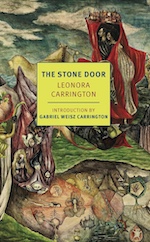 The Stone Door
Leonora Carrington
NYRB Classics
Written in the mid-1940s but lost and forgotten for another 30 years, when its eventual publication received dismissive notices for its tiresome weirdness and disjointed narrative, The Stone Door’s current republication, 80 years after its initial penning, seems at last to have an audience ready for it as a work of literature in itself by a woman who was also a painter, rather than as a painter who scribbled as a side hustle.
An essentially plotless novel, Carrington’s descriptions read like verbal mash-ups of images by David Lynch, Terry Gilliam, Tim Burton, and Hieronymus Bosch: Beautiful, eerie, haunting, askew yet “making sense.” There are male and female quests for the stone door, dreams within dreams, dreams sequences that become real-life events and vice versa. It can be read as a fantasy novel, too, although fantasy genre aficionados will probably bristle at its lack of plot. Because surrealism is process-oriented without a goal beyond giving practitioners a sense of tapping into their ur-selves, The Stone Door’s cataclysmic ending whispers off into a promise of more of the same tomorrow. Still, overall, The Stone Door reads as dream-logic visions based on tarot divination and symbolism, where metaphor and material are one. Anna Watz, a scholar who focuses on feminism and surrealism, provides an enlightening interpretation of the novel.
 Nadja
Nadja
André Breton/Mark Polizzotti
NYRB Classics
Autumn in Paris, 1926. While the surrealist writer André Breton is out for a walk, he encounters among all the others on the streets a young woman, walking in the opposite direction. Their eyes meet. She decides to accompany him, this stranger, and tells him her name is Nadja—“in Russian it’s the beginning of the word for hope, and because it’s only the beginning.” Within a few paces she asks if she may recite him a poem. This juxtaposition of the unlikely and appealing, charming and unexpected is all the surrealist—Bréton was unknown to the young woman—needs to explore the contours of his art’s anarchist tendencies and see what lies behind this naturally surreal mind.
Divided in two sections, a prelude to the encounter, followed by descriptions of their meetings and Nadja’s unfortunate decline. The first part of the book sets the context for what follows both in terms of physical setting—Paris in the ‘20s—and other striking coincidences of sudden and profound connection and insight, connections compelling and obsession-producing.
Bréton’s and Nadja’s meeting sparked an immediate fascination with each other that seems to have included but transcended love at first sight. (I say “transcended” because Bréton told his wife about Nadja. Although Bréton was sexually enamored of Nadja, he seemed far more interested in her as an object of study, as well as an index to his own peccadillos of arousal, amusement, and creative impulses.
Bréton never tries to romanticize his infatuation with Nadja and notes the meetings that ended in yelling matches, with stating his frustrations with her tardiness and their differences of opinion on many matters. Nadja seems to have a drug problem—whether heroin, cocaine, something else, or a combination of the above or all the above isn’t clear. If not an addict, then a serial heavy user of whatever was to hand. Bréton merely observes, doesn’t ask questions or participate. His descriptions of her life suggest that Nadja often resorted to prostitution for food, drugs, and a place to live, Bréton merely being one of several men who gave her cash. She has the ability to burn through hundreds of francs within a matter of days and have no clear idea (that she’s willing to say aloud, anyhow) of where it went.
Such relationships are doomed, and if one doesn’t bail, both will go down with the ship. Apart from a general compassion for Nadja’s well-being, Bréton moderates the emotional pull she has on him so that he is able to finally end the affair without being destroyed by it. Nadja is her own worst enemy, and she eventually ends up in an asylum for the mad and destitute.
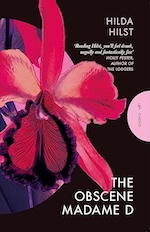 The Obscene Madame D
Hilda Hilst/Nathanaël + Rachel Gontijo Araujo
Pushkin Press
“Who, Ehud, who extinguished my envelope of light, which doesn’t stop asking questions in me without possible answers, which doesn’t hear and has aged so, which is ruining the tips of my fingers for groping so, who in me doesn’t feel?”
The narrator of this brief work, Hillé, aka Madame D (as in dereliction), at the age of 60, makes a bedroom for herself under the staircase of her house, foregoing (hence the dereliction) her marital duties (making coffee, having sex) and neighborly visits. She has gone to her staircase room in order to be mad.
We learn that her husband, Ehud, died a year after she moved to the staircase. She spends her time (before and after Ehud dies, apparently) mulling over the (to her) disgusting changes the body inflicted by time, wondering where God is, opening window blinds long enough to put on the mask of an animal while showing her naked body to prying eyes of neighbors. Neighbors visit her, ask why she no longer joins them, gossip to husbands about the horror she’s become.
Much of the narrative is devoted to exchanges between Hillé and Ehud—remembered or imagined isn’t clear. Loss, mourning, decay, the squalid earthiness of life that God created and abandoned. Like her fellow Brazilian Clarice Lispector, Hilda Hilst creates interior worlds of hallucinogenic surrealism to explore and understand the world on its own strange terms, although more accessible and less hermetically interior than Lispector. Recommended.
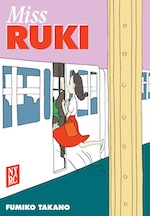 Miss Ruki
Fumiko Takano / Alexa Frank
NYRComics
Miss Ruki was a comic strip with a sit-com premise: vignettes about two women in their late 20s, working and living in Tokyo in the late ‘80s, early ‘90s. Appearing monthly in a Japanese lifestyle magazine for women, Miss Ruki depicted a contemporary odd couple, the strip has the attributes of conventional comedies based on buddies in close quarters: Opposites in temperament and physique, yet ultimately supportive of each other.
And they face the same “dilemma” for many single women of the time: Where will I find a husband? That said, neither seems particularly driven in dress or behavior to find a mate—they dress conservatively and only think of men only as long one is within their range of vision. Miss Ruki, the taller of the two, is genial and winsome, given to impulse but restrained by practicality. Ecchan, her friend, is shorter and curvier than the heron-like Ruki, with a short bob rather than Ruki’s shoulder-length hair. She is freer with her money than Ruki, especially when it comes to buying clothes, and she is shyer than Ruki, another of the book’s ironies, as Ruki can do her work at home while the less socially graceful Ecchan must go to an office. Although they take meals together and sleep on different tatamis in the same apartment, the apartment they sleep and take meals in may be Ruki’s or Ecchan’s, depending. There isn’t an undercurrent of suppressed sapphic attraction here that I can sense; the arrangement just seems to be a component of (at least female) Japanese friendships.
Ruki and Ecchan discuss work, men, shopping, saving, and dressing, but no boyfriends threaten the relationship, and their lives remain remain unaffected by national and world events until the very end, when Ruki sells her stamp collection to travel to Naples, thus ending the series. Takano works in the manga genre but it’s not the fantasy end of manga with large-eyed characters imbued with magical powers and the ability to transform shape. The strip has a static format: equally sized panels across two pages, which Takano makes visually interesting by changing the point of view of each panel. Miss Ruki is a convivial introduction to real-life-based manga and a reminder of what American Sunday-supplement comics used to be like.
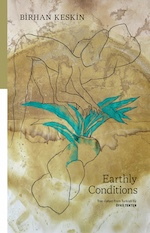 Earthly Conditions: Selected Poems
Birhan Keskin/Öykü Tekten
World Poetry Books
Earthly Conditions is the first anthology to be published in the U.S. by Turkish poet Birhan Keskin, limpidly translated by Öykü Tekten. Selected from five previous collections, the poetry of Earthly Conditions deals with loss and memory—topics one might expect from someone whose life and place of residence have been uprooted, transplanted, and uprooted again. The tone tends toward the somber, resigned and resistant, with no pleas made to a hopeful god:
with the fire of absence we clung to experience
we were cracked open, broken
hurt
because sand was yellow
the sky, a yellow memory.
Sky and ground an arid yellow: As above, so below.
Keskin’s language is plain-spoken and simple, with recurring images and a tendency to anthropomorphize nature when thinking of exile. Here is one of her portraits, “Spider.” Attuned to its environment, it knows that, to survive, it needs the ability to face sudden change:
on my right hip, the dust of love has gathered
in my dimple, a lyric memory
i hear the world through the dew on my belly
each of my feet points in a different direction
the world was to change constantly
memory to weave spider webs
my soul’s pendulum throws me
onto the white horse of bravery, or sucks me
into a venomous fear…
In “Threshold,” she imagines the life of a snail shell, which is both home and mobile.
i fell, kept quiet, grew pensive
became home to a snail
wounded on its left
and a neighbor to a weeping tree
saying the earth, ah the earth
i got used to the noise
of the place i occupied
I look forward to future editions of her works in English.
 Tongues, Vol. 1
Anders Nilsen
Pantheon
Artist Anders Nilsen’s newest multi-year project is Tongues, combining the myth of Prometheus with violence in the scrublands of contemporary Afghanistan. Volume 1 collects the first six chapters of his work in progress, which were first published individually by subscription from Nilsen himself.
Growing tired of being chained to a rock so an eagle can tear out and eat his liver every day, Prometheus tries to strike a deal with his captors to release him: the damage done by gifting humanity with fire too far gone, so what’s the point? Meanwhile, out in the desert, rockets have destroyed a small transport of vehicles, with a young girl and a monkey as survivors, and in another place a teen by himself with a teddy bear strapped to his back walks with seeming purposelessness. Neither the boy or the girl is native to the area, and thus their appearance is more striking. Also in the area are marauders whose purpose is unclear, but which seems more criminal than military. What these narrative strands have to do with each other only slowly clarifies as the story goes on.
Until things start making sense, however, we have Nilsen’s beautiful lines and layouts to enjoy. Meticulously laid out and drawn, two recurring motifs appear that seem to represent organic and inorganic forms, whose relationship also remains, at this point, mysterious through to and including the end of this first volume. The organic relates to a particular plant’s form—symmetrical, smooth-shaped, and unknown: There is a quick-growing plant that bursts forth from cadavers, sprouting at least six feet tall within a day—a curiosity none of the players in this drama currently have time to explore. The inorganic relates to the design of the panels themselves, also symmetric but also with a form that is somewhere between crystal and geometry. This form is mirrored by another mysterious presence: a cube with what appears to be multi-dimensional abilities, including the ability to collapse on itself. This cube, we sense, is the target of the various narrative strands. Prometheus is told that he may soon be released—not due to his petition but because his captors have found a way to eliminate the problem Prometheus started.
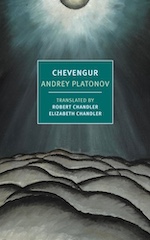 Chevengur
Andrey Platonov/Robert Chandler and Elizabeth Chandler
NYRB Classics
“How come we still feel uncomfortable, even though everything’s so good here? Because—as one comrade has just correctly put it—every good truth must come only a little and only at the endmost end, but we’ve organized the whole of communism here and now and it’s not entirely to our liking. How come everything’s correct here, with no bourgeoisie, with nothing but justice and solidarity—and yet the proletariat feels bored and lonely and longs for wives?”
Deemed unpublishable during his life—its account of Soviet life was seen as honest rather than as happy-clappy wishful thinking—Chevengur has now been translated into English by the dependably first-rate team of Robert Chandler and Elizabeth Chandler, based upon the most recent scholarly edition available in Russian. Chevengur is the Communist Promised Land, sought for by Sasha Dvanov and Stepan Kopionkin across the breadth of Revolutionized Russia, along with Kopionkin’s horse, Strength of the Proletariat, to see for themselves this world-transforming miracle.
Along their way, they pass through villages too far removed from events central to the revolution to see any benefits. The problems of the revolution are only too familiar to them: Given land, the peasants nonetheless find the fruits of their labor confiscated by the government. Starvation and governmental disorganization are endemic.
Chevengur, however, is the communist Eden, a small village somewhere on the vast Russian steppe. Throughout the rest of the book, as the characters goes through town after town, everyone they meet is excited that communism has finally arrived. But nobody knows where it is or in what it consists. Although the proletariat’s paradise, Chevengur is devoid of inhabitants—its former residents were all bourgeois trash and had to be evicted. A team of eight Bolsheviks then goes from house to house, scrubbing each down in preparation for the proletariat’s arrival, and airing out the bourgeoisie stench. Although the Bolsheviks can’t define communism, but they swear they’ve made all the correct preparations for it.
With a type of idealistic good that can only come at the final moment of existence, as the character Prokofy points at late in the novel, it’s no surprise that the people’s paradise still feels lacking. What is the “everything” that is “correct” here in Chevengur? “Justice and solidarity,” not food and employment—two pairs that cannot be reconciled under this political system. In a land of eternal poverty, of endemic material want, who wouldn’t try to wring nourishment from ideas, especially those wedded to a sense of fulfilling God’s will, which Richard Chandler convincingly argues in his afterword was a real expectation of many religiously minded Russians who were fed up with the morally corrupt tsarist system. As the narrator points out about the character Serbinov, “he saw world history as a useless bureaucratic institution, where the weight and meaning of existence is taken away from a human being with painstaking precision.”
But the new system the Bolsheviks hope to erect has its own brand of “painstaking precision” it applies to life, inflicting even on the Russian environment itself Marxist theory so everything living and inorganic can be trained to recognize the inherent rightness of communism and serve its purpose (my emphases): “The path under Sasha’s and Prokofy’s feet was hidden by tall, peaceful grass, which had seized all the land around Chevengur not from greed but from life necessity.” What could go wrong?
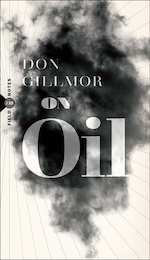 On Oil
Don Gillmor
Biblioasis
On Oil offers a concise state-of-the-horror appraisal of humanity’s addiction to petroleum products, combining first-hand experience, historical research, and interviews with petroleum experts.
It begins in the early 1970s, when the author, Don Gillmor, moved to Calgary to take advantage of the good pay offered to oilrig roughnecks. Ten years before Gillmor’s arrival, an enormous oil field was discovered in Alberta, and Calgary became a boomtown.
The first rig we stopped at had a sign that read “This rig has worked 0 accident-free days.” A man in his twenties sat on a forty-gallon drum, head down, hand wrapped in gauze, blood staining his jeans. So, a job opening.
His coworkers were disaffected men twice his age and older, drunk, bitter, frustrated, and divorced: all the feed an English major could hope to dine on in summers before, during, and after college, performing dangerous labor over long shifts, unprotected from the weather and drunken coworkers.
The dangers posed by gas and petroleum to the environment—specifically, in its ability to heat the planet—had been accurately forecast by the end of the 19th century, was verified by the CIA (of all organizations) in the 1970s. Other individuals and groups also predicted throughout the 20th century environmental disasters triggered by rising heat, with the period of 2025-2050 given as the equivalent of environmental end times. Accompanying the environmental disasters suffered around the world has been the economic devastation done to dying, former boomtowns (such as Calgary) from job loss and cleanup efforts.
Complicating reform efforts is the fact that many early oil producers were also evangelical Christians, for whom oil was God’s gift of eternal bounty. President Ronald Reagan, twice elected in the early 1980s, appointed evangelicals who eliminated as many environmental regulations as possible, setting back for eight years, in the U.S., serious efforts to reign in and clean up toxins from the earth, water, and air. The Reagan administration was then followed by four years under oilman George H. W. Bush, who was advised that, although the environmentalists had been right all along, it was too late now to undo the damage caused, so full speed ahead into the apocalypse.
So much for the environment. How about life for the average citizen in countries dominated by oil production?
Political scientist Tery Lynn Karl coined the term petrostate, and in her seminal study of oil-producing nations in the 1970s, she concluded that while oil brought wealth, it tended to erode democracy and contribute to inequality. Authoritarian governments in oil-producing countries often neglect health, education, and social services, and put a disproportionate amount of money into fuel subsidies.
Sound familiar?
Low taxes are one of the hallmarks of petrostates, a way to placate its citizens (Texas, Wyoming, and Alaska have no tax, Saudia Arabia has no personal tax, the United Arab Emirates has the lowest taxes in the world, Alberta has no sales tax and the lowest corporate taxes in Canada)…Louisiana, another low-tax petrostate (10 percent of US oil production), has the second-highest poverty level in the country, and a long, very colorful history of political corruption.
Oil-producing countries quickly find themselves co-opted by oil production interests, which include enforced deletion from official documents all evidence of the harms and corruption inflicted by vested economic interests. Although Gillmor doesn’t discuss this, as declining industries take longer to pay off bank loans (because of diminishing returns on investment), fewer and fewer banks will be willing (or able) to loan money to those industries. Meanwhile, countering these trends, the Chinese government has focused on both reducing its petroleum dependence on other countries and making the environment cleaner for its citizens. It has quickly become the world leader in EV production, and solar and wind power development and deployment.
Despite laws and regulations requiring them to do so, oil companies do not set aside enough financial reserves for environmental clean-up after wells have been abandoned or for the destruction done while oil is being produced, because the laws and regulations are not enforced. Small petrostates find that much or all the royalties paid from oil reserves ends up in the coffers of a single nation leader, who uses the money on European spending sprees for luxury goods. When corporations leave a country after the wells have dried, they tend to leave behind a country with a devastated environment, populated by uneducated people living in dire poverty.
Fracking, the latest development in oil production is a financial and environmental disaster, costing more to produce than it gains in sales, poisoning water wells, decreasing life expectancy among those who live near fracking operations, and worse. Unlike oil wells, which may produce steadily for decades, the bulk of fracked oil is released within the first year, sharply dropping off during the second year.
Death, destruction, and money—all part of God’s plan, apparently. What’s not to like?
 In the Roar of the Machine
Zheng Xioaqiong/Eleanor Goodman
NYRB Poets
Born in China in 1980 on the cusp of the nation becoming a world-dominant manufacturing behemoth, by the time Zheng Xioaqiong was 21, China’s manufacturing was running full-bore, providing steady employment and pay for tens of millions of people from the countryside who would otherwise live at subsistence level, at best. As a woman, and an internal migrant, Zheng Xioaqiong would be paid less than men who, like her, also worked shifts of 11 or 12 hours a day, seven days a week, not including mandatory overtime, with one weekend off a month, sleeping eight to a dorm room (likely unairconditioned at the time). The work is both tediously repetitive and dangerous. The women hope to find husbands. Barring that, they turn to prostitution or return to their villages empty-handed. Many women send the money they manage to save back home. (In one of Zheng’s poems, a pay of 1,000 yen is mentioned—presumably pay for a month of 11-hour shifts—which amount to less than $140. From this amount, a frugal worker might wrest $20 spare to send back home.)
Anyone who’s ever worked in a factory can recognize or empathize with the lines beginning “Life,” the initial poem from Zheng’s first collection, Huanmaling (2006), which sets the tone for the whole volume:
What you don’t know is that my name has been hidden by an employee ID
my hands become part of the assembly line, my body signed over
to a contract, my black hair is turning white, leaving noise and toil…
The line workers know each other by number only, cogs enumerated for ease of replacement. Yet, Zheng sees how her ant-like labor in a vast Chinese factory fits into a larger neo-liberal nightmare, described in “Industrial Age”:
At the US-owned factory Japanese machines run Brazilian mines
to produce iron pieces, Germany’s lathes shape France’s
coastline, South Korea’s shelves are filled with Italian parts…
And so forth, for another dozen lines.
Zheng’s collection Woman Worker (2012) consists of prose poem vignettes describing the lives, hopes, and disappointments of female factory workers, most limned as individual portraits. The collective “Middle-Aged Prostitutes”—women abandoned by lovers after becoming pregnant, some the sole source of their distant family’s income, placid in the company of fellow prostitutes, though impoverished.
Respite from eternal toil is found in nature (the Rose Courtyard poems) and poetry itself. From “To Give”:
The fading away of gentle youth
for many years life has been
like a dull word I’ve been revising
…I live in perplexity
turned melancholy by distant events
used up by drudgery, allowing a few words
to suffuse my life, like disgrace, grief,
loneliness—but there is a quieter word too: poetry.
Zheng’s poetry voices a demand for dignity and grace, one imbued with the dreams of humanity rather than the drive of industry.
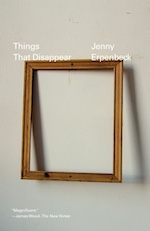 Things That Disappear
Jenny Erpenbeck / Kurt Beals
New Directions
“[W]henever a thing disappears from everyday life, much more has disappeared than the thing itself—the way of thinking that goes with it has disappeared, and the way of feeling, the sense of what’s appropriate and what’s not, what you can afford and what’s beyond your means. We don’t have darning thread anymore! Really, why? People shouldn’t darn their tights, they should buy new ones!”
This slender collection of biographical vignettes is imbued with a melancholy sensibility that comes with living in a post-industrial state, worsened in tone from also being a former Soviet republic—East Germany—the promises of whose ideologies were incapable of providing its citizens with a decent standard of living, however one wants to define the term. Politics aside, there is the life once lived in a community, a community as prone to the vicissitudes of historical forces as any other, and the things, places, people, and events that shaped a social and personal life: nursery school, knickknacks from a former regime, cheese and socks, “drip catchers,” friends, and more.
Terse not elliptic, the narrative temperament of Erpenbeck’s nonfiction prose (beautifully rendered into English by Kurt Beals) has, like her fiction, a wry sense of loss not quite convinced of the improved state of being that was to come with progressive change.
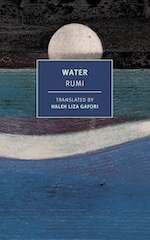 Water
Water
Rumi/Haleh Liza Gafori
NYRB Classics
Translator Haleh Liza Gafori returns with Water, another splendid translation of Rumi’s poetry after 2022’s Gold. Rumi, a Sufi mystic from the early 13th century and founder of the sect known in the West as Whirling Dervishes, was an enormously popular speaker and poet. Born in Afghanistan Rumi’s father kept the family on the move for ten years, trying to keep ahead Genghis Khan’s invading forces, and finally settled in Turkey.
His father, an Islamic theologian, had Rumi study, in addition to Islam, the arts and sciences and the languages of the lands they passed through. This produced in Rumi a learned and compassionate scholar and poet who shaped a message of divine love that was hopeful and unsentimental. Exhorting listeners to find God within themselves, to see Him imbued throughout all of existence, Rumi pleads for a world in which people treat themselves and others as worthy of that love divinely created, to drink in the love until they are ecstatically drunk:
Child of flesh and bone, you are a child of soul.
Love is your trade, your mission, your calling.
Why do you busy yourself with so many other tasks?
In one house, you were wounded a hundred times.
You keep circling that house.
You keep eyeing the door.
In another house, tasted a hundred kinds of sweetness.
You trusted none of them.
Bitter, you never grew sweet.
Dear one, I want to see you Love-drunk.
If my words make you vigilant and wary,
I’ll say no more.
Here I am, gazing at you in silence.
Open your eyes to the Love in my eyes.
Drink it down.