
How do we make sense of things when our way of making sense of things no longer makes sense? On how we construct understanding from incomplete, unreliable, or unfamiliar information
A Captain from Portugal
Guy de Cointet
Primary Information
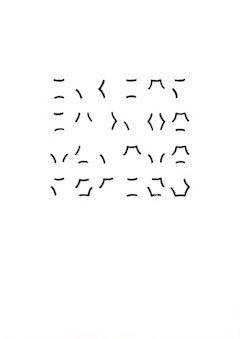
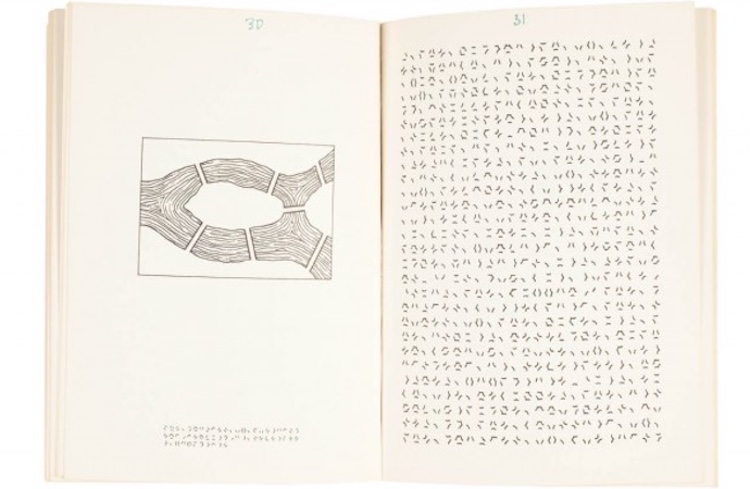
Originally self-published in 1972, A Captain from Portugal is an asemic story—can something without meaning also be considered “nonfiction”?—that appears more interested in how information or a story is relayed than in what it relays. Captain gestures toward the conventions of nonfiction with its inclusion of captioned illustrations—unless it’s channeling W. G. Sebald. Whatever is going on here is expressed in a script devised by de Cointet consisting of arc segments alone and in combination with other segments, oriented up, down, sideways, backwards, and forward.
Perhaps de Cointet encoded his text with semantic content. I may lack the skills to decode its message, but I can appreciate the look of the text across the page. In its straightforward presentation of an imaginary topic, Captain reminds me of David Wilson’s Museum of Jurassic Technology, its displays and ephemera largely a parody of museum practices and the conventions by which museums present objects to the public (cf. Lawrence Weschler’s Mr. Wilson’s Cabinet of Wonder (1995)).
There’s a musical fragment whose notation doesn’t match current practices, a sequence of runes(?), a square black and white illustration that looks composed by a hyperactive Piet Mondrian, a double-sided rasp (?) with odd serrations, and there’s—the one thing I do recognize—the famous Königsberg map of two islands connected by seven bridges that prompted Leonhard Euler to determine whether a walking path could cross every bridge exactly once. (It proved mathematically impossible.)
Who knows what’s going on? It’s a mysterious artifact, something encountered at the outset of discovery and meaning.
Chin Music
R.T. Short
Breakdown Press
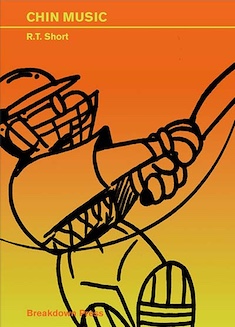
Richard Short’s Chin Music is a wordless depiction of a cricket game, its players, fans, close calls, and drama inherent in the game. I know nothing of cricket, although I can identify the equipment used to play it, if the components are assembled in one place. The tensions between the competing teams, the hopes of the fans, the nervousness and aggression of the players are all depicted in a series of positions akin to what Degas may have sketched watching ballerinas practice.
Although the players and their fans look like balloon sculptures, the body proportions accord with the human body (more or less) and how the body looks torqued into various positions determined by throwing a ball, hitting a ball with a bat, running, catching, leaping, falling. These are etudes on the human body in motion sequenced as a game. Its wordlessness forces sense to be made of the faces, the positions, the players’ reactions, the crowd’s responses.
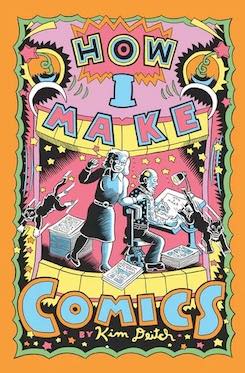
How I Make Comics
Kim Deitch
Fantagraphics
Kim Deitch’s latest book, How I Make Comics, promises answers to two questions: Where do his story ideas come from, and how does he turn them into comics? A series of nested stories mixing real and imagined incidents with urban myths answers the first. The second, as it turns out, requires considerably less explanation. Deitch’s implicit message is that almost everybody and everything has a story behind it that can be explored.
And here almost none of the stories—presented as cartoon ideas paraded before his wife, Pam—have a conclusion. Instead, the ideas are nixed by Pam and the narration segues into the next yarn, some of them referencing previous yarns, giving How I Make Comics a meta-narrative twist, including the fact that we get to see what Pam doesn’t want others to see. That is, Pam’s rejection of each story becomes the pretext for its publication: What she doesn’t think deserves an audience is precisely what the audience gets. Ultimately, it’s readers who will judge their merit, with the marketplace becoming the final arbiter of taste (ahem) and entertainment. (That’s the story-idea how. The technical how? You have to practice—but that’s from the last two pages of the book.)
Deitch’s world—its businesses, offices, and homes, inside and out—looks straight out of film sets from the 1920s through the 1950s, a kind of early-modern suburban drab. His characters look as though their clothes were cut from the same decades. How I Make Comics begins with a recollection from Deitch on the time he appeared as a member of the Peanut Gallery on the Howdy Doody show on the same day as Donald Trump. Only a child then, but Deitch depicts him as already formed into a soulless embodiment of dishonesty, pettiness, and self-absorption. From there we go to more familiar Deitch territory: vaudeville, silent films (animated and live action) and early talkies (animated and live action), midgets and other small folk.
A story set in 1922 about a midget dressed as a dog who bombs a warehouse morphs into a husband-and-wife musical vaudeville routine featuring the midget in a dog suit and his wife. In the 1930s, an elephant escapes from the circus during a stop in Brooklyn and is only discovered years later—still alive and still in Brooklyn. There’s a visit to Toy Town, where the “souls of dead human bodies” are transferred “into new miniaturized human bodies,” and an investigation into the story of a 40-year-old cat living in Brooklyn.
How I Make Comics also shows how a resourceful old hand can create homes for drafts and dead-ends—good work is there, as fine as ever, but the individual pieces are slight. Or they’re incompletable. Or something else. I don’t know if this is how Deitch’s book came about, but it seems within the range of a solution he might devise, a thread connecting fragments each interesting as far as it goes, one interesting bead after another, with an absurd premise holding them together. And Deitch’s readers, me included, are entertained again.
“This One Actually Has a Bit of Truth in It”: How Kim Deitch Makes Comics
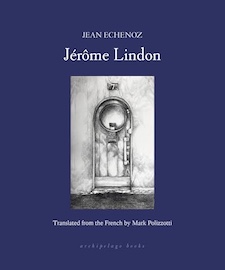
Jérôme Lindon
Jean Echenoz / Mark Polizzotti
Archipelago Books
A eulogy of a few dozen paragraphs—a mentee for his mentor, a friend for his friend—in Jérôme Lindon, French novelist Jean Echenoz relates anecdotes, like passing around snapshots, about his relationship with his publisher on the occasion of Lindon’s death in 2001. Being unfamiliar with both men, I read Jérôme Lindon as an exercise in narrative persuasion. What does it matter to me who this Jérôme Lindon fellow was? Just make me believe he existed, even if just as a fiction.
In relatively few words, then, Echenoz succeeds in limning the temperament of both men, a success that comes through nicely in Mark Polizzotti’s translation. Here’s an example of the working relationship they developed, one renewed every two or three years as Echenoz submits a new manuscript:
When we see each other now and again, I avoid talking about my work, especially when it’s not progressing well. As a young man, I imagined that an editor would be the author’s helpmeet, suffer with him through his torments, stroll by his side around the Luxembourg Gardens earnestly discussing where to introduce a character, the transition between two chapters, that sort of thing. I quickly realized from Jérôme Lindon that an editor has other things to do, or at least, he does. He has no patience for hand-wringing, and despises it when someone takes him for what he’s not, whether surrogate father, confessor, or therapist.
Even after Lindon does something that angers or offends Echenoz, Lindon’s opinion of his work remains of utmost importance to Echenoz because Lindon’s tastes are always spot on. Two examples of Lindon being disgusted by manuscripts Echenoz hands him show Echenoz on reflection discovering Lindon was right. Well, not discovering. Confirming what Lindon said at the outset. Lindon could tell Echenoz that a manuscript was no good while simultaneously making it clear that Echenoz remained his author. In these few pages, Echenoz traces the evolution of a relationship, and the ways in which the two men showed their appreciation of and respect for one another. And since this is a word of thanks for the gift of a friendship, Echenoz humbles himself before the memories and lessons given him through it.
How could it not matter who Jérôme Lindon was?
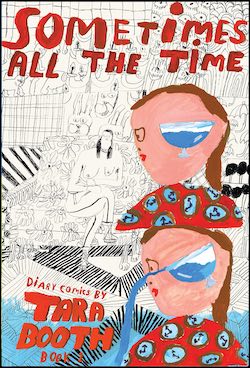
Sometimes All the Time: Diary Comics by Tara Booth, Book 1
The first in a projected series of volumes to be released annually, Book 1 of Sometimes All the Time reproduces Tara Booth’s raw materials—diaries, sketchbooks, and exercises—spanning ~2009-2018, with an emphasis on 2017-2018. Booth’s drawings and paintings cover familiar ground for fans of what used to be called underground comix: An artist’s brutal self-examination made for public consumption, not simply to invite laughter at her own expense but to universalize aspects of her life—states of being commonly experienced in solitude and rarely discussed. The honesty—overcoming her self-delusion about her alcoholism, for instance—includes such cringe-worthy moments as her wearing white pants when her period starts. (A good comparison would be with Esther Pearl Watson’s Unlovable trilogy.)
Her loose style conveys the immediacy of sensations as they are felt rather than in cool reflection. While her drawings can be precisely detailed (usually material objects), the human form is much more amorphous—hands are suggested but not individual fingers, heads—especially hers—are shaped like nubs, the expressions created by the eyes and mouth getting the most detail. I often wonder if she’s trained her non-dominant hand when depicting humans (except for the life studies drawings included here, which indicate her technical range is considerably greater than her preferred style suggests.)
There are brief autobiographical stories—illustration and narrative combined—and series, portraits, strange tableaux, nudity (her own), and so forth. As a record of one artist’s working methods, Sometimes All the Time shows a thinking mind at work, using art both to express existence and to exorcise the worst of it. Included are Q-and-A exchange between Booth and some of her fans in a letter section toward the end, as well as an interview with Booth in which she discusses the evolution of her art, including the retreat in her work from her private life. (She kept an online daily diary a couple of years ago, containing the types of subjects most people keep private about themselves, often involving but not limited to bodily functions and physical self-images, which can be especially cutting.) Perhaps the catharsis the raw materials were no doubt intended to provoke did their work.
“I never, ever thought that I’d end up sharing drawings publicly”: Tara Booth on opening up
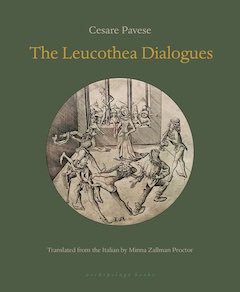
The Leucothea Dialogues
Cesare Pavese / Minna Zallman Proctor
Archipelago Books
In The Leucothea Dialogues, Italian author Cesare Pavese has Greek gods, demi-gods, and humans discuss fate and change, whether the acts of the gods upon humans are cruel or fair, whether the fates of humans are of their own design or inflicted by the gods, and whether, given the outcomes, it matters if they are fated or willed. Through these dialogues between mortals and gods, humans demonstrate the ability to imagine themselves as authors of actions formerly attributed to gods. Would human behavior, human beginnings and ends, differ if they were of our own fashioning rather than a deity’s?
Dialogues include those between Oedipus and Tiresias on blindness, Eros and Thanatos on flowers, Sappho and Britomartis on seam foam, Castor and Pollux on families, and more. The old argument is familiar: If people are fated to do as they do, then the choices they’ve made to seal their fate—while feeling freely made—were actually ordained. Then what is the point in life, what is the point in fulfilling the conditions one has been made to live under? In the dialogues, comparisons are made of sexual desire, military conquest, and other drives. What are the motivations, the feelings, thoughts, and justifications, human and godly? What is the point of reflecting on the past when the events then were as fated as those yet to come?
Pavese shows the gods serve to mirror ourselves, our understanding of the world, our place within it, and the constraints we must maneuver within it. For the gods, eternity means living in the moment, the here and now without reference to past or future. For humans, eternity means remembering and being remembered. They remember actions, anticipate consequences, explain themselves, and hope to be recalled afterward. In the dialogues men and gods justify their ways to each other, with varying degrees of plausibility and selfishness, rationalization and justification.
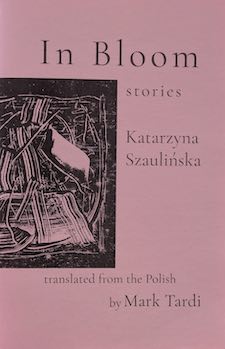
In Bloom
Katarzyna Szauli?ska / Mark Tardi
Toad Press
In Bloom is a chapbook collection of four short stories by Polish writer Katarzyna Szauli?ska, whose narrative tone, nicely expressed in Mark Tardi’s translation, takes a sly, jaundiced view of the world. Its underpinning irony turns dramatic situations into acts of patience determined by who wears out first. A parallel narrative attitude can be found in Margaret Atwood’s fictions, but Szauli?ska increases the acidity.
Szauli?ska practices psychiatry in Warsaw, and the stories making up In Bloom are narrated by people who know the field and deal with manipulative clients, delusional patients, and self-destructive addicts. But the narrators share a similar deadpan affect, weary from dealing daily with stubborn cases of duplicity and obliviousness. “Bedfellows” presents a duel between an admitting doctor at a hospital who refuses to let in a drug addict who just wants to sleep on a hospital bed for the night, have a cup of soup, and skip out before the drug rehab can begin. In “Online,” during the pandemic, at the end of an online therapy session, a patient tries to wheedle a few more minutes out of a session that’s just expired, prompting an internal struggle in the therapist between her desire to help others and the need to take care of herself.
The centerpiece of the chapbook is the title story, a Kafkaesque fantasy about a group of men whose genitalia have transformed into flowers—or so they believe—including a priest whose flower is particularly resistant to returning to its former shape. The men undergo a ritual by a potato-sack-wearing guru who tells them he cured himself in the manner he intends to inflict on them.
In “Degesch Blues,” a medical worker in a health clinic, whose girlfriend lives in Ukraine, in danger from Russia’s invasion, takes in a disoriented elderly woman who blathers on cheerfully about meeting her husband at the Zyklon-B factory during World War II, where they worked side by side, in love. “I loved my husband, you know? I wouldn’t trade him for the world. And I met him there, by the Zyklon. Have you ever loved someone?”
An excellent collection from an author and translator who should fill a book with more such well-written stories.
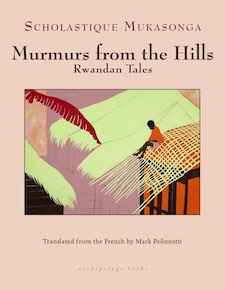
Murmurs from the Hills: Rwandan Tales
Scholastique Mukasonga / Mark Polizzotti
Archipelago Books
Scholastique Mukasonga (b. 1956), born and raised in Rwanda, was living outside Rwanda during the 1994 genocide when some 800,000 people, overwhelmingly Tutsi, were murdered over a span of a hundred days, many of them by machete. Framed between the Hutu Peasant Revolt of 1959 (which displaced 300,000 Tutsis) and the Rwandan Genocide of 1994, Murmurs from the Hills recalls events and stories from Mukasonga’s youth, by which time Belgian colonial rule had hardened distinctions between Hutu and Tutsi into political and racial hierarchies.
The six tales recounted here mix memoir with fiction, local folklore, and rural Rwandan understandings of Western European doctrine, showing how belief in traditional ways owes less to capitulation to superstition (as if priests had anything to complain about that) than to connection to personal, familial, and community history, example, and duty. And Mukasonga relates these events from the perspective of a girl and then a woman, whose responsibilities and life choices, in Rwanda, tend to be more narrowly circumscribed than those made available to men.
Murmurs from the Hills follows Mukasonga from her birth on the banks of the Rukarara river to the school examination day that will determine her future—perhaps with a degree from a white college she can qualify for a civil service job doing secretarial work. Her mother, however, has a premonition about her daughter’s future, and takes her in the middle of the night to a great tree to perform a ritual in which she carves a sliver from the tree and turns it into a protective amulet for her daughter, whom she sees as having a future far from home, in white men’s land. The amulet becomes a cultural barrier leading to the dissolution of a romance between Mukasonga and a European man, who scoffs at the amulet as superstition.
We learn about ethnic divisions, aversions, and evasions, all apparently power-related because they don’t fight over each other’s possessions—their antagonism instead involves socially constructed hierarchies of status and power. Tutsis are traditionally cow herders and Hutus are traditionally farmers. Investigations like Philip Gourevitch’s We Wish to Inform You That Tomorrow We Will Be Killed with Our Families show the extent to which colonial powers transformed differences in indigenous modes of living into supposed differences in character and human worth.
We also read about the Rwandan reverence for cows, which surpasses mere thankfulness for the milk into something approaching that of a spirit animal as a companion. Mukasonga recounts the story of an old poor man who, living alone, wants for nothing more than to spend his remaining days with a cow to look after—it doesn’t even have to be a productive cow for him to esteem it.
A fable about a woman named Misfortune reads like a Rwandan version of the adage “you can take the X out of the Y, but you can’t take the Y out of the X” and what that might mean when read as an allegory of being Rwandan. In that story, one woman’s inability to conceive a boy (a misfortune) after producing multiple girls is interpreted by other women as a misfortune waiting to befall all of them if the community doesn’t get rid of her. So, Misfortune is forced across the river into Burundi, where she eventually remarries and has four healthy boys. Meanwhile, in Rwanda, the women’s lives remain as miserable as ever. As Mukasonga’s own story implies—as well as that of her brother and a former schoolmate of hers—Rwanda seems to spit out those it most needs.
Mark Polizzotti’s translation is artfully phrased in idiomatic English that never brings attention to itself, letting Mukasonga’s story brook along effortlessly.
Interview with Scholastique Mukasonga in The White Review
Everyday Tang: On What We Can Learn from a Dynasty
Xiaolu Guo
Notting Hill Editions
Novelist Xiaolu Guo, having left China for Britain years ago, decides to take her 11-year-old daughter to China to learn something of her history. Specifically, Guo takes her daughter to sites where the Tang Dynasty ruled 1,300 years ago, one of the high points in China’s long history. While Vikings were raiding European coastal villages, Guo notes, the Tang Dynasty was encouraging literacy, extending to women to a degree remarkable for the period.
Her daughter’s initial reaction (tween ennui) does eventually segue into increasing interest as the days pass, but not before Guo comes to terms with the fact that, while this may be her daughter’s history, the solipsistic nature of adolescence will have its way.
Guo compares Tang Dynasty events and figures to those in England and Europe at the same time, and discusses cultural beliefs—such as Daoism, Buddhism, and Confucianism (which can confuse Westerners who don’t understand the differences)—to exemplify the practices that accompanied these beliefs, including China’s long history of using rigorous examinations as the basis for social advancement. We learn about Empress Wu, who prevented her sons from taking power from her and sought to consolidate her own. As Guo and her daughter note, women in power aren’t necessarily feminists, and Wu was about as feminist as Margaret Thatcher.
Guo summarizes the dynasty’s legacy as having brought to China
reforms of the examination and administrative system, advancements in science and medicine, the value placed on translation and public literacy, the successful integration of ethnic groups, the sublime poetry of Du Fu and Li Bai, the mystical paintings of Wang Wei and Zhang Xuan, high fashion in women’s clothing beyond the palace walls, exquisite ceramic and pottery arts, the invention of gunpowder and printing, highly elaborate cuisine, creative urban design and park developments, and much more.
Everyday Tang is a brief but fascinating introduction to the Tang Dynasty’s multifarious achievements, with references to many enriching sites, events, personages, art, and literature worth exploring more deeply.
Tang dynasty artworks and artifacts from the Smithsonian Institution collections