
 i arrogantly recommend…#71 is a mostly monthly review column of unusual, overlooked, ephemeral, small press, comics, and books in translation by our friend, bibliophile, and retired ceiling tile inspector Tom Bowden, who tells us, “This platform allows me to exponentially decrease the number of views on screens by people who have no use for such things.”
Links are provided to our Bookshop.org affiliate page, our Backroom gallery page, or the book’s publisher.
Read more arrogantly recommended reviews at: i arrogantly recommend…
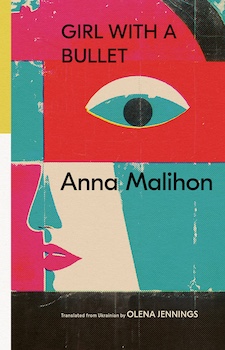 Girl with a Bullett
Anna Malihon / Olena Jennings
World Poetry Books
Ukrainian poet Anna Malihon’s works have transformed, since Putin’s invasion of her country, from “tightly rhymed poetry” to looser free verse, according to Olena Jennings, Malihon’s translator. Perhaps the war has shaken her sense of cohesion that form imbues artistic expression with; certainly, it has affected the routines of and memories associated with everyday life the poems of Girl with a Bullet describe. Homes destroyed, children killed, friends and family exiled, existence an imprisonment.
In one of her untitled poems, Malihon writes,
They return when darkness descends:
everyone that you could save . . . And couldn’t.
Their voices are clear: “Run little one,
there isn’t time to think.”
And the marksman who covered you like snow covers a plowed field
didn’t have a chance to say “I love you,”
fell quietly without surprise or regret
on that historic day.
Heartache, emotional turmoil, confusion, and anger bring Malihon to apostrophize,
Tell me, November, stop time for an hour,
how many of us will you take in this unequal match,
how many of our best will fall from a hill into dark water.
Why are you silent, November? What are you waiting for?
Why are we filled with so much anger, over wisdom,
with so much white despair in our hair?
Olena Jennings’s translation conveys the energy, outrage, and pleading of Malihon’s poetry into forceful lines rendered into idiomatic English warning and reminding of terror brought home.
 Even Time Bleeds: Selected Poems
Jeanette L. Clariond / Forrest Gander
Princeton University Press
Mexican by way of Lebanese descent, born 1949, Jeanette L. Clariond has won numerous awards for her poetry and has been a dedicated translator of works from Anne Carson, Elizabeth Bishop, Primo Levi, and others. Translated by fellow award-winning poet and translator Forrest Gander, the poems in Even Time Bleeds, gathered from several of Clariond’s books, cover such topics as Mexico’s ongoing femicide pandemic, scientific versus spiritual knowledge and the capacity for empathy allowed by the spiritual but ignored by technology. Here’s an example, from “Looking at What’s Looked At”:
On the wall, only reflections.
Nothing is really there,
nor is the real any guide to salvation.
But the glow of golden leaves
—all foliage—
is a beginning, for when the sun sets and darkness
writes itself over the plants, something ignites at their core.
Clariond writes poems on absence and the qualities that make for presence—which reveal there never was an absence, but that conditions determine what one can see. She often alludes to Christianity, the crucifixion, and the rood, contrasted against the light of science, which is no aid to sensuous knowledge. In “Sky of Shadows” she writes,
Loosed from the Lord’s hand, birds darken the sky.
Habituated to light, we forget how to read shadows.
We’ll come to polish
the word
as we’ve polished a silver bowl.
We brush aside
the science, laded with darkness,
which brings feeling to our touch, while we try to understand
the loneliness of the elm on the riverbank.
I haven’t quoted from some of Clariond’s strongest work here, that on Mexico’s ongoing femicide. I’ll just say that readers familiar with Carolyn Forché’s “The Colonel” will know what to expect, only the target has changed.
Beautiful, thoughtful, well-translated, and relevant.
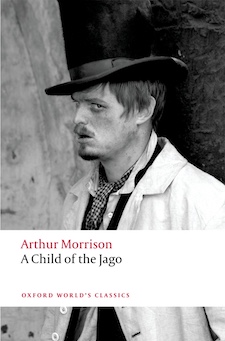 A Child of the Jago
Arthur Morrison
Oxford World’s Classics
Taking place in an East London slum during the 1890s, A Child of the Jago is a British rejoinder to Stephen Crane’s “Maggie: A Girl of the Streets.” A realistic depiction of multi-generational impoverishment, crime, and disease, Jago studies the life of Dicky Perrott over 10 years—from ages 8 to 18—and his parents and siblings. The Jago was fictionalized in name only—the place was real but had been torn down by the time the novel was published. Because the social conditions in which its denizens floundered, the destruction of the old apartments only forced residents to move to other impoverished quarters nearby.
Crime and booze rule the Jago’s streets. One priest, Father Sturt, tries to find employment opportunities for his parishioners and steady sources of food, but with limited success: The food offered comes at the expense of having to endure church services, which the parishioners are reluctant to attend, and employment is usually rejected.
Except for certain robberies and neighborhood battles, few people plan their actions ahead of their occurrence. What is in hand is treasured above mere future possibilities. The men, women, and children rob each other and those who stumble into their neighborhood, taking stolen goods to a local fence, and pennies for which they exchange for alcohol and stale bread.
It’s the age before guns became plentiful, so the violence is limited to the effects engendered by fist, brick, and wood. Because the Jago’s inhabitants are malnourished (Dicky Perrott only stands five-two by the time he’s 18), the fights might be spectacular but the stamina to sustain them limits their duration to an hour or two when members of rival neighborhoods provoke each other’s vengeance, the neighborhoods united only by their mutual hatred of the police. No policeman dare enter the Jago alone.
Morrison shows Dicky’s difficulty in obtaining and keeping honest work—his peers are against it as is his first fence, a Mr. Weech, who wants Dicky to keep supplying him with stolen goods. His father is a drunk ne’er-do-well, his mother an inept sewer of canvas bags (16 hours a day of sewing brings in enough income to pay the weekly rent).
Suffice it to say that A Child of the Jago is not a feel-good tale, and the conditions and opportunities it describes remain largely the same today because society still prefers over systemic change shrugging its shoulders while sneering at the unworthy, shiftless poor.
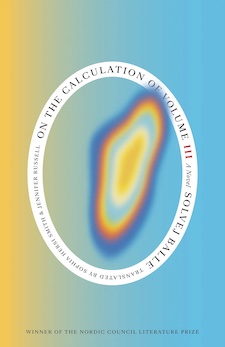 On the Calculation of Volume, Book III
Solvej Balle / Sophia Hersi Smith + Jennifer Russell
New Directions
For readers unfamiliar with the first two books in this seven-book series, here’s a summary of its premise: While on a business trip to Paris, a woman named Tara Selter discovers that she has become stuck in time, the day of her arrival, one November 18. No one she speaks with that day remembers conversations they had with her when she returns the next day, another November 18. Except for her own actions, every day repeats in every detail. Her aim is to figure out how to return to the normal cycle of time.
In the third volume of this seven-book series, Tara has discovered another person stuck in time and as long as she. Henry Dale is his name, originally from Norway but now spending time in Germany, like her, attending the odd lecture at the local university. After spending a few November 18s together exchanging notes on how they have grappled with their situation, Henry moves in with Tara (they sleep separately).
Before this calamity in her life, Tara sold used books and was happily married. While she has spent many November 18s with him by this time in the series, he never remembers their encounter. She is eager to resume her life with him. Henry, however, was a divorced academic who used the repetitious day to pad his vita with articles he’d written. He was fatalistic about the day and assumed nothing he could do would get him unstuck. He does have a kindergarten-aged boy he likes to visit and makes periodic trips to the U.S. to see him.
It is while he is on one of those trips that Tara meets Olga, a 17-year-old student, also stuck in time and herself looking for Ralf, a fourth person stuck in November 18 but gone missing.
Book III places the series in a holding-pattern that spends part of its time recapping Books I and II, allowing Tara another group of days to try different ways of approaching her husband about the problem (and again failing), and adding new points of view by way of additional characters, who each have their own vantage point and set of metaphors with which they attempt to understand and work out their predicament. They come no closer than Tara was by the end of Book I.
Ralf is eventually found; the four move into a vacant mansion; problem-solving resumes—but with two twists: they start examining the inconsistencies in the time loop they’re in (certain items bought on the 18th vanish overnight, others remain), and—just as Book III closes—they are visited by five newcomers.
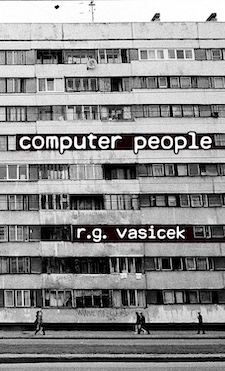 Computer People
R. G. Vasicek
One of the trends in under-the-radar publishing is lo-fi, which eschews the time-consuming vetting of a mainstream publishing house for the immediacy of a medium that aims to reflect contemporary life—self-publishing and along with it the limitations it allows for design and fonts: the modern equivalent of mimeographs and xeroxes satisfying the urge to get it out now. If the layout and font (resembling that of a typewriter) of Computer People look as raw as the text reads, remember that the ad-libbed looseness of Bukowski is an artifice harder to achieve than it looks. The design elements signify “authenticity.”
Despite the book’s title, its aesthetics eschew computer culture, let alone worship it. In something between essay and auto-fiction, the book opens with photographs of notebook pages, which become typewritten transcriptions, the book we’re reading. The computer people of the book’s title are of two types: Those who think (compute) versus those who live as machines, serving as inputs for faceless corporations. Despite the casual look of the layout, the semantic content quotes Hegel, Virgil, Levinas, and figures in terms of applying their philosophies to a life lived.
To the digital life, Vasicek gives the finger: “I’m going to say fuck it… fuck this fake reality… I’m saying it now… fuck it… fuck this fake reality.”
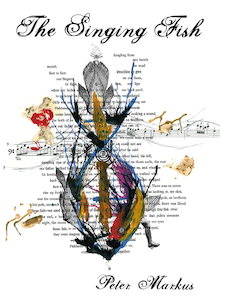 The Singing Fish
Peter Markus
Calamari Press
The Singing Fish is a novella set in a realm with elements of gothic fantastika (such as one of the protagonists deliberately nailing his hand to a post), where the occurrences quickly and unexpectedly turn weird, and the cruelty is cartoonish—after all, for instance, the characters’ heads return in one chapter after being sliced off in a previous chapter. The characters are generically named: Brother, Girl, and Boy. There are two Brothers, one of whom narrates the chapters, most of which could stand on their own as a weird tale of a world like our own but ruled by cartoon physics.
The voice is an odd cadence made of noun-verb-noun phrases grammatically simple and repetitive, paratactic in the manner of oral storytelling, something along the manner of The House That Jack Built. Here is a sample:
We were the both of us ripping off hunks from the moon with the muddy-clawed hammers that were our fists. And that fish that walked on water, when this fish heard the sounds of us brothers singing from the river’s muddy shore, this fish turned its fish head towards the sound that us brothers were making, and what this fish did was, this fish walked across the river’s muddy water, over to us brothers, and what it said to us then was, What are you two looking at?”
If Huck Finn dropped acid with Salvador Dalí, you’d end up with The Singing Fish: Yarns about living next to a muddy river, fishing and diving in it, and hammering fish heads (and human parts) to a post made for scaling.
 On Love and Barley: Haiku of Basho
Basho / Lucien Stryk
Penguin Classics
Over 250 haiku are collected in this volume of poetry by the 17th-century Japanese master, Basho, wonderfully translated by Lucien Stryk. Stryk’s translations of On Love and Barley aim for capturing each haiku’s mood and images rather than mimic in English the syllable pattern followed in Japanese (5-7-5), while succeeding in compressing the poetic expression into three lines that never total above ten words.
Despite their brevity, these are not poems to be read as one might social media posts, which constantly aim to undermine contemplation. If the silence embedded in these poems can’t be heard, they’re being read too fast. Basho’s poems embrace still contemplation in which deep and miraculous beauty is revealed to surround us at every moment, and in which ask us to use our senses to see existence anew by wondering, for instance, what a certain sound might look like. (Not as wonky as it might sound. Sound artist Stephen Vitiello, for instance, has recordings in which light (vibrations) reflected from, say, a skyscraper, is transformed into sound (also vibrations but set to a level humans can hear), and these sounds change based cloud coverage and angle of the sun.) Juxtapositions of disparate sights and sounds indicate auspicious moments. Here are some samples:
#34:
If I’d the knack
I’d sing like
cherry flakes falling.
#17:
Sparrow in eaves,
mice in ceiling—
celestial music.
#149:
Rainy days—
silkworms droop
on mulberries.
Basho succeeds in distilling poetry to its essence, allowing suggestion, nuance, balance, and image to bloom in the reader’s mind.
 Letters on England
Voltaire / Leonard Tancock
Penguin Classics
First published in 1733, Letters on England consists of letters written while Voltaire visited England. Topics include English culture and cultural figures in the fields of politics, science, religion, and literature, beginning with a report on a Quaker church service. Many of the figures discussed were either still alive (with whom Voltaire was probably also personally acquainted) or recently deceased (as with Newton). He discusses the works and ideas of Isaac Newton, John Locke, Francis Bacon, Descartes, Shakespeare, Alexander Pope, Jonathan Swift, John Dryden, and more, including a few off-the-cuff translations into French of the poets.
The last and longest letter (25 pages) concerns nothing British: Pascal’s Pensees. For Voltaire, Pascal too often derives conclusions based on unspoken assumptions that also tilt toward cynical exaggeration rather than on claims defensible via evidence and logic. (Worth picking up a copy of Pensees for that alone. Voltaire is a reasonable rationalist, and ridgid dogmas he finds absurd and harmful.