
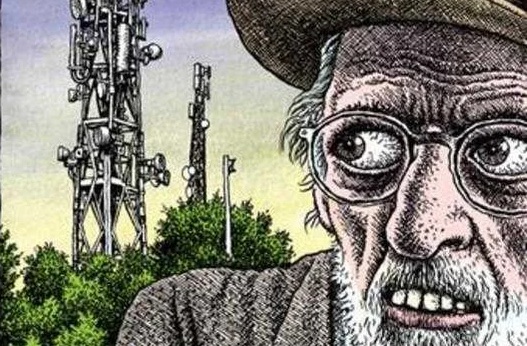
A detail from R. Crumb’s Paranoia front cover.
i arrogantly recommend…#69 is a monthly and sometimes bi-monthly column of unusual, overlooked, ephemeral, small press, comics, and books in translation reviews by our friend, bibliophile, and retired ceiling tile inspector Tom Bowden, who tells us, “This platform allows me to exponentially decrease the number of views on screens by people who have no use for such things.”
Links are provided to our Bookshop.org affiliate page, our Backroom gallery page, or the book’s publisher. Bookshop.org is an alternative to online gorilla bookstores that benefits indie bookstores nationwide. If you notice titles unavailable online, please call and we’ll try to help.
Read more arrogantly recommended reviews at: i arrogantly recommend…
 Motherdying
Michael Lentz / Max Lawton
Isolarii
Winner of the Ingebor Bachmann Prize for new writing in 2001, Motherdying is Michael Lentz’s companion volume to his Schattenfroh. Whereas Schattenfroh is a 1,001-page monument to authoritarian patriarchy, Motherdying, is a tiny (3”x4”, 150 pages) marker in memory of the mother. Schattenfroh’s non-stop narrative on power and its enforcement is countered by chaptered steps acknowledging the grief caused by witnessing the wasting away of a stoic figure whose family members repeatedly endured interrogations by the Nazis running their country.
Apart from the tendency of the German language to form words for new things and concepts by yoking together words that already exist (such as the book title, which encapsulates not just a mother dying but the specificity of a mother dying), Lentz’s descriptions are prosaic, fact-like, and emotionless. (Translator Max Lawton preserves Lentz’s neologisms to preserve the specificity of the images evoked by them.) The emotionless text is not the same as a cold, unsympathetic text; it acts to pin down, for further study, how, for instance, his mother looked and acted in the hospital, her habits as a housewife before and during her illness, the progress of the cancer as it slowly eats away her capacities to move, speak, and think.
The narration remains matter-of-fact for the book’s first three-quarters, but vitriol begins seeping in once treatments for his mother’s cancer seem ineffective, her doctor indifferent, and her mind and body release their grip on decency. The sentences lengthen, the compound words multiply and lengthen, the frustrations with medical care become more strident.
As her death approaches, denial of the inevitable kicks in:
“we watched TV together again, then she fell asleep and wanted to be taken back to her bed because she didn’t have the strength to lie there any longer, then I said goodbye again with gestures handgestures and I thought she’ll manage that she’ll stay awake it doesn’t make a difference she won’t topple over she’ll pull through in the end she needs to rest she can still walk after all and if one can still walk then one isn’t yet falling over and if one isn’t quite falling over yet then one isn’t quite dead yet and if one isn’t quite dead yet then one is still managing OK.”
And then one admits that she isn’t managing OK, and the incipient death that accompanies her in photographs from even decades ago emerges from its chrysalis.
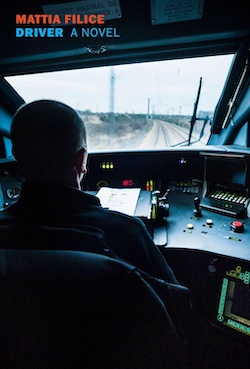 Driver
Mattia Filice / Jacques Houis
NYRB
Driver is a novel based on Mattia Filice’s 20-plus years as a train engineer in France, following the narrator from his training period to his development from neophyte to full professional, to the stretch of time as an old hand. Far from being a simple job of acceleration and deceleration, Driver reveals the task of driving trains as onerous, stressful, and potentially lethal.
On the job, the narrator discovers first-hand the horrors created by people who use trains as a suicide device. Given the inertia created by pulling hundreds of tons of cars and freight, trains can require 700 feet to completely stop, so the driver’s eyes are always on the far horizon, while his brain realizes that even his immediate reaction to a lethal situation often will be insufficient to prevent tragedy. The narrator’s body count from his own career comes to 16. (We learn of rail employees whose sole job it is to hose down the fronts and sides of engines.) Wildlife, too, stray onto tracks and risk potentially damaging the train’s undercarriage, severing cables as their bodies are pulped. Pranksters place objects on tracks to see the objects destroyed, not realizing their ability to derail the train.
Collisions require stops so the train can be examined for damage and so, in certain cases, the engineer can talk with authorities after accidents involving humans. Inspections require time, of course, time lost that may put a train behind schedule. However, making up for time by driving faster only further endangers the train and its cargo (sometimes human passengers), and engineers are fined for driving too fast: they work on tight schedules with little room for maneuvering.
Not surprisingly, the training period has a high attrition rate, largely determined by each recruit’s mix of self-discipline and steely nerves. During a field run, one old hand asks a trainee to turn, face the back of train, plug his ears, and crouch down, which the trainee does without question. The old hand has seen a suicide ahead, knows the train cannot stop in time to prevent it, and doesn’t want the recruit to have to see or hear it.
Train driving is a lonely job, and whole days—hundreds of miles—can be traversed without meeting or talking to anyone. Most time is spent alone with one’s thoughts, even at day’s end. Train routes often end far from the drivers’ homes, so they often sleep at junctions in bunks designed for them, in rooms never as comfortable and quiet as home, and the sleep rarely as good.
The last thing seasoned drivers must remain mindful of is the annual health examination for hearing loss, weight gain, high cholesterol, diabetes, and psychological fitness. One man the narrator trains with suffers a paralyzing stroke at the age of 28, probably from stress.
Filice’s prose offers a rhythmic analog to the rhythms of a driving train, not in meter (clackety-clack) but in pacing. Sentences alternate between appearing broken into lines, as in poetry and drama, and being splayed across the page in paragraphs, when the need to emphasize specific thoughts, feelings, and actions is of less importance. Filice’s translator, Jacques Houis, does well at conveying this. Technically, it’s a type of avant-garde expression that doesn’t feel avant-garde.
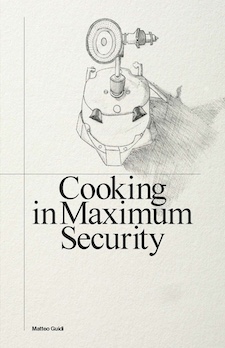 Cooking in Maximum Security
Matteo Guidi
Half Letter Press
From 2009 to 2013, Matteo Guidi corresponded with a number of inmates across several of Italy’s maximum-security prisons. Over this period, the inmates sent him recipes for foods as various as bread, endive and beans, apple strudel, penne pasta, and more. Using a combination of permissible pans, semi-clandestine handmade utensils and baking equipment made from found junk, and food sent from home, these resourceful prisoners demonstrate what a great spur to creativity constraint is. Although the main course is presumably taken in the prison canteen, the book offers an otherwise full menu—starters, first and second courses, sides, drinks, and desserts—for the cell.
Mario Trudu’s illustrations of the cooking implements are the heart of this cookbook, illustrations accompanying instructions on how to make the tools used, recipes of ingredients and equipment needed, and step-by-step directions for cooking. Bed sheets are used for straining tomatoes; shoelaces for “Granddad Ciccio’s pepper bacon”; a piece of wood to stir a pot of “Old-style penne pasta” (“can be obtained from a crucifix”); and other variations on conventional tools. One recipe warns: “Never ask diners if the meal is tasty. It is not very tactful.” That said, an appendix lists over 300 items prisoners can buy from the commissary and their cost, including frozen sea bass, mozzarella, and canned tuna.
Still, one can appreciate the urge for ease and comfort, the desire to work with one’s hands and create something, the enjoyment of eating with others. For the cookbook collector, Cooking in Maximum Security deserves a place alongside Chris Maynard and Bill Scheller’s Manifold Destiny, a cookbook with recipes you can cook on your car’s engine while traveling to see Grandma.
 Tales of Paranoia
Robert Crumb
Fantagraphics
Tales of Paranoia is Robert Crumb’s first book of new comics in 23 years. At 82, Crumb remains a master draftsman able to imbue existential drama even in stories whose outward actions consist only of depictions of Crumb in bed worrying over anxious thoughts. His paranoid musings cover COVID-19, the vaccines developed to counter it, the “deep state,” bad “LSD” trips, and pleas to what may be an imaginary god.
A problem common to believers in conspiracy theories is that otherwise healthy skepticism toward any assertion of fact or truth is not balanced by a distinction between possible and probably or a foundation upon which facticity or truth can be established—it’s just radical doubt all the way down. Although I find fault with some of his reasoning, Crumb is as articulate and expressive in his writing as he is his drawing, given to entertaining points of view contrary to his own. He may be old but he hasn’t mellowed and shows every sign of refusing to go gentle into that good night.
 Altcomics #7
2dcloud
A 40-page anthology of new comics from Blaise Larmee, Katie Lane, Clair Gunther, Jason Overby, Matthew Thurber, and veteran Frank Santoro. Although colors are used, most artists here tend to work within the confines of monochromatic scale with ink, watercolors, and washes, and all have unique styles and modes of expression.
Matthew Thurber’s inside covers consist of 3×3 panels that mix portraits of people choking themselves alongside innocuous shots of office equipment, theme parks, and so on. Clair Gunther’s “The Street Sweeper” channels Stan Mack and Jules Pfeiffer, and Jason Overby with seeming arbitrariness imposes panels on full-page figure studies (which end up making visual sense), inside of which a narrator reviews why he gave up art for a couple of years. The juxtapositions between images and words require readers to make their own connections to complete the expositions. Blaise Larmee is the star here, providing front and back covers and a two-part story that superimposes rough sketches atop fussily precise, gridded drawing, erotic imagery with statements on consciousness, creating semantically dense sequences.
Overall, the artists in Altcomics #7 provide smart contributions to the exploration and development of visual storytelling.
Ugly Duckling Presse’s chapbook series, Señal, is devoted to translating contemporary Latin American poetry into English. Now up to 26 volumes, the chapbooks reviewed below are by poets hailing from Columbia, Peru, Guyana, and Venezuela.
 Against the Regime of the Fluent
Natasha Tiniacos / Rebeca Alderete Baca
Venezuelan poet Natasha Tiniacos limns the plights of exiles and those still living under domination of a hostile government, for whom with threat of death—by the government or on the journey of escape—hangs over every moment.
Beginning with a return to a house filled with (literal and metaphorical) hungry sleepers, Against the Regime of the Fluent is witnessed by a narrator who can keep silent no longer: “I have resolved that maybe my voice matters / that when I dissent / luck backs me up into a corner.”
The voice begins reluctantly, confessing “I touch everything I break” in this “story of how I’ve failed.” The voice is a survivor’s. Now in a safe place, reflecting on what has been left behind: a flowing, fluent power like a river that destroys everyone and everything in its path. A natural force, but one that will eventually erode even what supports it.
The narrator can only send back messages of hope to those left behind:
“We must be an Odysseus until the very end,
it’s not strange that someone with only one eye
would believe what I tell them…
If he asks me who I am, as I sharpen my stake,
I’ll say ‘Nobody.’
So when he tries to take his revenge
and they ask him who hurt you
he says Nobody. Nobody in the flesh. The sheep’s
abdomen, hairless and hot.”
 Jombii Jamborii
Jeremy Jacob Peretz + Joan Cambridge-Mayfield
The official language of Guyana (formerly British Guyana) is English: It is the only dialect accepted for conducting governmental and educational transactions. However, most inhabitants of Guyana speak a Creole that mixes English with traditional, indigenous language, and thus the mandate to speak and write in standard English serves as a class and racial barrier that retards the economic rise and security of that majority population. Creole, spoken or written, is not tolerated in schools, and is assumed by school officials to be each student’s primary language at home.
Thus, Creole serves as a daily reminder for the Guyanese of their status and social history, while also preserving their ties to the land and traditional indigenous folkways. “Jombii Jamborii” is Guyanese creole for “wild party,” and readers who are already familiar with the Englished “jamboree” will find that much of the Creole appearing in this chapbook can, with a little work, be translated into English. (Jombii Jamborii includes both poems entirely in Creole with facing English translation, and poems that mix English and Creole.)
Who attends this wild party? The ancestors, whose spirits continue to exist in the land, allowing the living to feel and be directed by the messages they receive and see in the natural world around them, including wind and water. A libation to the ancestors, then, is the appropriate way to begin the festive gathering:
we can’t see you
but we can sense
you are here with us
we know you are
like the breeze wafting through
these forest thickets called life.
accept these dewdrops
on your forehead of mossy stone
all who want us to prosper
with more more more future
THIS IS FOR YOU!
FIRE ONE WITH US!
all you blowing good wind on us
the rest will keep wandering
far, far from our party.
And with that, we enter their world and the spirits that inform it.
 Lemonade: A Paranormal Investigation
Catalina Vargas Tovar / Juliana Borrero
Lemonade is a poem about ecological disaster, with the potential energy of a mountain representing nature to reward or punish. The paranormal factor is translingual, that which bridges the physical to the metaphysical. It is “translingual” because, as in William Burroughs’s assertion that “language is a virus,” so that the capacity for language which allows us to communicate with each other has also led to the planetary-wide degradation of nature. If I’m reading Lemonade right, the translingual is represented here by the color yellow—for the ingested lemonade, of course, but also for the soul’s ectoplasm.
The mountain “keeps time / like phlegm / sticky / thick / burning / furious” . . . “a yellowish light / creamy and intense / will thicken the night // the air will become milky / the dew will coagulate / from now on / our words / will be written in ectoplasm,” and the “ghosts / . . . drink lemonade.” “[W]hen we become mountains / the whole atmosphere will be ectoplasm.”
The mountain—nature, that is—transcends language. It came before us and will outlast us, and the material and spiritual will again be one.
 Red Lip Peril
Dalmacia Ruiz-Rosas Samohod / Judah Rubin
Originally written between 1977 and 1988 but not published in chapbook form until 2024, the poems comprising Ruiz-Rosas’ Red Lip Peril cover Peru’s 10-year period of wild political instability. From protesting the military regime of Francisco Morales Bermúdez to fending off the terrorism of the Shining Path, Ruiz-Rosas reflects on the fear, distrust, and mixed feelings generated by such living conditions. In the everyday life of a nation at war with itself, moments of joy give way to memories of police beatings, are community gatherings with friends become tainted by fear of infiltration by informants. A poem with lines alternating between all caps and all lower case seems to be a lament about being stood up for date (all caps) and the facts (in lower case) that the no-show was busy fighting police.
We’re compelled by our own knowledge
to have our eyes wide open
mind perpetually pulsing
Look the trash blanketing the sidewalk
is up to our knees on some stretches
Because for us the world doesn’t end
where the gardens do
Our life is out in the street.