
i arrogantly recommend… is a monthly and sometimes bi-monthly column of unusual, overlooked, ephemeral, small press, comics, and books in translation reviews by our friend, bibliophile, and retired ceiling tile inspector Tom Bowden, who tells us, “This platform allows me to exponentially decrease the number of views on screens by people who have no use for such things.”
Links are provided to our Bookshop.org affiliate page, our Backroom gallery page, or the book’s publisher. Bookshop.org is an alternative to online gorillas, and that benefits indie bookstores nationwide. If you notice titles unavailable online, please call and we’ll try to help.
Read more arrogantly recommended reviews at: i arrogantly recommend…
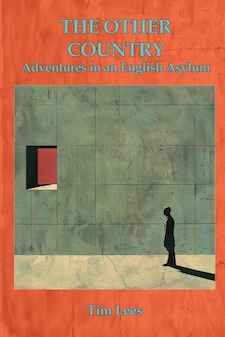 The Other Country: Adventures in an English Asylum
Tim Lees
Incunabula
Ray is young, unemployed, broke, and badly in need of getting his life “back in shape.” Thus, he finds himself accepting a position as a Nursing Assistant during a time of economic turndown with few job prospects. As the principle of Chekhov’s Gun would have it, if you place a gun on the wall in Act One of a play, it better go off by the end of the play.” In Sunflower, the ward in which Ray works, the gun is always already on the wall. And it certainly goes off.
If there’s such a sub-genre as “asylum lit,” one of its tropes is demonstrating that human behavior exists on a continuum, and that the capacity for cruelty and kindness on the part of either the patients or staff seems balanced. Violent outbursts do occur, but the staff have been trained in restraint without pain. Still, the gun must go off; the question is, which side of the continuum will fire it?
Time—narrative time, at least—passes oddly here. Most of the novel’s incidents occur in the asylum, a neon-lit, tile-floored echo chamber painted in neutral colors where seasons and holidays don’t exist. And there’s the loneliness. On both sides, staff and patients. Except for infrequent work-related outings, the staff rarely develop friendships with each other or open their hearts. Patients are rarely visited by family. If they are, it’s usually disastrous.
Ray’s story spools out in a series of anecdotes about what occurs while he’s at work: The painstaking accounting he and others must do of eating utensils, pool cues and pool balls, nail clippers, and so forth borrowed, returned, and secured. The peripheral vision he must develop to lessen the likelihood of receiving an unexpected kick or punch; of having to act fearless in the face of threats; of being arbitrarily reprimanded by sadistic management. When he first hires in, he’s told people typically burn out after six months; he lasts two years, evidence of a capacity for simultaneous empathy and depersonalization.
My only nit with Tim Lee’s book is that the narrative largely ignores Ray’s home life, the one he set out to straighten. Apart from being told that he has a scotch or two when he gets home, maybe listens to some music, then goes to bed, we know nothing of who he is when he’s at home as a contrast to who he is at work. He mentions in passing—once—that he keeps a diary. Oh? Even if every recounting of a day in Sunflower ended with “and then I went home, had a drink, and went to bed,” that droning foundation could make his experiences on the ward keener in contrast. But apart from chiding an author for not doing what he perhaps never set out to do, The Other Country is an excellent illustration of human compassion at its limits.
 Enemy of the Sun: Poetry of Palestinian Resistance
Naseer Aruri and Edmund Ghareeb (Eds.)
7 Stories Press
First published in 1970 and long out of print, the original intention behind this collection of “Poetry of Palestinian Resistance” aimed to highlight the similar plights faced by Palestinians and Black Americans in their struggle for civil rights. The activist and Black Panther Party leader George Jackson (author of Soledad Brother and Blood in My Eye) was so inspired by the collection that one of the poems Jackson copied down to share with other Black activists was mistaken as his own. Fifty-five years later, the plight of Muslims in Gaza have only worsened, and Black Americans as a group remain behind their white cohorts in terms of education and economics.
Of the original contributors, Westerners may be familiar with the poetry of Mahmoud Darweesh, Haroun Hashim Rashid, and Kamal Nassar. Four other poets contribute work written since the Israeli government’s attempted annihilation of Gazans after Hamas’s ill-considered slaughter and kidnapping of Jews who lived on the other side of the Gaza Strip in October 2023.
In 1970 (let alone today), which black citizen of the U.S. couldn’t empathize with Sameeh al-Qassem’s “A Hanging Human 1964”?
One of the toys that appeared on the Israeli market was that of a “hanged Arab.”
A hanging human body
The prettiest of toys
The Sweetest recreation for children
Displayed on the market!
No, it is not there anymore
It has been sold out for days
Don’t search for it, tell your child
It’s sold out for days!
Oh, souls of those
Dead in Nazi concentration camps—
The hanged human
Is not a Jew in Berlin.
The hanged human is an Arab
Like me, of my people
Hanged by your brother—
Forgive me, hanged by the crypto Nazis
In Zion!
Souls of the victims
Of Nazi camps—
If only you knew!
If only you knew!
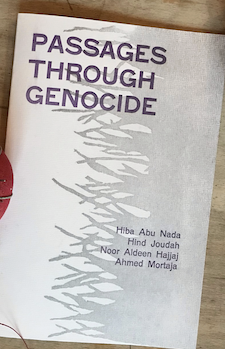 Passages through Genocide
Hiba Abu Nada, Hind Joudah, Noor Aldeen Hajjaj, Ahmed Mortaja
This 28-page pamphlet, published December 2024, includes poetry and diary entries from four Palestinians written during the Israeli government’s genocidal war on Gazans, beginning on October 7, 2023. Two of the four writers were killed during the attacks, and a third continued writing after being pulled from the rubble of a building that collapsed on him during an attack. These are real-time accounts—pleas, descriptions of degradations, cries to God, cries to humanity. From Hiba Abu Nada, five days before she was killed:
“That sounds we hear is the sound of death that has passed over us to choose another. We are still alive, we hear the death of others we know, we say: Thank God, the last sound they heard was not the sound of the missile. Those who hear the sound of the missile survive. We are alive until further notice.”
To read more and to find out how to help, visit www.gazapassage.com.
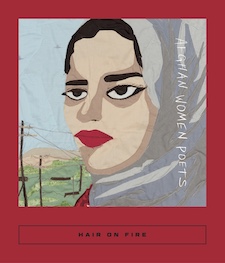 Hair on Fire: Afghan Women Poets
Two Lines Press
Five poets writing in Persian whose works reflect the lives and concerns of the Afghan diaspora in general and women Afghanis in particular: Mahbouba Ibrahimi, Maral Taheri, Karima Shabrang, Mariam Meetra, and Nadia Anjuman. Rendered into English by six translators (Persian on the verso, English the recto), these women describe fears of abandonment, fret over their children’s safety, long for a life that existed before the Taliban, before the Soviet invasion. In exile, they feel out of place, alone. Here is the entirety of Karima Shabrang’s untitled poem (translated by Sabrina Nouri and Samantha Cosentino):
Of all things silent I am afraid,
of silent streets at night
when I know
that tomorrow will birth terror
and two-headed creatures
with long hands that reach
the bottom of every life
the end of my hopes.
Of the silent newborn I am afraid,
when he opens his eyes each morning
to find a rifle on the wall greeting him, not a father,
and a few years later
bullets will teach him to add and multiply
and missing classmates to subtract
those turned to corpses last night.
Of long hypnotic beards I am afraid,
when I know
in the thick plot of hair lies a mass execution.
Of all things silent I am afraid,
of a silent God
who dwells where the hands of orphans can’t reach.
Hair on Fire is the twelfth anthology of literature and poetry in translation published as part of the biannual Calico series from Two Line Press. Previous anthologies have focused on Caribbean writing, gay Brazilians, Arabic poetry, Russian poetry, and more.
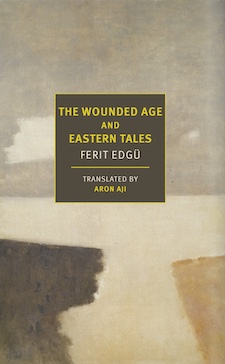 The Wounded Age / Eastern Tales
Ferit Edgü [Aron Aji, trans.]
NYRB Classics
Set in Turkey’s eastern mountain region, Ferit Edgü’s two novellas—The Wounded Age and Eastern Tales—reports on the peoples of the area—Armenians, Greeks, Assyrians, and Kurds—who have been warring against each other for centuries. The vignettes comprising the books, most only a page or two long, come across as a blend of poetry, prose, and drama. We know from The Wounded Age’s introduction that its nameless narrator has been called to cover a mountainous area riddled with murderous ethnic conflicts. The names and backgrounds of those the narrator meets are never identified, probably because they all inflict the same horrors upon each other and in that way resemble each other, each page-long vignette an observation or anecdote from the narrator’s notebook.
For this edition, the two novellas have been switched in terms of chronology of their original release date, with The Wounded Age better representing Edgü’s mature style. These tersely captioned snapshots of observations and conversations with those he encounters are like lyric poems of wartime reminiscence of worry, frustration, fear, and mourning. Whether the people encountered are Armenian, Greek, Assyrian, or Kurd, Edgü tell us only what they say and do, what they eat, what they share, what they fear or shrug off. Many have lived their entire lives as roaming exiles, under fire wherever they attempt to settle. Edgü lived among these peoples for nine months, but the encounters haunted him the rest of his life.
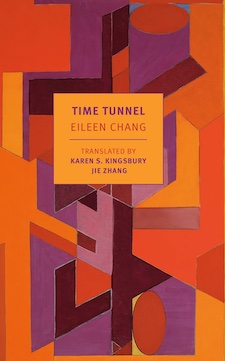 Time Tunnel
Eileen Chang / Karen S. Kingsbury & Jie Zhang
NYRB Classics
Time Tunnel collects short stories and essays by Eileen Chang spanning her last 35 years, and thus covering her time while living in the U.S., after leaving Shanghai in 1952, when living under communist rule was no longer tenable for her. The stories reflect on an earlier era, before the triumph of Maoism but in its early years before his series of five-year plans became excuses for committing mass murder. Time Tunnel features her signature style of focusing on multi-generational households in which increasing Westernization—including clothes, music, women’s rights and education—struggles with maintaining traditional ways, both of which (Westernization and traditional values) the Communist Party rejected. (The changing political system serves mainly as background noise in Chang’s stories.)
“Young at the Time,” the first story, is from the point of view of a young Chinese college student who develops a fascination with a young Russian ex-pat working and studying in Shanghai. She, Cynthia, and he, Ruliang, teach each other German and Mandarin, respectively. Cynthia is oblivious to Ruliang’s (ambiguous) affections, which seem more with her exoticness to him and the possibility of a different type of life he would lead if they were together. As a study in possibilities, Cynthia’s life, Ruliang comes to realize, is a study in universal limitations.
However, as the temporal proximity to the events she records increases, something has been lost in the warmth and sense of discovery brought by new sensations, so that the short stories here feel stuck in limbo—their novella-lengths either in need of paring down or filling out. (“Young at the Time,” a 20-page story, succeeds as a narratively tight tale better than the novellas do.)
However, the later pieces included in Time Tunnel are essays about her impressions of the U.S., written between 1958 and 1988, have the freshness of her older fictions. Her comparison of New England to China (circa 1958), in an essay of the same name, finds her making startling observations about bodily and material safety in the U.S., which Chang finds a paragon of virtue compared to rampant crime in China.
Time Tunnel will be welcomed by fans of Eileen Chang, such as myself, but neophytes are recommended to start with Chang’s Love in a Fallen City.
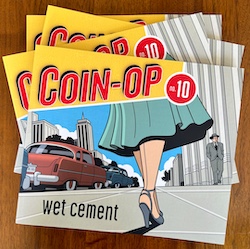 Coin-Op No. 10: Wet Cement
Peter and Maria Hoey
Coin-Op Books
Two of the most lasting narrative forms developed during the 20th century were surrealism and the hard-boiled detective story. Peter and Maria Hoey combine these approaches in the tenth issue of their series Coin-Op to create an absurdist 50’s-style combining crime, science fiction, and weirdness. Their deadpan illustration style is somewhere in the realm of Chris Ware and Seth, combining quotidian, extraordinary, and ridiculous experiences with a straight face.
Wet Cement opens by introducing us to G., an “engineer in the bureau of sidewalks” and L., who “works in the bureau of streetlamps,” his neighbor on the floor below. Unbeknownst to either of them is that in the middle of the night, microwave transmissions are sent out from the top of the city’s skyscrapers. These transmissions are heard by some of the citizens, who sleepwalk into empty vans awaiting them on the streets outside their apartments. Taken to a secret location, their brainwaves are recorded, then fed into a cement mixer. The citizens are returned home, where they awaken, still tired from their restless night, but with no memory of what has happened to them.
After a meeting between the bureaus of sidewalks and streetlamps, L. tells G. that she sometimes has seen him from her apartment window walking around outside in the middle of the night. G. is puzzled; L. fears she has offended him. Soon after, G. disappears. With thoughts of an old flame adding to her sense of confusion and loneliness—her former boyfriend D. is in prison for bank robbery—a film short about cement at the local theater gives her an idea for freeing D., an idea that will tie together all the story’s loose ends.
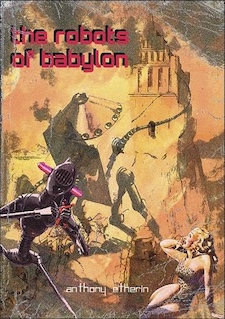 The Robots of Babylon
Anthony Etherin
Penteract Press
Attention, fans of all things OULIPO: Anthony Etherin’s The Robots of Babylon contains various types of palindromes, anagrams, lipograms, tautograms, abecedarians, and pangrams, and more, all in service of playing with tropes from old science fiction and monster movies. Accompanying them are Etherin’s collages of images from SF and monster magazines.
As an example, here is Etherin’s “Lock Ness Monster,” “a palindrome-by-letter, followed by an ottava rima (ABABABCC) in iambic tetrameter” featuring “each letter of the alphabet at least once” (i.e., a pangram):
Emit,
sad Loch,
self’s tides….
Nessie is sensed—
its flesh cold as time.
Upon the vernal equinox,
when all our fictions come to pass,
a shadow leans across the rocks.
Beneath the water, clouds amass,
a nebula absorbs the loch’s
illusions—hoaxes, dreams in glass,
the jostling haze of history’s whims—
until, at last, a creature swims….
Etherin handles with deft ease the constraints he puts before himself, an ease which reminds me of Art Tatum’s ability to sit at the piano for hours and effortlessly turn out permutations of melody and harmony from old standards, belying just how difficult such alchemy is.
 Scaling the Mountain of Winter
Luke Bradford
Enneract Editions / Penteract Press
A small gem of a book (it’s only 28 pages), Scaling the Mountain of Winter is the result of Luke Bradford’s erasure of “Scaling the World’s Most Lethal Mountain, in the Dead of Winter” by Michael Powell (published online at The New York Times in 2017 and still available). Based on the constraint of working with only the letters available in the sequence they originally appear, erasure, in visual poetics, consists of erasing from a source text (either found by chance or chosen deliberately) its words and punctuation, except for those letters and words that can be brought together to reveal / create a subtext. What has been blanked out may be decorated over, as in Tom Phillips’s famous A Humument from 1970 (and still going through revisions) or, more recently (2011), Matthea Harvey’s Of Lamb, which redacts a biography of Charles Lamb to mine a story about his daughters.
Unlike other forms of erasure, which shows traces of the artist at work, Luke Bradford worked with a digital text, leaving no traces or suggestions of Bradford’s technique (“track changes” would have preserved Bradford’s deletions). I don’t have the patience to do a line-by-line comparison of the source text and Bradford’s creation from it, but he evokes a haiku-like compression from it.
No one can be certain how a body will react at the top of the world. The air has half the oxygen. Climbers enter Death; it is difficult to draw breath, the heart strains to pump blood. When climbers reach the summit, their breathing will be a shallow, fast pant. They will vomit and suffer and begin to hallucinate.
A past-exhaustion night climb. He huddled inside a tiny tent and made tea for two: himself and his companion.
I felt him. And he was not there.
All of which brings us to climbing.
 Jail on Wheels: A Mid-20th-Century Scared Straight
Jacqui Shine
Half Letter Press
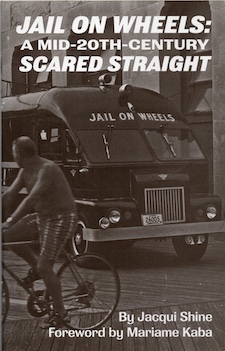
A short but well-researched pamphlet (86 footnotes for 30 pages of text) on an amateur-level attempt to stifle crime in the middle of the last century. Begun by Sheriff J. Edward Slavin, whose background as a carnival barker substituted for his utter lack of criminology credentials, Jail on Wheels consisted of buses filled with items related to committing crimes and enforcing justice—including an electric chair and, eventually, a gas chamber—which drove around the country in an attempt to reduce the newly defined arena of juvenile delinquency.
Slavin himself seems to have been a shady character, as the jails he oversaw in Connecticut were prone to frequent escapes (which could be paid for), and the prisoners prone to shakedowns for extra cash. Slavin even had say over who among the law-abiding citizens qualified for home loans in the city he lived in. (And the only city he lost in during county elections.) Starting in the late 1930s, when campaigns to halt juvenile delinquency began, Slavin wrote radio programs and comic books featuring one Sheriff Jack, who was prone to spanking naughty boys as a deterrent from entering a life of crime. No evidence supports the idea that Slavin’s Jail on Wheels had the desired effect (nor did its successor, Scared Straight). In fact, by the 1960s, Slavin’s buses avoided high-crime areas because his drivers were alternately robbed by local thugs and arrested for carrying guns by local law enforcement. A fascinating chapter in the history of American criminology.