
i arrogantly recommend… is a monthly column of unusual, overlooked, ephemeral, small press, comics, and books in translation reviews by our friend, bibliophile, and retired ceiling tile inspector Tom Bowden, who tells us, “This platform allows me to exponentially decrease the number of views on screens by people who have no use for such things.”
Links are provided to our Bookshop.org affiliate page, our Backroom gallery page, or the book’s publisher. Bookshop.org is an alternative to the big online gorillas that benefits indie bookstores nationwide. If you notice titles unavailable online, please call and we’ll try to help.
Read more arrogantly recommended reviews at: i arrogantly recommend…
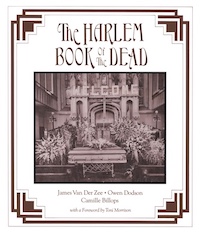
The Harlem Book of the Dead
James Van Der Zee, Owen Dodson, Camille Billops, with a Foreword by Toni Morrison
Primary Information
First published in 1978 and now reprinted, The Harlem Book of the Dead is a document of historical significance. James Van Der Zee (1886-1983) was a photographer of daily life prominent during and after the Harlem Renaissance, when he started. This book focuses on his photographs of the dead, whose funerals he was hired to commemorate, as well as his daughters’ funerals. The photographs would be kept as mementos by family members, photographs Van Der Zee sometimes altered to soften the blow of the content—adding background images of angels, inspirational quotes, and other tropes of hopefulness. The casket arrangements are respectful and dignified without pretension. In the case of infant death, the child might be shown in the arms of its stoic, grieving parents. (Apparently during the decades these photographs were taken, infant death from pneumonia was common since their parents often lived in un- or under-heated apartments.)
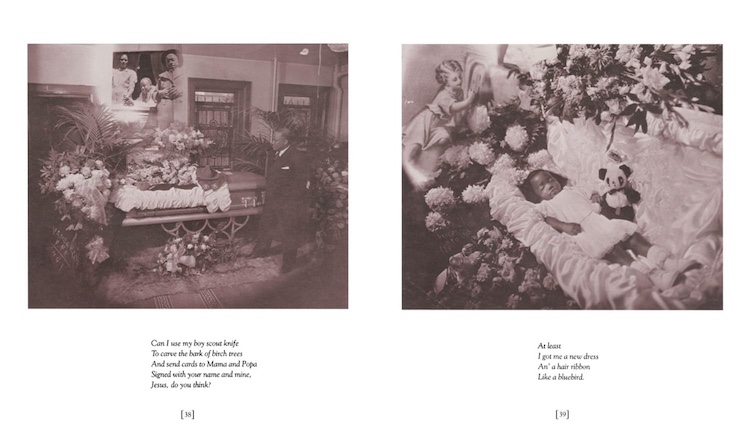
Two sets of texts accompany the photographs: an interview and a series of poems. Interleaved among the photographs is a dialogue between Van Der Zee and Camille Billops (1933-2019), the sculptor and filmmaker, that focuses on Ver Der Zee’s life, the contexts in which he photographed, and the message he hoped his funeral photography would serve for families of the deceased.
The second set of texts are poems by Owen Dodson (1914-1983), poems that range from hymn to protest, reflecting the mood of the photographs—solemnity, loss, loneliness, rage—and the community they were created for. The Harlem Book of the Dead is a superb artwork in the form of a testament to a time, place, and people.
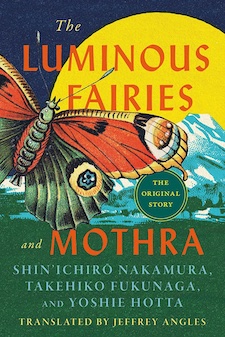 The Luminous Fairies and Mothra
Shin’ichiro Nakamura, Takehiko Fukunaga, Yoshie Hotta / Jeffrey Angles
University of Minnesota Press
In 1961, Japanese film company Toho Studios commissioned three prominent fiction writers to develop a monster story. Mothra was their creation, frenemy of Godzilla. Taking place on a South Pacific Island named Rolisica—an amalgamation of U.S. and Russian islands near Japan that each nation used for its nuclear tests—a group of explorers rescue four sailors marooned after a typhoon destroys their ship. No sailor shows signs of radiation poisoning despite the nuclear tests, and each speaks of island inhabitants who saved them. How any creature could endure multiple hydrogen bomb explosions is what the expedition hopes to discover, hazmat suits in tow. What they discover is perhaps more fantastic than what the sailors had told them of, involving a race of people about two feet tall who sing rather than speak and seem possessed of an ability to communicate telepathically. The small race of people worships a large egg protected by four tiny women; i.e., the luminous fairies (the film version has only two). Developing within the egg: Mothra.
An American (of course) sees big bucks to be had by exploiting the luminous fairies on the lecture circuit, so he kidnaps them, forcing them to ululate on command. . . The egg holding Mothra decides it’s time to get cracking.
Translator Jeffrey Angles provides an insightful afterward explaining Mothra’s backstory and the historical context its creation was in reaction to, as well as demonstrating the unlikely connection between Mothra and Hugh Lofting’s Doctor Doolittle series.
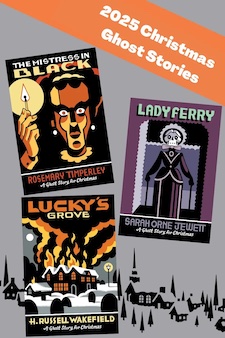 SETH’S GHOST STORIES FOR CHRISTMAS:
Lady Ferry by Sarah Orne Jewett
Mistress in Black by Rosemary Timperley
Lucky’s Grove by H. Russell Wakefield
Biblioasis
Now in its tenth year, the Ghost Stories for Christmas series—selected by designer, illustrator, and decorator—returns with three reanimated tales, each published in its own pocket-sized edition, ranging from 50 to 90 pages. Back in the day, magazines and newspapers published ghost stories meant to be read during the Christmas season. Who knows what the connection is between Christmas and malign spirits, but it’s the same fascination Tim Burton exploits in his film The Nightmare before Christmas, which both reverses the chronology and extends it to the period between Halloween and Christmas. When it was a thing, writing ghost stories was not merely an affair for B-grade genre writers but attracted mainstream authors. Charles Dickens, Edith Wharton, and Arthur Conan Doyle are among the mainstream writers still read and studied in colleges featured in Seth’s series—as well as stalwarts of the weird and eerie, such as M. R. L. James, Algernon Blackwood, and Shirley Jackson.
H. Russell Wakefield’s Lucky’s Grove can be read as an eco-horror thriller ahead of its time that could be subtitled “The Plant’s Revenge.” Although I doubt that was Wakefield’s intention 85 years ago, today it’s hard not to read as a cautionary tale—and the only one of the series that actually takes place on Christmas. Just as nature is telling us now, ignorance of natural laws is no excuse, and all who violate them will be punished.
Mistress in Black by Rosemary Timperley deals with a common experience (perhaps something we’ve done ourselves): the strange way in which one person’s anger toward and disappointment with another person is taken out on a third party, the one it’s “safe” to punish. One small town’s secret is revealed when a new teacher is hired to replace another, well-beloved teacher. Hints of suppressed lesbianism add to the drama of the denouement.
My favorite of this year’s trio of tales is Sarah Orne Jewett’s Lady Ferry, which deals with a restless spirit that has become accepted by the household she occasionally haunts, for hers is a melancholy story. The quality of the story, in addition to its attentiveness to mood and detail, has much to do with its pacing, which owes to, I suspect, having been written to be read aloud. If a comma = ½ beat pause, a semi-colon = one full beat, and a period = two beats, then Lady Ferry excels at pulling along the listener, building a string of details, connecting them, and pausing to let their creepy significance sink in.
Each story, from cover to inside decorations (Seth’s term for what the rest of us might call illustrations), sets the scene and mood, while never giving anything away: They’re the creaky door that invites you inside, the things bumped into in the night.
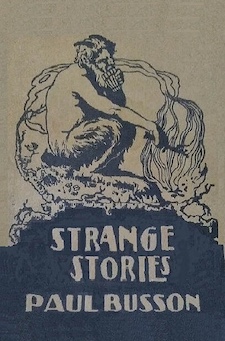 Strange Stories
Paul Busson / Shawn M. Garrett
Strange Ports Press
Paul Busson (1873-1924) was an Austrian author who published stories that mixed elements of weird fiction with horror, suspense, ghost stories, and tales of lost worlds. Fast-paced yet suspenseful they are examples of efficiency in setting eerie and unsettling moods, often ending with a zing of fate arising quickly but—in hindsight—fated all along. Strange Stories collects tales composed by Busson from 1903 to 1923.
Busson’s stories about eerie, malevolent Nature—such as “The Smoking Stone”—have the foreboding atmosphere found in stories by Adalbert Stifter and Charles Ferdinand Ramuz, which take place in treacherous mountain areas, areas particularly dangerous to the hapless human denizens faced with the anger of a spurned demi-god no longer worshipped. Particularly malevolent creatures of the forest may actually be malign spirits embodied alternatively between human and wolf form. The righteous are not always saved by their devoutness, but a type of rough justice prevails, and most people try to retain the balance between good and evil.
Still, confronted with unspeakable horror in human form, men (it’s always men) may be powerless when the form is dressed in beauty. Here is Busson’s description of a femme fatale:
Her sweet, rosy, childlike face seemed to have a particularly promising smile for everyone who came near her, and the small favors she dispensed with the air of a queen were like sharp fishhooks on which all these men wriggled. During those few days at sea, they completely lost their minds and behaved like madmen. Sometimes they all hated one another, sometimes they attacked one individual. When they rushed from all sides to greet the woman who appear on deck, it looked as if flies were feeding, the kind that would surely please the spider in whose web they were hanging.
She was certainly not a kind creature. On certain occasions, I saw in her doll-like face two small wrinkles, like snakes, slide around the corners of her mouth and a pale fire in her bright eyes—sure signs of cruelty. Children look like that when they torture animals.
Entertainingly creepy. Best read in failing light.
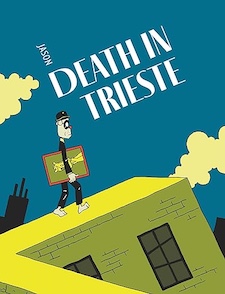 Death in Trieste
Jason
Fantagraphics
Jason returns with a collection of three capers featuring anthropomorphized dogs engaged in surrealist misadventures. Opening with “The Magritte Affair,” Paris and its artists are under a strange attack in which a pair of gangsters break into homes to replace the paintings already there with one (a forgery) by Magritte. Upon seeing the Magritte painting, the hapless resident starts reciting surrealist statements and exchanging their customary clothing for a black suit and bowler. Two investigators are sent to solve the mystery and see that justice is done. Tightly paced, one of Jason’s mostly consistently wacky stories.
The eponymous story, “Death in Trieste,” is a multi-stranded tale with frequent cuts from one strand to another—including the death of Rasputin, the inter-war period of Dada in France, a person dressed as a musketeer, and more—at a dizzying pace. All three stories here are tightly edited and trust the audience to remember the disparate threads.
The last story, “Sweet Dreams,” imagines reactions to news that a collision with a comet will destroy Earth in three days. As well as Jason’s dog-people, ancient mummies are upset by the news and break free of their museum captivity world-wide. The story includes guest appearances from such ‘80s bands as Ultra Vox and the Eurhythmics, making the narrative feel like a re-imagined BBC TV series. Among the many characters observed, only one asks if anyone, given the time remaining, wants to fuck, and a man tucks in by listening to Bowie’s Low. Jason has mastered the art of spare storytelling, and edits a 90-minute movie down to a 10-minute action-fest. His strongest work in years and a great introduction to Jason’s twists of pop culture.
 Unfit
Unfit
Ariana Harwicz / Jessie Mendez Sayer
New Directions
Lisa is the mother of twin boys lost to her in a custody battle. Unable to see them apart from brief, supervised visits, and tired of the slow-working social services bureaucracy and her lawyer’s inability to have her boys returned, Lisa decides to take the boys while sleeping at her in-laws’ house. She sets her in-laws’ barn afire and slips into their house during the distraction to take the boys.
Lisa narrates the story, and through her we find out that she is oblivious to or unmindful of the social conventions that, followed, would prove her to be a conscientious parent. Unfortunately, her lawyer needs to tell her how to dress and speak before the various professionals tasked with evaluating her. The results: 150 letters to the court testifying against her parental competence.
With the sleeping boys in tow, Lisa roams from out-of-the-way place to out-of-the-way place, directionless but trying to keep a low profile while a nation-wide hunt (in France) alerts the populace to the barn burning, kidnapping, and charges of attempted murder facing her. Her lawyer and ex try to convince her over the phone to turn herself in, which Lisa has no interest in doing, keeping the calls short and (she hopes) untraceable, and ditching the car to further aid her escape unhindered.
Unreliable as Lisa is as a narrator, it does seem that she is a mentally ill woman among dysfunctional in-laws and ex: Loads of drinking, anti-Semitism (Lisa is Jewish), bullying, and inconsistent behavior. The boys lead unstructured, near-feral lives, following by example. Sometimes, the winner in a custody battle is only by minute calibration the better parent.
Late in the book, Lisa and her ex meet, she still with the boys, which he takes while distracting her with a ruse. A car chase ensues and a stop, during which Lisa steals back one of the boys. Another car chase and stop ensues, Lisa and her ex exit their cars, and then:
We embrace, which one do you have, he laughs, J, I think, but I’m not sure, I’ not sure about anything, why did we have them, what do you mean why, we love them more than anything, without them we’d be nothing, you wanted them, and I didn’t, but now I do, thank you for forcing me to become a father, I though it would be a horror movie but thanks to you I have them, thank you for raping me, if you hadn’t I wouldn’t even be a mother, I’d just be another piece of shit in this world, it was a beautiful rape that meant I could give them to you.
The kids never have a chance.
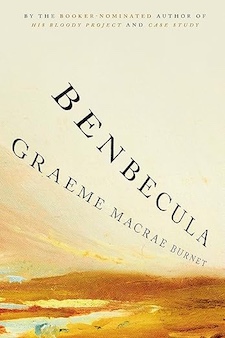 Benbecula
Graeme Macrae Burnet
Biblioasis
Based upon a true occurrence, Graeme Macrae Burnet recounts the murder of a man’s father, mother, and aunt in the mid-1850s on the island of Benbecula in the Scottish Hebrides, told from the point of view of Malcolm McPhee, brother of the murderer, Angus. Sparsely populated, the land and sea make for impoverished living, and during the time the story is set, families, such as the McPhees, make only pennies on harvesting kelp 15 hours a day. The father is a decent sort, but passive and given to work mostly on his potato patch, which, as Malcolm points out, really doesn’t need tending since potatoes do well at growing of their own accord. His wife almost never leaves their hut, spending her days tending the fireplace and drinking whiskey, leaving the children Malcolm, Marion, and John to do the work. Angus is content to let the others do work for him, since his parents aren’t keen on enforcing discipline.
None of the children stay in school long, which is fine with the parents who don’t see how book learning will improve their ability to rake kelp. Angus, though, is defiant on top of his laziness, with a penchant for masturbating in public and chasing schoolgirls. After a two-week stint in which he is tricked into performing work on a cobbler’s farm, he returns in a violent disposition, requiring his family to bind him by rope, hand and foot, until he calms down, which takes several days. When he finally calms down, he claims to have no memory of his violent episodes. However, within a few weeks, the episodes return, the parish is troubled, and soon the community’s authorities visit the parents to suggest Angus be instituted. But institutionalizing him will cost money the family doesn’t have, and so they keep a weather eye on him.
Malcolm, who tells us this tale, describes daily life on Benbecula, as well as his own biography and what his life has come to since the murders. Malcolm has no calendar, does not attend church, and has largely given up work, selling the few possessions left to him with which to buy whiskey. We know of his infatuation with a girl when he was in his teens and his family still attended church. The girl rejects him for his poverty, and he never again tries to court a woman. After the murders, the community shuns what is left of the family, except for the wife of one of the parishioners who is sent out every few weeks or once a month to sweep and straighten the hovel and give him a bath, which he otherwise wouldn’t grant himself. Malcolm suspects that she is sent to make sure he hasn’t lost his mind, too. He knows only the date Angus committed the murders, about which he says three-quarters through the book:
The fact that I know the calendar date is enough to tell you that … this is the day my account has been leading up to. I do not suppose that many among you would have the least interest in the incidents I have thus far related were it not for the fact that they serve as a prelude to violence. When a tale promises bloodshed no one leaves their seat, and you may rest easy that I do not mean to disappoint you.
In the first chapter after Angus murders his parents and aunt, Marion and John announce to Malcolm that they are leaving, seeking their fortunes where the McPhee name isn’t associated with murderous insanity. Malcolm tells us at the novel’s onset his worries about himself based on Angus’s behavior because he sees himself in it. But the statement is dropped, the narration continues, and nothing in his self-reporting indicates behavior akin to Angus’s.
However, once his siblings announce their departure, we learn via John that Malcolm is just as nasty as Angus (in words, anyhow) and lists behaviors Malcolm has never admitted to in his narrative to us, but which are, nonetheless, consistent with what he has revealed to us.
So why have twelve armed men surrounded Malcolm’s hovel? He can’t recall anything he might’ve done to provoke them.
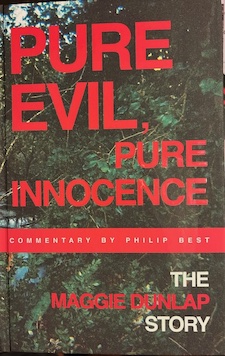 Pure Evil, Pure Innocence: The Maggie Dunlap Story
Philip Best, commentary
Amphetamine Sulphate
Maggie Dunlap is a young American photographer (b. 1995) who arranges scenes that imply violent menace. They draw heavily from the tropes of bland detective work to news reportage, tropes developed to convey a sense of impartiality, of objectivity, to merely documenting the material evidence, which underscore the ominous, ambiguous nature of the documents, that—apart from human bodies—add a layer of horrifying banality to what they depict, as the mundane accrues feral, malevolent force. A woman’s shoe rests on its side on a carpeted floor. A man in a haz-mat suit looks into an opened backseat of a car. A man holds a rifle against his chest, barrel facing diagonally down. A hammer with a clump of something on the ball and a smear on the handle.
Writer and publisher Philip Best provides the “commentary” to the photographs by Dunlap found here. The “commentary” is a collage of voices, written and oral, by those involved in murders or their solution: “Notes to self” by a man plotting a kill, reports by detectives listing body parts and dump location, victims’ statements, interrogations, catalogs of home items seized with a search warrant: guns and porn. The considerable power Best’s prose packs owes to his trusting the intelligence of his audience, for whom of the simple juxtaposition of certain banal artifacts and bare facts render only too clearly their implications. His commentary (a neutral-sounding noun) is supplemented by a 10-page “Further Reading” list, which I assume only from scanning the titles are all crime-related / true-crime books. How much his commentary is based on direct quote or paraphrase from these books or original idea, I don’t know. One or two missing persons cases he references are familiar to me, so I’m curious about his method. It could be the case that he has so utterly mastered the rhetoric and tropes of crime and its documentation that his prose sounds like original source material. The writings of Peter Sotos instill a similar unsettled, claustrophobic feeling with their narratives of, by, and about serial killers, serial rapists, and pedophiles.
Together, Dunlap’s photographs and Best’s commentary have created a power, disturbing artifact. If the True Crime genre has an avant-garde, Pure Evil is its apex.