
I arrogantly recommend… is a monthly column of unusual, overlooked, ephemeral, small press, comics, and books in translation reviews by our friend, bibliophile, and retired ceiling tile inspector Tom Bowden, who tells us, “This platform allows me to exponentially increase the number of people reached who have no use for such things.”
Links are provided to our Bookshop.org affiliate page, our Backroom gallery page, or the book’s publisher. Bookshop.org is an alternative to Amazon that benefits indie bookstores nationwide. If you notice titles unavailable online, please call and we’ll try to help.
Read more arrogantly recommended reviews at: i arrogantly recommend…
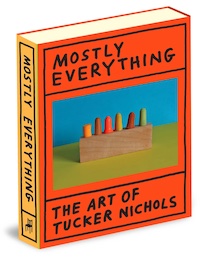 Mostly Everything: The Art of Tucker Nichols
Tucker Nichols
McSweeney’s Publishing
Mostly Everything is a career retrospective by the artist Tucker Nichols, whose work I first became aware of as the illustrator for the children’s book Crabtree by Jon Nichols (whimsical and worthwhile for child and adult). Divided by topic rather than presented chronologically, the Mostly Everything means Humans, Landscapes, Diagrams, Flora, Sculptures, Science and Technology, and more.
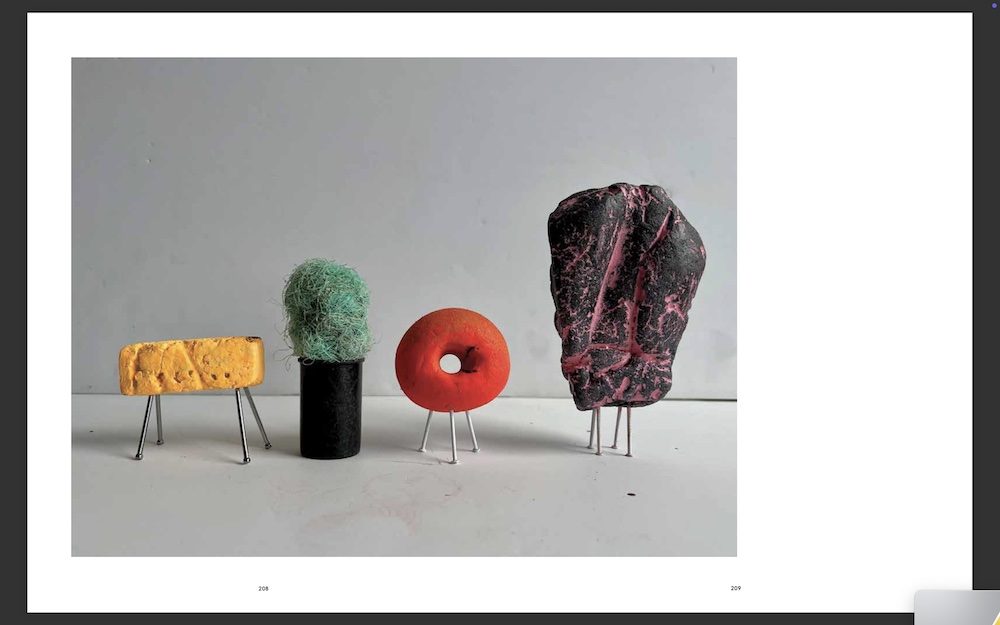
Showing a wide range of interests in media used to express his ideas, Mostly Everything includes Nichols’s paintings, drawings, banners, signs, photographs, rocks, sculptures/found objects, Post-its, charts, string-like objects, editorial cartoons, spot illustrations, and sand etchings. Working with primary and secondary colors, black and white, Nichols has a good eye for juxtaposing objects into visual balance. Nails, ear plugs, pleasantly shaped rocks, and other ephemera made the center of attention, suddenly encourage contemplation over color, shape, size, proportion, and harmony. And the works convey energy, too, even the still lifes.
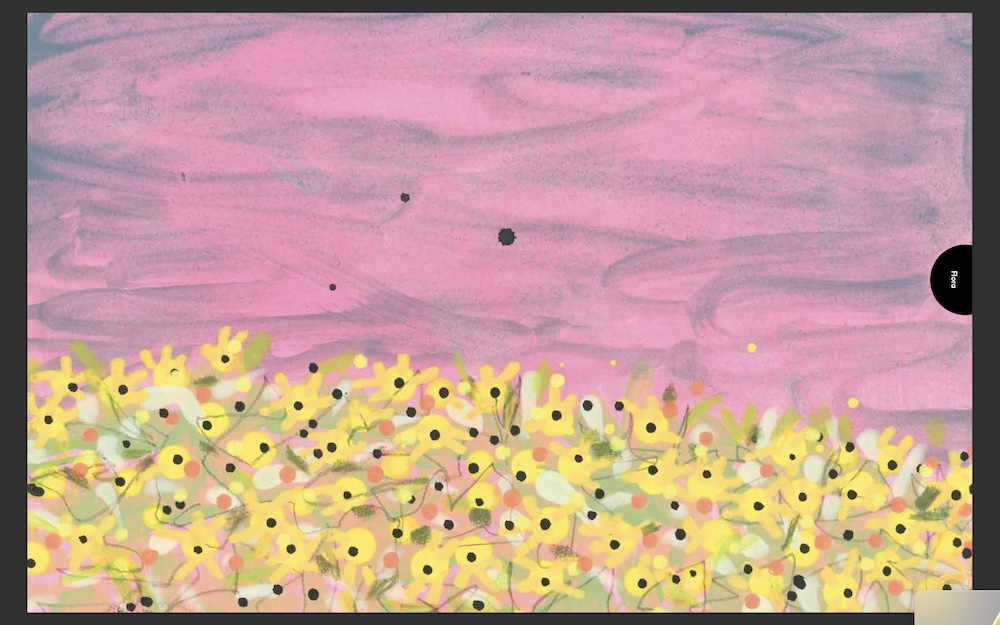
For instance, Nichols often deploys little nodules at the ends of skinny protrusions, colored to contrast with the picture’s dominant color scheme, urging the eye to bounce from one nodule to another. The visual field it bounces over is anchored by the background forms and palette, which coheres the overall image, enhancing the contrasting colors and imbuing the image with palpable energy.
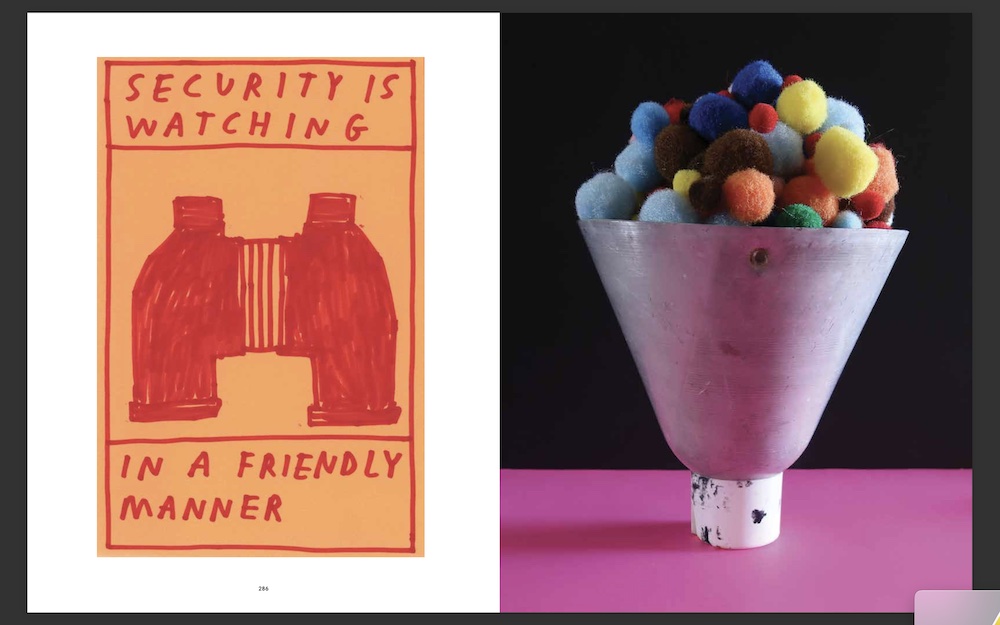
In a set of examples, Tucker has assembled of dozens of parti-colored Post-its pinned across memo boards (presumably) and other large, wall-like surfaces. Some Post-its are drawn on, others written on, with such notes as “WORLD SERIES PROGRAM,” “BLACK AND WHITE PHOTO OF SUNSET,” and “DRIVERS LICENCES FROM WHEN I HAD GLASSES”—an imitation of a brain at work, a list of items held in storage, the items that pop up in the mind unbidden, the thing you’re maybe trying to recall (“PHONE NUMBER FOR A GUY NAMED PAUL”)—the various Post-it colors pinging the eye from one thought to another. Is this, perhaps, a 21st-century update of Rodin’s “The Thinker”?
Well-edited and sequenced, Mostly Everything is like the perfect date: beautiful, fun, and intelligent.
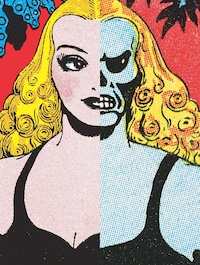 Turn Loose Our Death Rays and Kill Them All!: The Complete Works of Fletcher Hanks
Fletcher Hanks
Fantagraphics
Fletcher Hanks was the Ed Wood of superhero comic books. Easier to enumerate his shortcomings than his successes, his draftsmanship is stiff and his page designs don’t guide the eye. Illustrations for his text-heavy tales seem like afterthoughts, and his stories lack drama and suspense: the conclusions are foregone because no force of evil is a match for his heroes. Stories six and seven pages long often allot their climaxes to whatever can be fit in the last half page. As a result, Fletcher’s stories often end with visually anti-climactic pffts rather than triumphant tada!s, even when the stakes include destruction of planet Earth.
Not that these qualities are necessarily bad.
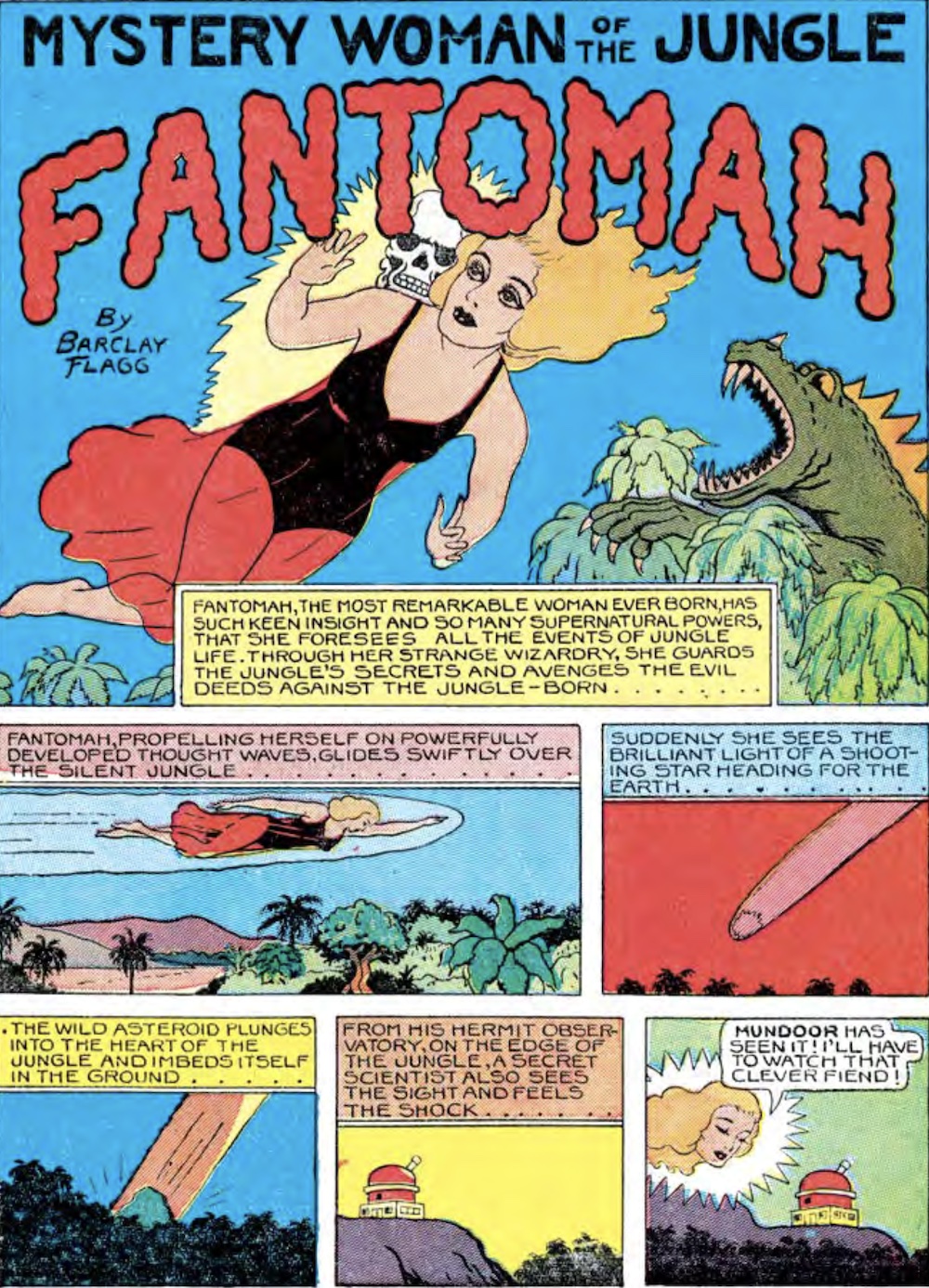
As with Ed Wood’s films, a lack of talent does not mean a lack of enthusiasm for telling stories, however ineptly imagined and relayed. Raw exposition only underscores the teller’s earnestness; we can feel the sincerity of his commitment, although what we appreciate in the work may not be the achievement he hoped to have recognized.
Writing under a surfeit of pseudonyms—including Chas Netcher, Barclay Flagg, and Bob Jordan—Fletcher’s pantheon of heroes include The Super Wizard Stardust; “Space” Smith; the eco-warrior Famtomah (“mystery woman of the jungle”); “Big Red” McLane, the small-batch capitalist lumberman; “Whirlwind” Carter; Buzz Crandall of the Space Patrol; and other excitingly named worthies. Fantomah rules over nature, while the space heroes rule over technology. Fantomah is white but her human beneficiaries are dark. Fletcher’s male heroes—jaws jutting two or three inches past their nose, their foreheads suggestive of acromegaly—don skin-tight dry goods over muscular, V-shaped torsos à la Tom of Finland, but modestly groined. When not fighting interstellar crime organizations, Stardust is usually found at either “his observatory on his private asteroid” or “traveling highly accelerated light waves in a tubular spacial.”
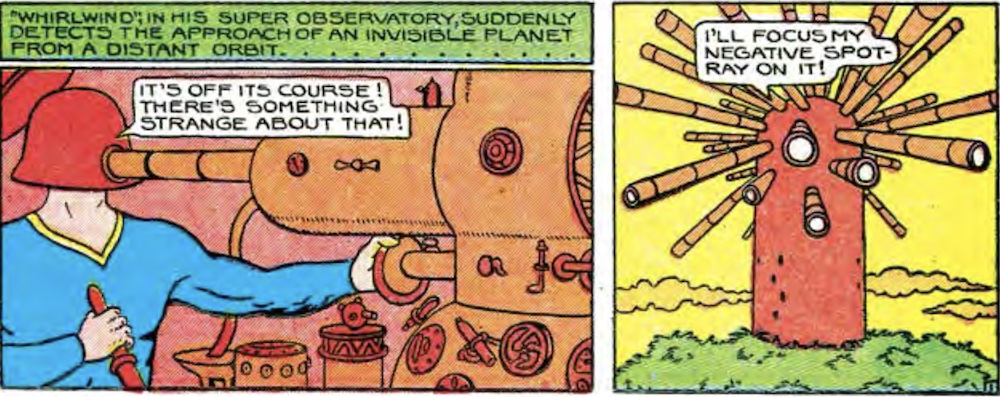
Aliens arrive either in spacesuits or in the nude (or discrete loin covers). Because they are bad, the ETs frequently suffer from any given superhero’s predilection for lifting creeps several stories in the air with anti-gravity forces, leaving them to hang until the hero can bring round a police force (using several other rays at his disposal). Fight scenes—and there are always fight scenes—are enlivened with such onomatopoeia as “sock!,” “biff!,” “bang,” and “bong!”
In one story, Stardust is attacked by Emerald Men from another planet/solar system/galaxy/time dimension, etc., whose “anti-star-metal acid bombs” Stardust deflects with a “screen of acid-proof dust,” after which he “draws a wave of film-rock gas from a nearby star and encases ‘the Emerald Men’ in a crystal cell.”
Want to suspend disbelief while reading Hanks? Wear a truss. But you’ll take much more pleasure in reading this if you ignore the disbelief and truss. For everybody who grew up watching ‘50s-era low-budget SF and horror films on Saturday afternoon TV.
Four Works by R.G. Vasicek:
(1) Writer
(2) I Am a Machine Poet
(3) Edge-of-the-Construct
(4) Amerika: A Sort of Pseudo-Reality
Self-published
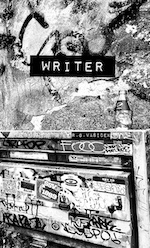 A practitioner of what he calls lo-fi samizdat, R.G. Vasicek’s works demonstrate what can be achieved by a writer with a DIY / Maker Faire ethos. For readers looking for media that speaks directly to them, Vasicek’s works lack suspicion-inducing gloss and come without PR mediation. Vasicek’s prose reads as if influenced by Bukowski’s choice of unfussy vocabulary and Ginsburg’s choice of spontaneous poetics (“First thought, best thought”), as well as his own tics and obsessions. Apart from the approach with which they were written and, with the photographs, sequenced and collaged, each work takes on a different theme, even though the narrative voice remains consistent.
Writer reads like a writer’s notebook accompanied by photographs, consisting of observations, questions, ideas, and statements about aspects of everyday existence. Writer’s black and white and negative photos buttress the emotional weight of the text, and giving sense to where the writer lives, what he sees on his walks through a post-industrial waystation that shapes his thoughts.
every writer is a lonely
creature //
i call myself on a
telephone
there
is
no
answer
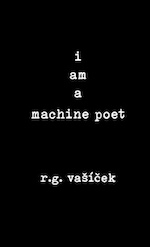 Although i am a machine poet gives no indications of how it should be read—as a single work, as a collection of prose poems and photographs, with each separate from the other, in combination, or both. I interpret i am a machine poet as a series of (mostly) untitled vignettes about everyday life, whose themes are extended by but independent of the black and white photographs interspersed throughout. Its disjointed but coherent jump cuts between paragraphs and set pieces is reminiscent of the sudden switches in time and place in Burroughs’s Naked Lunch, a form of disorientation before he started employing cut-ups.
In another section, prefaced by a quotation from Wittgenstein, Vasicek parodies Wittgenstein’s practice of numbering his arguments and sub-arguments down to the thousandths place, to explore the arena of sex and food. “N+7 Machine” tests an Oulipo-like constraint about word substitution via multiple iterations of a phrase and its output, and another story riffs on an assertion by Adorno that private life no longer exists.
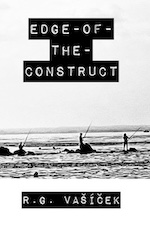 “Tell the truth but tell it slant,” Emily Dickinson coached her readers. Edge-of-the-Construct explores, indirectly but persistently, the conflict between free will and the notion that we might be inhabiting a simulation of reality, comprised of a mix of text and photography that, in this book feel to be working in greater tandem than Writer and i am a machine poet, shifting effortlessly from poetry to photo essay to prose to an overall work that is simultaneously all three. In Edge, V includes among his own photography manipulated vintage porn from Jindrich Styrsky.
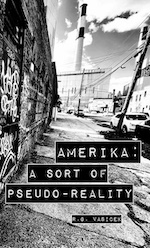 Vasicek’s Amerika could be as easily called “Quiet Days in Queens,” for its feral erotica à la Henry Miller, as the more prosaic “Notebook 1,” which the narrator keeps reminding us we’re reading—discursive notes-to-self: observations, quips, tentative fictional scenarios (the narrator is a writer), questions about existence—and the narrator’s ultimate question to self: Can a coherent whole be made from notes on life’s barrage of random incidents?
Outside a concrete apartment block, I shake my fist at the sky: Why must I work in the factory!?
The VW Beetle fails to ignite.
I walk to the tram stop.
Let me put things in order. What things? I do not know. Things. Objects. Subjects, The Universe. The Cosmos. Quite a mess, isn’t it? Disorder. Chaos. Utterly utterly perfect.
Each book is about a hundred pages, give or take—pamphlet sized. Given the large sans-serif font and, for three of the books, the number of photographs, I can image these books being read by somebody—a guy probably, but who knows?—on his lunchbreak at a small machine shop located along an off-street in an industrial park. The weirdo who reads. Vasicek’s books mull over ideas, goals, values, and what is sacrificed along the way. But—before the thinking gets too highfalutin—the narrator makes time to savor a nice piece of ass. And, like Vasicek’s books, you can get through one in a lunchbreak.
From his 404_Error Memoir at the PragueMicrofestival:
 Take a Walk with the Wind
Xiong Liang/Chloe Garcia Roberts
Elsewhere Editions
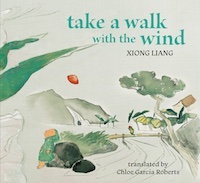
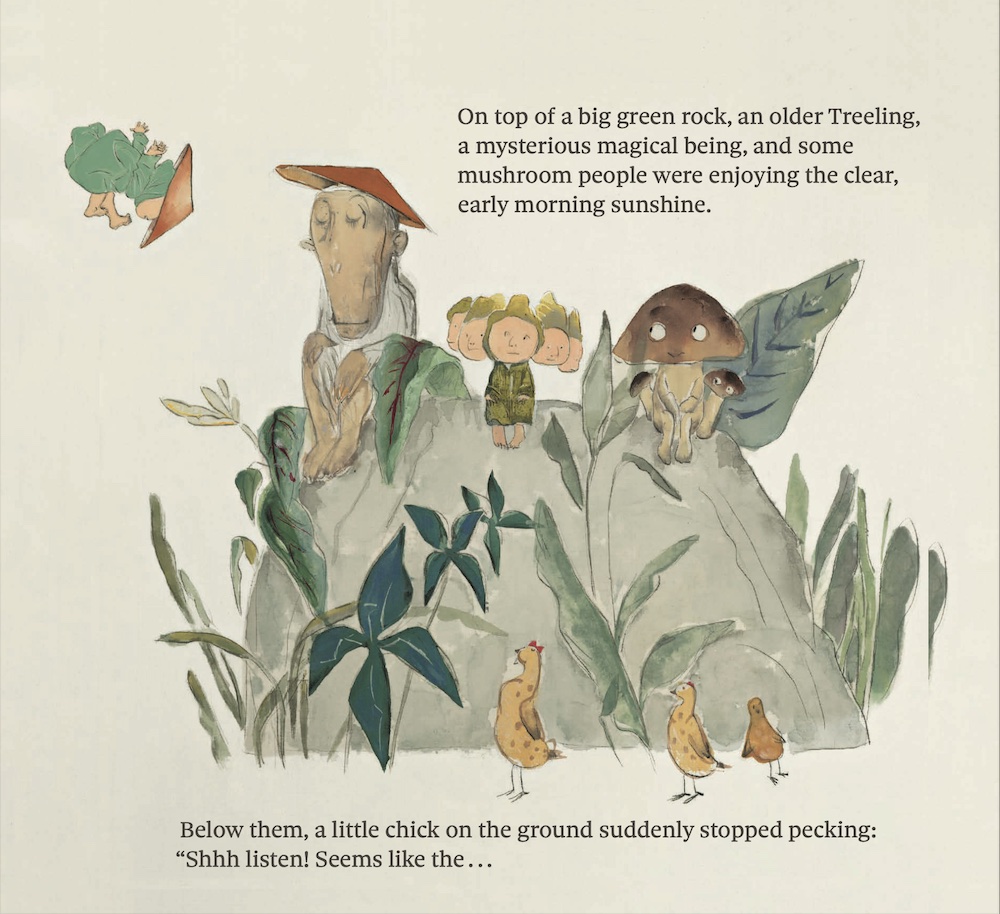
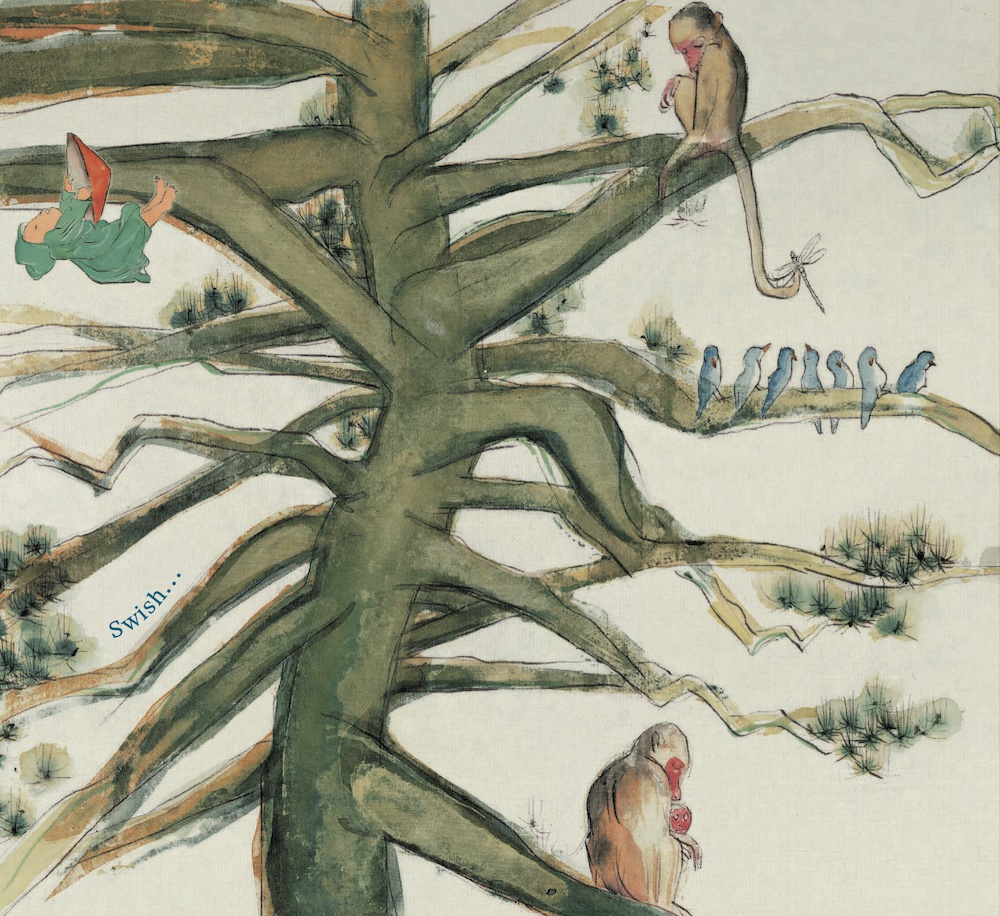
Based on a 2,300-year-old nature poem by Song Yu, Take a Walk with the Wind imagines a child accompanying a wind along its unpredictable path. For his visual interpretation of Song’s poem, Xiong Liang creates treelings, a sparrow-sized people that live in China’s mountain forests. One morning, the wind wakes up a little boy treeling for a walk, but because of the wind’s blustery mood, the little treeling keeps apologizing to the other creatures he stumbles into along his wind-borne way. Xiong’s illustrations are vividly imagined and well-executed—spare but evocative—using (I assume) graphite and washes as his media. A bedtime story to look forward to (or any time of day, for that matter). For ages 5-8.
 The Ways of Paradise: Notes from a Lost Manuscript
Peter Cornell/Saskia Vogel
Fitzcarraldo Editions
The Ways of Paradise is a cryptic essay based on a series of allegedly found notes summarizing the contents of European references from across the centuries on the concept of “paradise” and its variations and influences on cultural history. Beginning with Eden as its center, paradise, after Adam and Eve’s forced exile, became something that needed to be kept secret, and thus the labyrinth was developed. The center of each labyrinth is a symbolic center of the heavens, which allowed persons during the Middles Ages to embark on representative pilgrimage to Jerusalem (where the Crusades were taking place), understood as God’s chosen place on Earth.
The development of symbolism also began as a notion of joining to disparate halves to form a complete whole (per Socrates regarding men and women as two halves of a former whole, cleaved apart by God). This practice quickly developed into a method for verifying the authenticity of documents that had been torn in half—each owner held a uniquely irregularly-edged fragment that became regular and whole once joined with the other half.
Labyrinths in public parks—or labyrinthine parks—are mimicked by labyrinthine arcades (cf. Walter Benjamin). The wandering encouraged by parks and arcades is reproduced in the automatic writing of the Surrealists. The Surrealists believed that automatic writing brought forth what was buried by the subconscious, the territory of such psychologists as Freud and Jung. . . From there, we travel to the New World—the New Eden, as it was seen by Europeans—extending to Robert Smithson’s “Spiral Jetty,” a 20th-century labyrinth.
It’s a curious enterprise, The Ways of Paradise, making strange and unexpected historical connections (some more tenuous than others), but it shows (or tries to argue for) how certain ideas and practices can undergird a civilization for so long that those ideas and practices come to be understood as natural, as the way the world is. Revealing those ideas and practices becomes a sort of Jungian exercise in excavating the mythological tropes guiding our experiences.