
Ray Johnson photo by Bill Wilson
Memory is not an instrument for surveying the past but its theater. It is the medium of past experience, just as the earth is the medium in which dead cities lie buried. He who seeks to approach his own buried past must conduct himself like a man digging.
—Walter Benjamin, Berlin Childhood
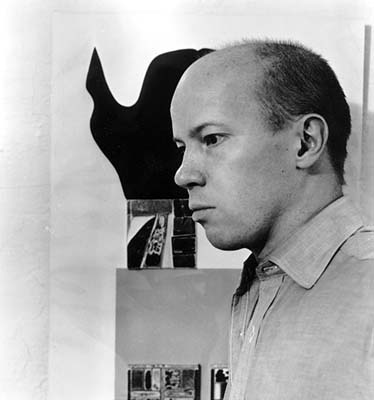
Ray Johnson has been called a mystery, artists’ artist and visionary artist. As one of the earliest progenitors of pop art, performance, installation and happenings, he was also the founder of correspondence art, phone art, Moticos and performance nothings. Ray’s body of work has had a growing public interest and fascination since his untimely yet certainly timed performative suicide, on January, Friday the 13th, 1995. Public recognition had long alluded Johnson, but soon after his death both Artforum and Art in America printed his work on their front covers and ran in-depth articles on his artwork.
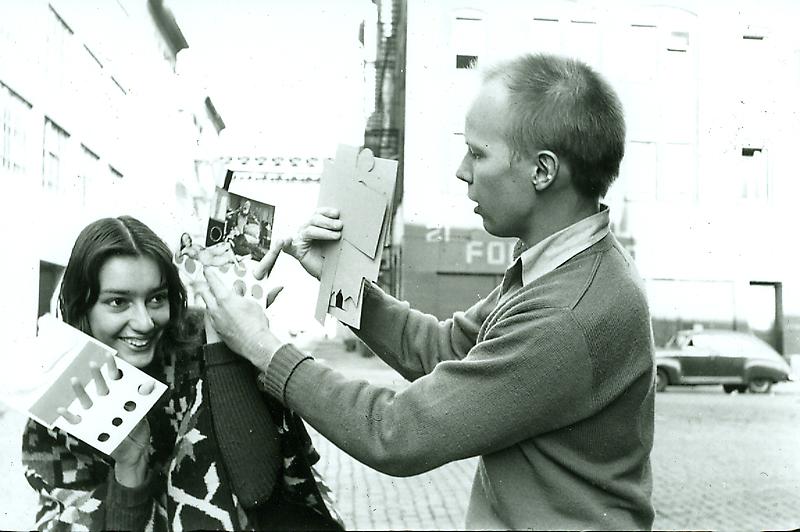
Ray Johnson with Suzi Gablik as they set up a moticos installation, autumn 1955. Photo by Elisabeth Novick.
Born in Detroit on October 16th, 1927, Johnson attended Cass Tech High, where his caricatures of Hollywood starlets were popular among his classmates. These early drawings were the beginnings of Johnson’s “fan-club” satire riffs on a celebrity obsessed world — a subject that he would hold steady throughout his life. Johnson’s best friend in high school Arthur Secunda, saved his juvenilia from the trash (and in personnel letters)and each one displays how caricature, pop-culture, humor and a creatively drawn line had penetrated his art.
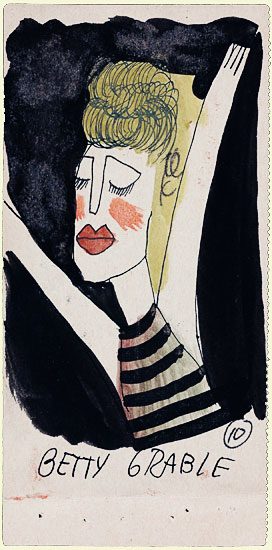
The Loves of Raymond Johnson, Card 2, 1943, Collection of Arthur Secunda
By combining his classmates and teachers with pop culture heroes like Betty Grable, “spy dancer” Mata Hari and the famous stripper Gypsy Rose Lee, the young Ray elevates his own middle-class life through the power of exotic imagination.–Sabastian Matthews, Messages in a Bottle: Notes of an Unlikely Curator
Often referred to as the most famous unknown artist in New York, in death, Johnson achieved a kind of fan-club immortality of his own. His highly personal art-from was transformed into miniaturized mass communication. From everyday letters, books and simplified performances, Johnson opened the borderline between his network of friends and the world, especially between what is human, humble, small and overlooked. He used alternatives to traditional exhibition —to escape and subvert the gallery system and create a thoughtful offbeat art experience, in-the-present, open-ended and free— a style and system similar to radio as theater, stand up comedy and jazz improvisation. Although he embraced a humble process (mail-art, sidewalk displays, collage) Johnson manipulated, recycled and often performed his work like a jazz artist riffing on themes commonly found in modern culture.
He meant his death by drowning as a mailing event. When he sent works of art through the mail to people as gifts, he was describing what he thought were the correct relations among people… An envelope from Ray was like a haiku, a moment of immediacy and indeterminancy, a particularly vivid moment outside the economy, outside the machinery of our culture. It was free. -Bill Wilson, Dear Friends of Ray, and Audiences of One
Johnson’s work was a parallel world that has been often compared to the internet and social media. He re-imagined art as a quick gift communication, a part of daily life—and a constant engagement that links the past, present and future into interchangeable symbols; fateful accidents, magic reversals and poetry. His books and letters were simple but intricate puzzles, jokes and riffs, self-contained miniature anti-museums; missives that questioned artistic purpose, collecting, collectors and especially the use of art, stretching it’s boundaries into poetry. Each piece was an offering commonly made for its receiver, often giving specific instructions with a response or action to follow.
I happen in my work to use words. And perhaps it’s all incorrect that these be looked at in terms of painting or creativity or beauty or whatever. It might very well just be useful objects like an automobile or a chair. And these happen to be things hanging on the wall. And what I wish — well, it would have to be a great interest — would be to try to present what goes into the making of [it.] I never used to believe in a work of art being bought.
-Ray Johnson interview with Sevim Feschi, 1968
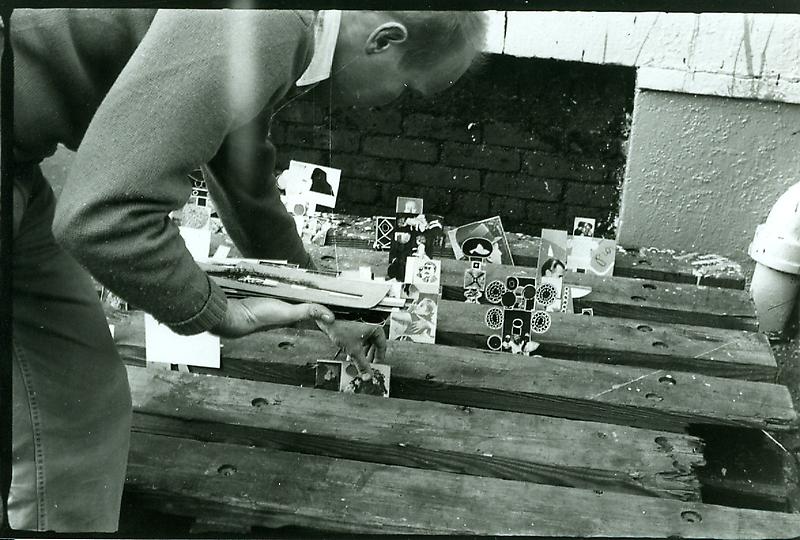
Ray Johnson setting up a moticos installation, autumn 1955. Photo by Elisabeth Novick.
Johnson was the first artist to use pop images as appropriated art years before Warhol and the first generation of pop artists. In the book Pop-Art 1955-1970, the influential curator and art critic Henry Geldzahler wrote that Johnson’s Elvis collage (1955) and James Dean (1957) “stand as the Plymouth Rock of the Pop movement.” The use of pop-celebrities by Johnson was an outgrowth of his high-school celebrity fixation.
In 1955, he used the neologism Moticos, as a Zen inspired name for the asymmetrical pop collages he made from newspapers, magazines and found poetry. These forms were organized into 3-dimensional patterns and subjects, then displayed freely in public spaces; on sidewalks and gallery lobbies of New York City. They are often referred to as proto-happenings or guerilla street art. He once described Moticos in a statement as “boxcars on a moving train” – a blurred movement and slice of time. The passage of time, was marked by the Moticos, grouped together as thin slices of moveable sculpture, glyphs reflecting the urban rhythms of culture, a portable communication, always rebuilding and ready for travel. Johnson himself was the locomotive, arranging his moveable collages in brief periods of time. Their installation was quick and instant, art that literally “popped-up” on the sidewalk and observed briefly by a constant stream of busy commuters.
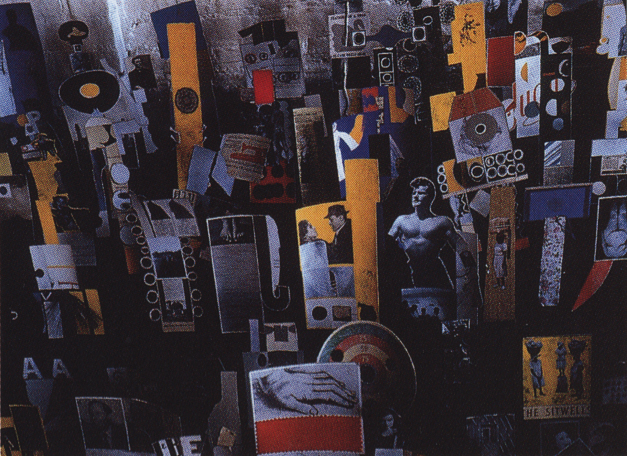
Moticos installation, New York City 1955, photo by Elizabeth Novick
Influenced by an apprenticeship under Joseph Cornell and an earlier Black Mountain College residency, Johnson worked primarily with collage, poetry and ink drawings, connecting with an ever expanding circle of artist-friends that included John Cage, Frank O’Hara, Norman Solomon, Warhol, Cy Twombly, Richard Lippold and Robert Rauschenberg. Collage was Johnson’s way of altering time and memory, using ideas and connections that could flow freely and disseminate between artists and the public quickly and informally. He connected with a small but growing circle of friends through postcards or letters, and tapped into memories (both his own and those of artists, correspondents and general culture) –a strategy that was collaborative and communal. When Johnson took Warhol for a haircut at Billy Name’s tin-foiled apartment in 1959, the silver factory era began — a world where Johnson was an active provocateur and participant.
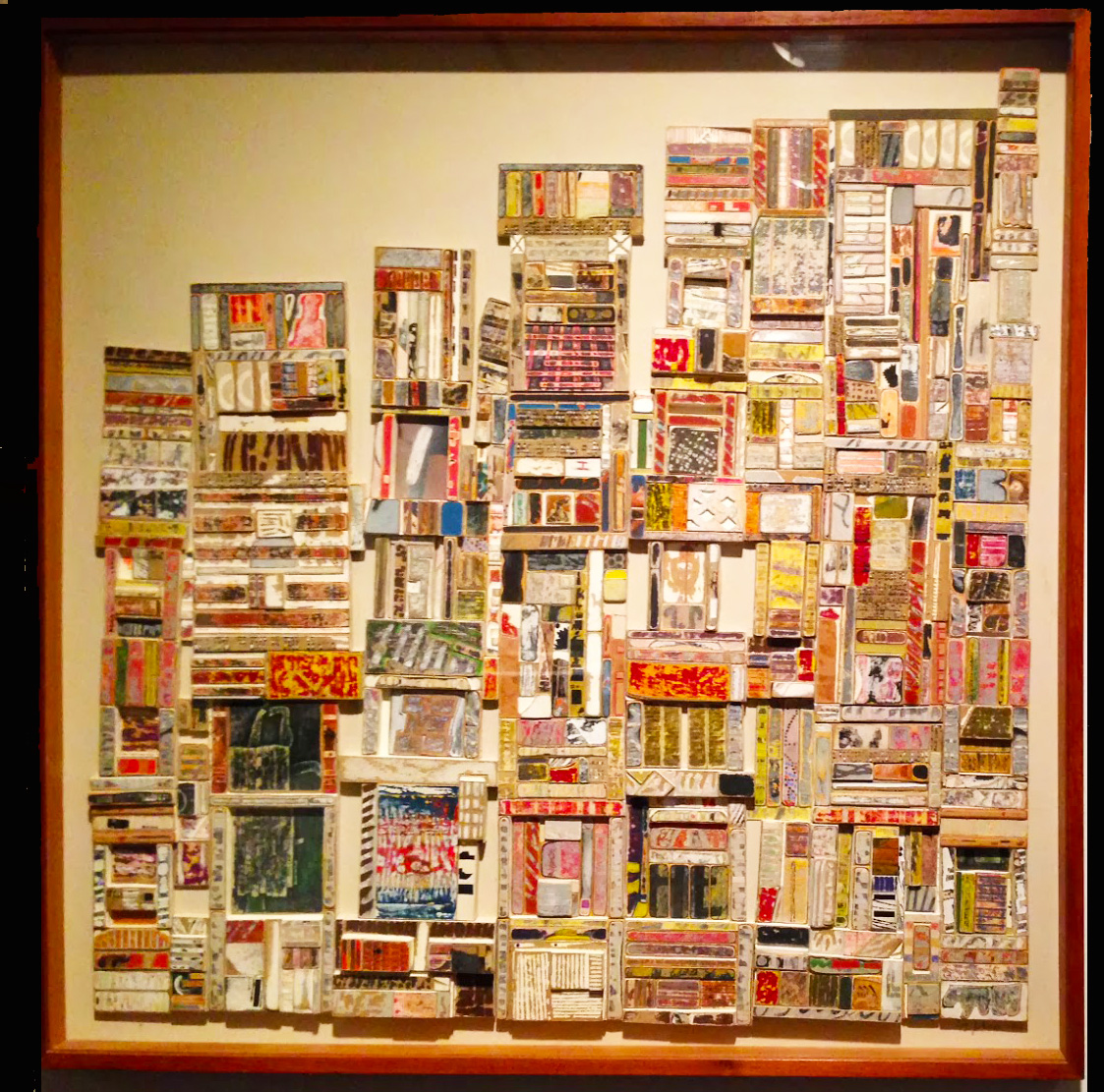
January/February by Ray Johnson, 1966
For many years the work January / February(1966) sat in the Detroit Institute of Arts’ deep freeze basement, going unseen, but soon after the museum’s $158 million overhaul in 2007, it was brought into the open. It suddenly and mysteriously had achived an intellectual currency. It looks like a maze of windows or doors stretching across the frame, a flattened connect-the-dots sculpture to fill in yourself, a work that also sums up many of Johnson’s best ideas—a kind of open theater where memory is projected.
January/February closely recalls Johnson’s ’50s experiments with Moticos, built up from layers of pasted magazine pages and Bristol board, carefully cut and sanded smooth. The images are no longer distinct but are blurred as if seen through window covered in rain. The work takes on the form of squares and rectangles with allusions to boxes, steps, stacks of books, or postcards; a secret architecture with divisions in space. It could be a library, apartment complex, windows, maps or a blueprint of the museum itself, viewed as an overhead diagram, or interior graphic. Perhaps dozens or hundreds of moticos were cut-up and recycled to make this single layered monument.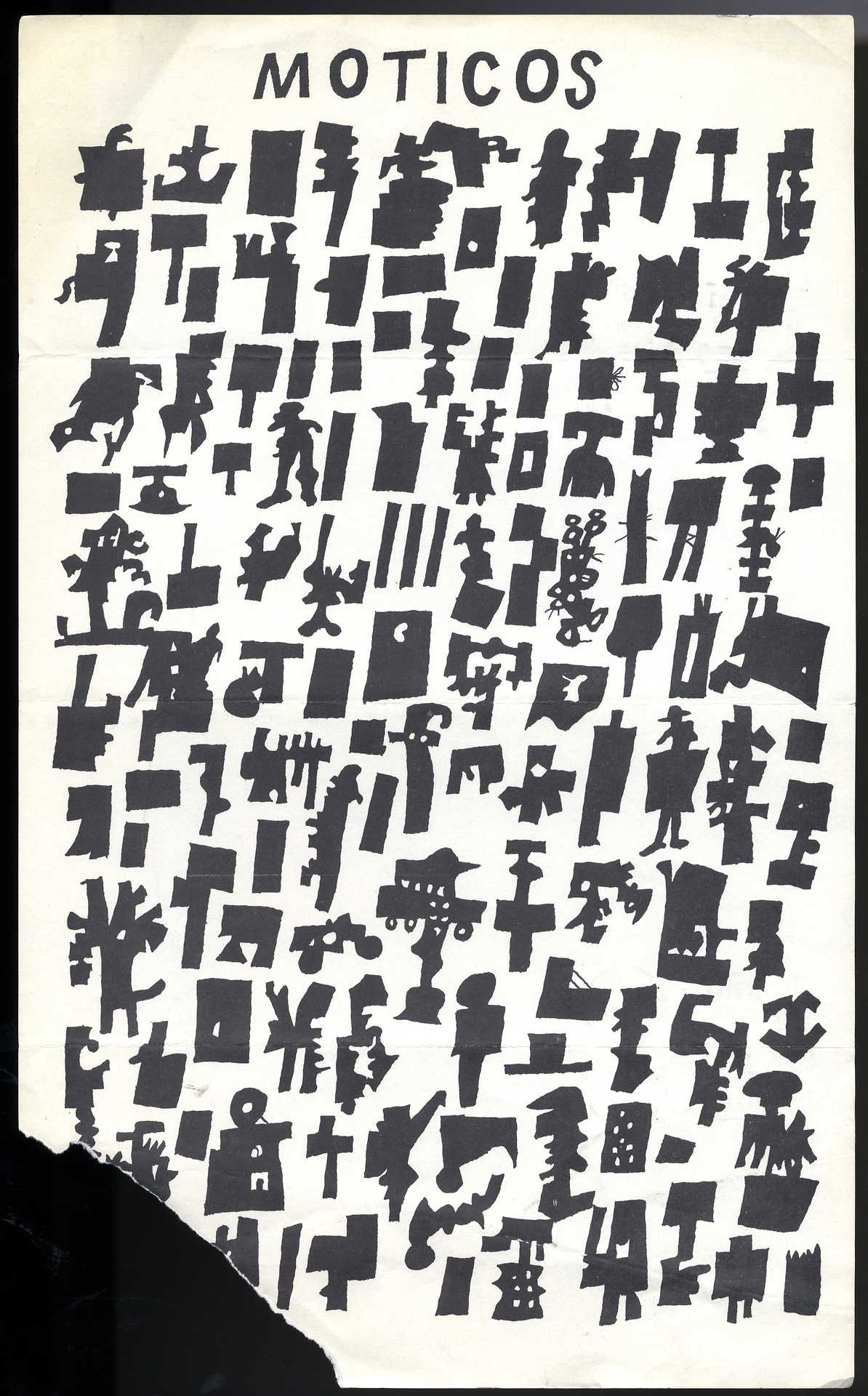
“Moticos” is an anagram of the term “osmotic,” the adjectival form of “osmosis,” which refers to the process of liquid flow between two semi-permeable membranes, and more colloquially, to the gradual process of assimilation or absorption of ideas. According to the possibly apocryphal account offered by Johnson, the term was arbitrarily picked from a dictionary by his friend Norman Soloman; yet, this word effectively evokes the idea of dynamic flow and exchange, qualities that are relevant to Johnson’s developing collage practice during this period. –Johanna Gosse, From Art to Experience: The Pourous Philosophy of Ray Johnson
January/February describes winter, and a frozen wilderness that Johnson would know from being raised in Detroit and the upper penninsula of Michigan. January/February is an afterlife of moticos, when the images become frozen and blurred between worlds. What is visible are antiqued cardboard fragments, dashes of rubbed out color and fragments of words built up below the surface. One of the few words left whole and readable is an almost microscopic clue: undivided. Perhaps Johnson was trying to reach a wholeness and completeness through his art and life- with no division visible.
January/February is both macro and microcosm, desolate yet dense and overflowing with information, an undivided osmotic collection of divisions, randomness and repetition, a visual Zen koan —a specialized viewing field that Johnson developed in his post-motico work. The reconstruction of the moticos by destruction (sanding and blurring) was Johnson reinventing himself –reclaiming his original vision as talismanic codes.
In his statement “What is a Moticos,” Johnson compares the term to a moving or standing still train-car. “The next time a railroad train is seen going its way along the track, look quickly at the sides of the box cars because a moticos may be there,” writes Johnson, “Whether the train is standing still or speeding past you, Don’t try to catch up with it. It wants to go its way. But have your camera ready to snap its picture. It likes those moments of being inside the box.” The analogy of a moticos to a train car boxes in motion is to pages of memory or to turning the pages of a book (another type of memory saving box) -and treasuring those moments: “Cut it out. Save it. Treasure it. Make sure it is in a box or between the pages of a book for your grandchildren to find and enjoy,” said Johnson.
January/February is connected directly back in time to his early pop/abstract mash-ups of the mid-’50s through a series of snakes and ladders, another symbolic motif that Johnson worked. His last body of work, unseen until after his death was done in photography and was also concerned with memory and the framing of moveable images; collages and word boards he would he would travel with and insert into the photos, making compositions that were deeply thoughtful, connecting back to his total body of work.
As custodian of imagination and memory, the museum is the flip-side of reality. It enables accidental communions, collisions of time in a controlled vacuum. The museum is a launching pad for alchemy, an undivided space where one can experience the life force of generations – and tap the memories of growing up beside them. The museum is a space where material and anti-material collide, where deviant observations are allowed, outside the confines of society January/February is a portal into Johnson’s undivided cosmic universe; a doorway into a mind focusing its attention on consciousness, memory, associations and the flow of life.
All museums are a form of moticos; assemblages of collected time, associations of past civilizations and culture that flash through the mind as we walk past them. Museums are defined not only by what they contain but by what they ignore, what is uncollected or invisibly stored. A museum is composed of layers, a collage of rooms filtered from pages of memory: the memories of the artist, curators, and public opinion. When thinking about objects in the museum, an alternative history takes shape: a history reborn in stillness with our own thoughts about culture and all that surrounds us in a quiet space waiting to be uncovered.
A shorter and different version of this essay appears in the January 2014 edition of ArtForum.
Hello–
Who wrote this essay? I don’t see it on the Artforum website for the January 2014 issue. Any more information would be appreciated. Thank you!
I (Cary Loren) wrote the essay. I’ve included a link to the Jan. 2014, Artforum issue but its available only for subscribers. You can also reach me at: bookbeat@aol.com
Denny is alive and well!
He did not pass away and is an excellent artist and a good person with a big heart
No, I am sorry but he passed a few years ago.
You are a dumb ass, Ray Johnson was a real mail artist. That name is not fake nor is it an alias. Learn your art history!