

i arrogantly recommend…#69 is a monthly and sometimes bi-monthly column of unusual, overlooked, ephemeral, small press, comics, and books in translation reviews by our friend, bibliophile, and retired ceiling tile inspector Tom Bowden, who tells us, “This platform allows me to exponentially decrease the number of views on screens by people who have no use for such things.”
Links are provided to our Bookshop.org affiliate page, our Backroom gallery page, or the book’s publisher. Bookshop.org is an alternative to online gorilla bookstores that benefits indie bookstores nationwide. If you notice titles unavailable online, please call and we’ll try to help.
Read more arrogantly recommended reviews at: i arrogantly recommend…
 Palinuro of Mexico
Fernando del Paso / Elisabeth Plaister
Dalkey Archive
Taking place in Mexico during the mid-1960s, Palinuro of Mexico concerns the lives of the eponymous Palinuro, a medical student, his first cousin and lover Estefania, and their extended family of eccentric strivers and travelers. Palinuro’s Uncle Esteban, whose exploits the first part of the book focus on, serves as Palinuro and Estefania’s introduction to medicine, describing for them in excruciating detail various body parts and fluids encountered during operations and medical procedures. In illustrating that aspect of Uncle Esteban’s personality, the novel gains an encyclopedia-like quality, in which discoveries are traced through the lineage of great doctor scientists. Despite the tales’ disgusting aspects, they fuel Palinuro and Estefania’s infatuation with medicine and decision in early life to follow their uncle’s example.
The novel develops features of magical realism as Estephania and Palinuro listen to their grandfather’s tales of family history, which include impossible and improbably metamorphoses and events, becoming an exercise in exuberance and excess, working within the tradition of jovial literary transgression of form and content: Digression upon digression a la Tristam Shandy; each chapter a different theme a la Ulysses; incestuous siblings a la The Man without Qualities; bawdy humor and grotesque adventures a la Pantagruel.
It’s a celebration of life that counters the police massacre of student demonstrators in Mexico in 1968. (As a prelude to the police actions of 1968, which connects to the novel’s theme of medicine, in 1964 Mexico’s doctors lead a strike against the government.) The demonstrations of 1968 were held, in part, to protest the government’s expenditures on preparations for the Summer Olympics, which were to be held later that year, rather than Mexico’s poorer people.
Thus, part of the novel’s exuberance, the many themes it develops to extremes, can be seen as Olympic events themselves. Certainly, parts of the police actions, when they finally arrive, are described as Olympic events. The novel’s climax is presented in dramatic form: Sound and fury, signifying nothing? The novel’s literary precursors would have us think differently.
 Scorpions
Yumiko Kurahashi / Michael Day
Wakefield Press
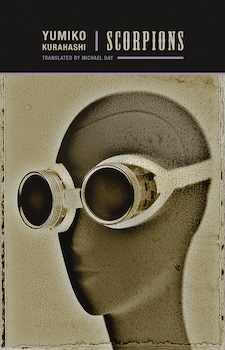
During the 1960s, demonstrations and riots were rife across Japan’s colleges and universities, conditions worsened by violent police interactions with the nation’s youth. As was common at the time around the world, young adults wanted fresh change to replace the post-War pallor cast over the world, change that would challenge staid bourgeois values. Yumiko Kurahashi was a Japanese writer who began publishing during this time. As many other works by young writers in the 60s, Kurahashi explored (and broke) taboos of bourgeoise society but, as a woman breaking these taboos, Kurahashi was seen as even more radical for creating protagonists given to incest and gratuitous violence. Leftist progressivism isn’t part of Kurahashi’s anti-bourgeois politics.
In Scorpions, identities are reduced to initials or derisory nicknames. Thus, the protagonist twins L (female) and K (male), children of M (deceased) and MADAME / OLD BAG, their mother. Whether this is a nod to Kafka, a duplication of the anonymity of subjects in technical reports, a comment the alienating conditions of contemporary life, or some mix of these possibilities, remains ambiguous.
L and K are the subjects of a report, a police investigation into the murder of their mother, Scorpions serving as L’s confession. L’s confession begins with her assessing as absurd the intent of the police’s psychological profiling of her—its interest in in reducing her to a category, determined in advanced by smug progressive intellectuals of a scientific bent—the Japanese tech bros of her day—who mean to institutionalize her for her own good.
Tell us all about what happened over the summer, you say. Okay, for the sake of your psychological evaluation for the court, I will. Since you’re planning labeling me schizophrenic and getting me released to a hospital—isn’t that right? Or is your aim to identify within me a uniquely modern anguish, pluck it out with tweezers, and display it to the world with an accusatory smirk? You are the perfect image of a humanist, you know, with your slick-backed hair and those glasses.
In addition to their mother— a convert to Christianity who may be insane—are RED PIG, a former associate of L and K’s father, his son Q, and Yukari, a young college girl and the only character to always be addressed by her full name. L and K live with their mother, Yukari rents a room in their house. In addition to L and K’s infatuation with each other, L is seduced by both the RED PIG and his son Q and K seduces Yukari.
Independently wealthy people with little regard for life—such as L and K—start playing with others as they might toys, when bored. The intended outcomes—seen as a rejection of the bourgeoise values the other characters represent—will not be in the name of bettering humanity.
 Lithium
Malén Denis / Laura Hatry
New Directions
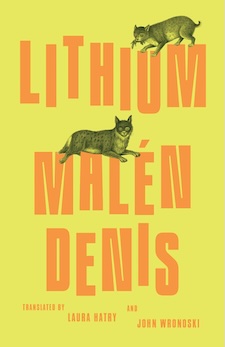
The eponymous lithium of the book’s title alerts readers to the likelihood that its unnamed narrator is in poor mental health, so that the incidents related—with borderline coherence regarding the full context of where she is and what is going on—remain hazy. One of the narrator’s emergency treatments at a hospital illustrates how mental ill-being affects physical well-being:
“Edema of the glottis. A shot of pure intramuscular adrenaline. With it the immediate sensation of the larynx expanding, recovering its natural pliancy. And the tension in my neck abated right away, but I was still scared, relaxed and on-edge at the same time. It took a while to get myself to the hospital because I refused to show up in the emergency room twice in a single week. A sort of superego-blockage related to shame, like that stretch when I just couldn’t bring myself to deal with bureaucratic stuff. I imagined that every else had a clear idea of how to manage things and that they’d make fun of my incompetence.”
Simultaneous, contradictory sensations of fear and tension on the one hand, and utter repose on the other; rash behaviors that lead to emergency hospitalizations; and pseudo-Freudian diagnoses to explain them away.
But wait, there’s more:
“I’m constantly performing rituals to keep myself calm. I cook industrial quantities of food that end up in the trash. I imagine you in a gray space with a vacant stare and my body is crawling with worms from my belly to my throat; they want to get out.”
Rituals (or are they symptoms of OCD?), hallucinations, insomnia alternating with narcolepsy: Our narrator is worthy of empathy, but her self-imposed chaos makes sustained kindness toward her a near impossibility for family and acquaintances.
Not surprisingly, she has difficulty maintaining intimate relationships, gets drunk and takes drugs with her friends, and is ambivalent about finishing college (she’s in her late 20s). She lives alone in the house she inherited after her mother’s suicide a year ago, along with enough cash to remain independent. The passage of the novel’s present time is indistinct, but a chronology of just a few weeks is suggested for the novel’s span by her descriptions of the size and playing and eating habits of her cat’s kittens and descriptions of her healing wounds. Note to fans of Clarie Lispector: She also has meditative encounters with a cockroach.
What’s a modern girl to do?
 The Lord
Soraya Antonius
NYRB Classics
Taking place during the years leading up to the Nakba while Palestine was under British control, The Lord depicts daily Palestinian life as it becomes increasingly intolerable for the Palestinians as Jewish settler forces—in conjunction with the British military—arrest, torture, and kill Palestinian civilians and destroy or steal their homes and property. At the heart of the story are Miss Alice, the daughter of a British Christian missionary, who teaches at an English-language school, and one of her former students Tareq. The British bring with them their class snobbery and anti-Semitism, an anti-Semitism that in no way benefits Muslims, who are seen as even more appalling. As with Leon Uris’s hideous novel Exodus, Muslims are variously described by the British characters as stupid, smelly, sneaky, lazy, and unprincipled. The British sense of the Muslim Palestinian’s inherent inferiority means that, in the instance of Tareq that guides the novel’s path, when Tareq scores perfectly on an exam that will allow him a pathway to better remunerated work within the civil service, Miss Alice assumes—without evidence—that he must have cheated.
Tareq is kicked out of school, his certificate denied, forcing him to find a different way to realize his dreams and financially support his mother. He takes up magic, performing rudimentary tricks for audiences in villages throughout Palestine. Being a roaming magician allows Tarque the closest he can come to seeing the world, by slowly expanding the geographical range of the village he visits.
Miss Alice isn’t sure whether she should feel guilty for the fate she has imposed upon Tareq, an unease increased whenever she sees him around town, his disappointment in her never shown. In fact, he remains amiable in her presence, wishes her well, and converses with her when he can—a residue of hopefulness on his part that a word from her could change his status.
While Tareq roams from village to village, anti-Jewish settlers mount increasingly frequent attacks against the British and Jews. A member of the British forces assumes that no one can innocently roam from town to town, that Tareq must be a scout for terrorist forces, and so a correspondence between the attacks and Tareq’s magic acts are assumed to be coordinated.
There must be an entire subgenre of fiction devoted to well-meaning Europeans arriving in countries with cultures unfamiliar to them, which they have no intentions of understanding but, instead, intent to impose what is in the best interests of a benighted people. We know already that, for such people, an industrious young man trying to support his mother, who also shows kindness to his neighbors, well such a man is only asking for trouble.
 Comfortless
Miguel Vila
Fantagraphics
Taking place during the Covid pandemic—a time we’d all like to forget—Comfortless explores the emotional stress imposed on individuals during periods of lockdown: Starting a habit of mask wearing, distrusting those who go unmasked and untested, assigning blame for untimely deaths, and, for singles, adapting (or not) to social isolation. Manipulation, neediness, spite, and resentment all spike during this period.
Using a thin line to depict realistically the intertwined lives of several friends (Vila’s draftsmanship is very good), Vila channels Chris Ware in his page layout, contrasting negative space with panel size, shape, and placement to guide our eyes and set the narrative pace: it’s like film but with the ability to affect both what we see and how we understand it.
Comfortless caps the era of anxiety and distrust with a nuclear explosion in Europe, where the story takes place, which only ups the emotional distress suffered by the book’s characters. Eventually, the pandemic subsides, leaving only the atomic residue to adversely affect health. On the other side, then, of catastrophe, we see that Vila has illustrated for us a sense that human duplicity is boundless, no matter how desperate the situation, or even because of desperateness of the situation.
 Gadzoox!
mm/dd/2025
Calamari Press
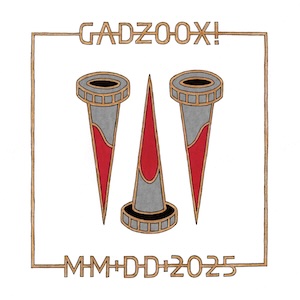
The pages of Gadzoox! mix letters, numbers, Greek letters, and mathematical symbols to represent words (sometime spelled phonetically), the sound of a word (i.e., 2), or similarity to letter form (5 = S). As with the acrostics of John Cage (who is referenced), the texts are meant to be read from left to right and top to bottom. Many pages are filled with multiple layers of texts and word forms—a multiplicity of information occurring simultaneously, as in our daily lives.
To read these pages—I came to understand each page as a distinct visual poem—requires slowing down, staring until your eyes adjust to the page, then scan the page for semantic content—the words made of bold-faced (or light-faced) letters that go down or angled across the page forming phrases of connected meaning. Soon other related words and phrases begin appearing on the page, but which time the texts become more legible, although the letter types used to write the expressions are unfamiliar enough to force a slow reading.
And that seems to be part of the book’s premise: Using technology to undercut itself, to highlight the importance of contemplation and reflection in human life for the formation of knowledge and empathy. The tools of coding from data communication that have been established to ever-diminish our short-term attention spans works are frustrated in the pages of Gadzoox!, which highlight what the inattention misses and how.
 Mirror Mirror #4
2dcloud
After a seven-year hiatus, a new Mirror Mirror anthology has arrived. A cross between Mineshaft and Bubbles plus its own vibe, Mirror Mirror mixes narrative and art, wide-ranging cultural reviews, works by breaking artists and interviews with them—while always remembering its heart is in comics.
The styles represented here are varied, and the artists’ names are new to me: Kriztina Tzekova, Alex Graham, Morgan Vogel, Henry McClellen (whose line I particularly like), and Inés Estrada (paintings of lucid dreams she had during a psychotic breakdown), plus a manga tale of over-the-top violence by Junichiro Saito, printed to be read right to left.
The editor of the revived Mirror Mirror plans to put out three issues a year. Since Fantagraphics’ Now! anthology series (also devoted to new, unconventional illustrated narratives) seems to be hibernating, Mirror Mirror has found a gap and it can fulfill.
 Fifty Poems
Rainer Maria Rilke / Geoffrey Lehmann
NYRB Poets
Geoffrey Lehmann has commended himself well will the goal he set for himself when translating these fifty poems by Rilke. Written before Rilke’s decisive turn against rhyme schemes beginning with the “Duino Elegies,” Fifty Poems contains Rilke’s earlier poems that do obey such schemes: Short lyrics, usually only four or five stanzas long, each three or four lines long, describing what a photographer might call decisive moments: The death of Jesus, people standing on a balcony at twilight, the sound of a piano in the day, the fading lives of flowers: The souls of those moments precisely illustrated, leaving a witness in thought.
Although some of these poems have been translated before—“Archaic Torso of Apollo” especially comes to mind—Lehmann is the first translator to attempt to preserve the sound of Rilke’s poems by obeying their rhyme and meter as well as possible, adjusting them where needed to account for the English language’s terser expressive abilities.
Let “Evening” stand for Rilke’s contemplative moments of epiphany as conveyed by Lehmann:
Held by a line of ancient trees, the day
gives up its blue as it grows late;
you watch; and now your two worlds separate,
one rising, as the other falls away,
leaving you wandering in a strange half-light,
wary of that dark house that is so still,
and yet without conviction and the will
to rise up and become a star each night—
leaving you wondering as to who you are,
your timid, hopeful life that does not pause
and sometimes reaches out, sometimes withdraws,
and fluctuates in you as stone then star.
“Your timid, hopeful life that does not pause”—What could be more affirming than that? Beautifully rendered poetry throughout. Strongly recommended.
The Forgetters
Dave Eggers
McSweeney’s
The Forgetters is work in progress by Dave Eggers, a work apparently without a set number of chapter, the chapters published separately as stand-alone short stories, perhaps working toward a mosaic of interconnected stories. Of the chapter / stories reviewed below, two have the same Giants baseball game in common, two have characters with a dead sibling whose influence hovers somewhere within them, and two have Christmas-time endings. Every protagonist is single, never married, in early middle age, and routine-bound (some routines more agreeable than others). But to routine a disruption must come, and it jolts. [My review of the incorrect version of Chapter 1, The Museum of Rain, may be found here.]
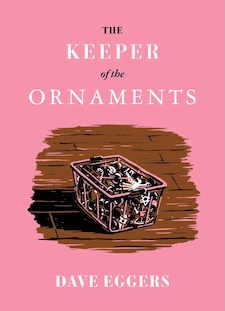 Chapter 3: The Keeper of Ornaments
In The Keeper of Ornaments, the protagonist, Cole, is a 44-year-old man, single, never wed, who discovers one day—to his irritation—that new neighbors have moved into the apartment next door, an apartment that has sat vacant long enough for Cole to have gotten used to and appreciative of the quiet. But now he’s confronted by screaming children, a TV with the volume set at blare, clanging pots and pans, and two cats—which have managed to find a hole in the shared wall between the apartments’ sets of cabinets—bursting into his apartment, knocking over and breaking objects. The single, divorced mother, Daphne, is pushing 30. Cole assures her—she wasn’t asking—that he preferred dating women his own age, and that he would not try to seduce a next-door neighbor. Instead, he sees himself an avuncular role.
It becomes a Christmas miracle story, minus assistance from angels and ghostly epiphanies, but miracle enough to include second chances.
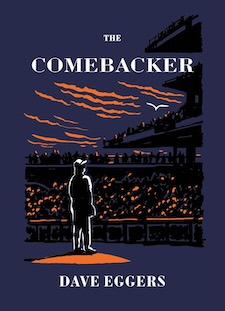 Chapter 4: The Comebacker
In his capacity as a local reporter for the San Francisco Giants’ home games, Lionel witnesses the debut of a AAA pitcher named Nathan, a man unusually articulate and thoughtful for a baseball player, as his first interview shows. But Nathan vanishes as quickly as he appeared, as AAA players often do, and Lionel retreats again into himself, but not without lingering thoughts of this odd duck.
Nathan is brought back a few weeks later as a reliever, helps the team maintain its one-run advantage, and speaks as eloquently, even poetically, as ever. Like Eggers’s earlier book about flying in a glider, Understanding the Sky, the narrative is built from a series of answers from Nathan to questions about how it feels to be pitching.
Lionel eventually hears that a line drive to Nathan’s temple prior to him coming to the Giants, a glancing shot that off the temple, loosened his tongue, imbuing his speech with its loquaciousness and his mind with a Buddhist’s serenity, beholding the miraculous within pedestrian experience.
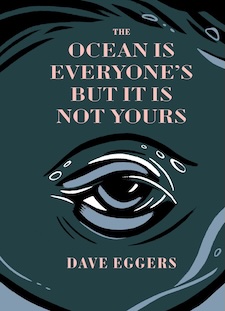 Chapter 6: The Ocean Is Everyone’s but It Is Not Yours
A young woman named Aurora takes over her father’s business taking tourists on whale and dolphin sightings in Monterey Bay. Another boat at the same pier has also run a similar business for decades, as had a third, whose owner retired without a replacement. Over these decades, Aurora’s father, the other boast owners, and eventually Aurora herself communicated with each other when the mammals were spotted. This maximized the number of happy tourists, which was good for business for all of them.
One day, a new ship arrives, its captain wealthy enough to inflict upon his competition stringent enforcement of every petty city regulation and code by its previously indifferent police force. The new captain has a large, uniformed crew, a large, black boat, and a bus service to the pier for paying clients. He does not share with the other boats when he has made sightings. He does not talk to them or acknowledge their existence.
The story also becomes one of old money versus new and demonstrates that older tactics exist for dealing with hostile competitors. Hello, Carlos!
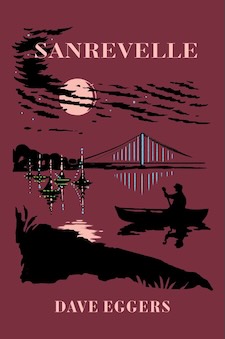 Chapter 7: Sanrevelle
Hop, late 30s, works for a failing law firm and lives alone in the sinking building the firm is housed in (San Francisco’s Millennium Building). As a change of pace, he takes up sailing lessons from a woman named Sanrevelle, also single but a few years older. Together, as student and teacher, their exchanges are terse but effective; learning presumably takes place, although a glossary of marine tackle is not required. Silently, they size each other up, positively. Since so much goes unspoken between them, Hop’s sense that Sanrevelle is fond of him must be delusional, he thinks, as he rows a canoe from boat to boat looking for her and the fact that she wasn’t where she had promised to be.
He’s rowing along the San Francisco Bay shoreline in early evening, where boats have lined up, each lit with Christmas decorations, for a parade of boats to celebrate the holiday. That’s as close to a spoiler as I’ll allow myself.