
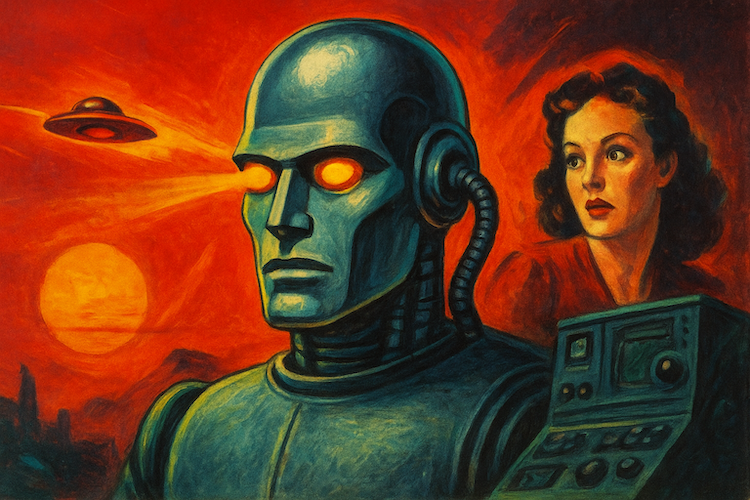
The AI Universe as imagined by Philip K. Dick
i arrogantly recommend… is a monthly and sometimes bi-monthly column of unusual, overlooked, ephemeral, small press, comics, and books in translation reviews by our friend, bibliophile, and retired ceiling tile inspector Tom Bowden, who tells us, “This platform allows me to exponentially decrease the number of views on screens by people who have no use for such things.”
Links are provided to our Bookshop.org affiliate page, our Backroom gallery page, or the book’s publisher. Bookshop.org is an alternative to online gorillas, and that benefits indie bookstores nationwide. If you notice titles unavailable online, please call and we’ll try to help.
Read more arrogantly recommended reviews at: i arrogantly recommend…
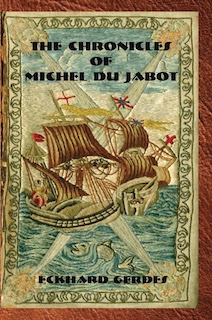 The Chronicles of Michel du Jabot
Eckhard Gerdes
JEF
I mean, you guys raised on Grisham and King, gals on Jong or Morrison, you believe fiction is a sequence of events. You have confused narrative for fiction. Some of you have confused fiction for story-telling. Narrative can be fiction can be storytelling, is vice versa and around. They are terms that do not conflict with each Œðer, nor are they eßential. The confluence of all three is popular, but not mandatory.
Eckhard Gerdes’s The Chronicles of Michel du Jabot takes the elements of sprawling picaresque novel with Odysseus-cum-Prodigal Son travails before, during, and after a long trip home from Mars to Earth, largely via various engagements with parkour and disc golf on the way back to his patient love interest and Dad, as well as lots of disquisitions about lots of musicians in blues, jazz, and prog, their various performances and albums. Take those elements and imagine them at the hands of an entity who channels Monty Python, the Firesign Theatre, and Modernism. The result is a 700+ page book of non-stop punning and word play:
Who had stored these bottles of wine in this cave? A connoißeur, of course!
A con, monsieur, of course!
Acorn monsters off course.
A common steer off course off course.
Akhenaton’s ear’s off coarse. His macron had gone circumflex. And I won’t even mention what he used to do with macaroons.
Examples of this kind of punning by Gerdes are like exercises in unpacking the multilingual puns in James Joyce’s Finnegans Wake. And as with David Foster Wallace, the footnotes are an added treat. Here are footnotes 4-7:
4Prounounced “shirt,” as in fiction+colonel+indict.
5This was a symbol denoting text from a sign, advertising, brand names, words that are owned by companies.
6Pronounced “Shaw,” as in “Featherstone-Hugh,” which is pronounced “fan-shaw.”
7Pronounced “movements,” as in phlegm+through+v+palm+e+pneumatic+ptarmigan+s.
Although the book is labeled as avant-garde, it seems that the claim is made because of Gerdes’s play with extending typography to include non-verbal clues indicating whether a statement is an aside, a private thought, or something else. Some choices—such as the use of Œ rather than “o” and the German ß instead of “ss”—seem merely whimsical rather than semantic. The upshot is, despite Michel du Jabot’s “experimental” label, it should not deter readers who fear or dislike Modernism—he’s just playing around. Which is part of the book’s implicit message: A person can be seriously learned in the humanities and politics and at the same time have fun with his idols and demons. Recommended for readers who love their humor absurd and smart.
 Flower
Ed Atkins
Fitzcarraldo Editions
Ed Atkins’ Flower is an anti-memoir in the form of a single-paragraph, stream-of-consciousness monologue about life’s minor joys and irritations, beginning with a description of mediocre sandwich wraps and where to find them. (Wherever you buy them, Atkins, summarizes, “The best wraps all taste the same: sweet creamed hospice.”)
It reads as a series of set-pieces, anecdotes, observations, and so forth, assembled as a single unit but with the slightest of narrative arcs as the opening begins with where Atkins is in life: in medias res. Night eventually settles in, as do fond thoughts of his wife, and big questions about god. Atkins’ technique isn’t grammatically and syntactically stream-of-conscious; instead, he represents the mind’s tendency—his mind’s tendency, at any rate—to flit from topic to topic, some periods of flitting longer than others, the topics trivial and profound, his moods running from rage to joy. Just as a good free-form jazz piece—spontaneously composed by its performers—has an experiential arc, so does Flower. Atkins’ comment on what he likes and looks for in works of art summarizes what he does in Flower: “I like it when in a film or another thing something structural or very formal that happens that’s unmistakably deliberate but also inexplicable and unrelated to the assumed consistency of the rest of it.”
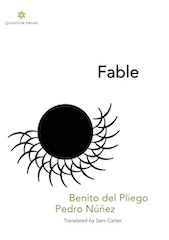 Fable
Fable
Benito del Pliego + Pedro Nüñez / Sam Carter
Quantum Prose
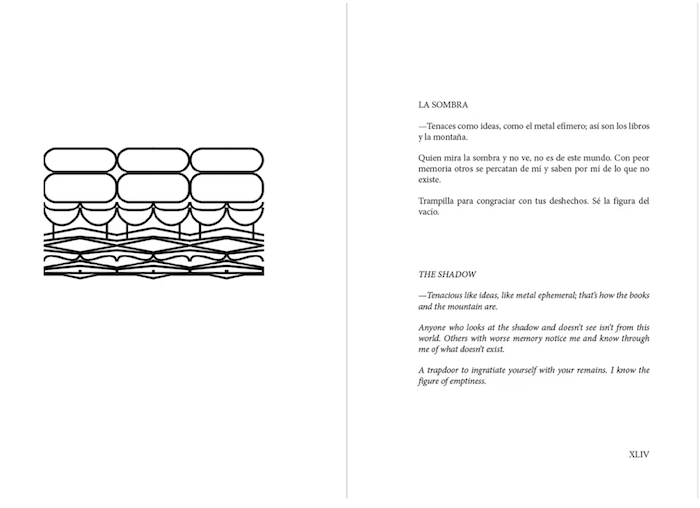
Fable by Benito del Pliego and Pedro Núñez combines the art of typography with oracular texts among which readers look to find the answer/suggestion to whatever question that might have been prompted by the image on the facing page (comprised of typographical fragments). Each text purports answers each reader’s personal question as prompted by the image. At least, that one suggested way and many others, the collaborators suggest—such as reading them as horoscopes for the readers’ acquaintances. At any rate, it’s an artwork that invites participation.
The texts are the sort of gnomic statements that make sense to the questioner, offering suggestions on actions to take (read metaphorically or literally), similar to the I Ching or Eno’s Oblique Strategies: a medium offering ambiguous declamations whose interpretations are matters of temperament rather than of fact. Here are two random examples:
—I can say what ignorance says: don’t spurn knowledge that offers nothing.
What remains is ash and in ash there are no words; not even in you, who insists on covering everything with them.
The second example is titled “The Wood”:
—Splitting isn’t a task for dreaming; the crack requires days. Water penetrates what the sun heats, and on humidity’s balm the moss’s chisel arrives. Nothing frees me from continuing to grow, today toward nothing like yesterday toward the light.
Rotting is a strenuous job; it’s a second birth.
Even without approaching the work with questions in mind, there is still the invitation to imagine how these specific images and words can be interpreted as embedded in each other, how do typographic elements metaphorically or symbolically resolve into their paired responses, and what type of results might be possible from such suggestions? “Fable” and “The Voice of Hearing” make up the two parts of the book, each with its own typographic symbol system.
Fable asks each reader/viewer to entertain the idea of bridging the gap between asemic and oracular expression, the liminal space between meaning and nonmeaning, and how meaning is created from visual suggestions.
 Flunker
Dennis Cooper
Amphetamine Sulphate
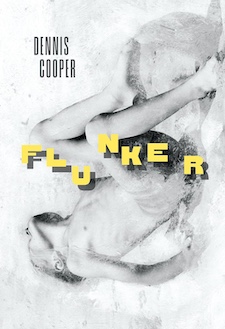
Dennis Cooper’s Flunker collects six stories about corners of the gay demi-monde. “Face Eraser” is a brief autobiography written as a dating site profile, complete with typos, slang, and neologisms. The young narrator, whose “name is pronounced GAY-bree-el,” is in and out of hospitals for self-cutting and beatings from others and seeks harm with the same relish he does sex. “From Here On” purports to be based on a memory of a 15-year-old Dennis about a 12-year-old boy and the mutual infatuation they shared over each other. The boy isn’t just cute, doesn’t just share the same drugs and interests, he also conveys an amorphous eccentricity. Is it because he is trying to come to terms with the dawning of his homosexual desires, is it because suicide haunted his future, or is it some combination, in which desire draws him toward death?
Mental health issues, drug and alcohol abuse, rough sex, incest, murder, and even cannibalism are among the characteristics expressed by Dennis Cooper’s homosexual narrators. I used to know three women who for years had each been raped by their fathers. All were profoundly affected emotionally for the worse. One was furious not just about the rapes but also because she found herself unable to express “normal” feelings of love so that intimacy was an impossibility. Another, whose mother knew about the rapes but never tried to stop them, found sex with her boyfriend confusing and shameful, in large part because she felt guilty for having been sexually aroused by her father’s attacks: How could something be simultaneously horrifying and pleasurable? Cooper’s stories explore similar territory, especially “Gold”—about a Russian father’s reward for selling his son into prostitution for a snuff film. Cooper doesn’t ask why or how then men and boys in his stories because as they are, he just describes them as they are and resists passing judgement.
 On Drugs: Psychedelics, Philosophy, and the Nature of Reality
Justin Smith-Ruiu
Liveright
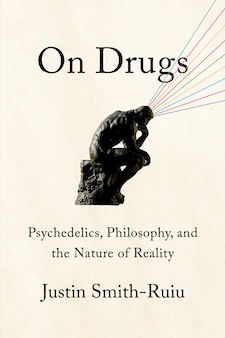
In On Drugs: Psychedelics, Philosophy, and the Nature of Reality, philosopher Justin Smith-Ruiu examines the liminal state between perception and reality through psychedelics—an approach philosophy has long dismissed as suspect or pathological. Both historical and personal, his project shows how altered consciousness can illuminate enduring questions about truth, mind, and world.
Smith-Ruiu begins by asking what makes an experience “psychedelic” and how the mind’s sober perceptions differ from its altered ones. He recalls childhood experiments with double vision—pressing on his eyes until the table before him appeared as two—and wonders why that distortion feels harmless, while seeing a breathing table under the influence of LSD feels metaphysically profound. The difference, he suggests, lies in what each distortion reveals about reality: the possibility of simultaneously seeing things other than as they normally appear and knowing it is a distortion.
How psychedelics expand or expose the limits of knowledge turns on the relation between truth, reality, and perception. Some experiences can be verified by others; they are veridical. But certain perceptions—like seeing spots after rubbing one’s eyes—are true only to the perceiver. Hallucinogens intensify this ambiguity, revealing how fragile our sense of the veridical is and inviting a reappraisal of what counts as genuine perception versus social convention.
This conviction—that one is “perceiving the world as it is”—is, for Smith-Ruiu, both irresistible and treacherous. He sets it within the broader human need to experience altered states. Dreaming, reverie, and imagination are not aberrations but intrinsic to cognition. The ritual use of mind-altering substances extends this faculty. Even nonhuman animals, he notes, practice “zoopharmacognosy,” seeking out intoxicants or medicinal plants. Among reindeer in North Asia, humans and animals even share “communal, symbiotic interspecies tripping”—a vision of consciousness as collective rather than individual.
Psychedelic visions—cosmic serpents, fetal astronauts, waves of universal energy—are not delusions, Smith-Ruiu argues, but imaginative gestures toward understanding. They may not correspond to literal truth, but they express the mind’s longing for it. The philosopher’s task is not to debunk such experiences but to integrate them into a fuller account of inquiry.
Philosophy and science, he reminds us, have long excluded madness and ecstasy from legitimate knowledge. Against Heidegger’s claim that true “being-with” (Mitsein) applies only among humans, Smith-Ruiu insists that, for instance, one can indeed “be with” a cow—that to stand near it is to sense another mind’s presence. Psychedelics, he writes, reveal “the extent to which the limits of Mitsein are not so much a reflection of the intrinsic properties of various external entities as they are of our own attunement.”
Smith-Ruiu’s metaphysical ally, Leibniz, theorized monads—infinitely many mind-like substances whose perceptions compose the world—which anticipated the psychedelic sense of universal consciousness. Both dissolve the boundary between self and world. Yet the early modern valorization of lucidity and rational control, Smith-Ruiu argues, suppressed the revelatory potential of altered states.
Such experiences are less private hallucinations than revelations of relational being. To encounter another mind—human, animal, or otherwise—is to apprehend one’s own existence as contingent on a network of consciousnesses. The awareness of this interdependence feels not illusory but necessary, a self-evident truth.
Smith-Ruiu’s reflections on time and embodiment further test modern materialism. Under psilocybin, he writes, temporal duration can seem illusory. He contrasts this with the idea that reality is a computer simulation, arguing instead that an artificial intelligence could not experience time as humans do, since its transitions would be instantaneous. Consciousness, as we know it, is inseparable from embodiment and temporal flow.
Where modernity medicalized madness and pathologized vision, Smith-Ruiu restores their philosophical dignity. The marginalization of psychedelic experience, he argues, mirrors rationalism’s suppression of mystical insight. A society that refuses madness can only treat psychedelics as therapy or threat.
In its closing pages, On Drugs turns spiritual. Smith-Ruiu acknowledges the overlap between psychedelic and religious experience but refuses to conflate them. “A psychedelic experience,” he writes, “is not opposite to a spiritual experience … but analogous to it.” The trip’s value lies not in chemistry but in its reenactment of a capacity already within us. Albert Hofmann, discoverer of LSD, made a similar confession late in life: many people have visionary experiences daily but fail to recognize their meaning.
This is Smith-Ruiu’s reconciliation: psychedelics may heighten awareness, but they are not prerequisites for revelation. They dramatize what consciousness already contains—the yearning to see through the veil and sense the cosmos as alive with mind. Rituals, he suggests, perform a similar role: they create moments of “controlled madness,” where meaning is suspended and the self moves freely beyond its limits. Getting out, as he puts it, is a way of getting in.
On Drugs is not a manual for tripping or a polemic for legalization. It is a philosopher’s field report from the edges of reason—a defense of ecstasy as a mode of inquiry. By treating psychedelic states not as aberrations but as data within the vast experiment of consciousness, Smith-Ruiu argues for a more expansive, capacious notion of knowledge that can lead to wisdom.
ANAMNESIS AND AI
How to Build a Universe That Doesn’t Fall Apart Two Days Later
Philip K. Dick
Isolarii
Anamnesis
Caroline McManus
Asterism
Searches: Selfhood in the Digital Age
Vauhini Vara
Pantheon
Philip K. Dick, Caroline McManus, and Vauhini Vara each examine how technologies shape our sense of what gets labeled “real.” Though their approaches differ, they implicitly agree that reality is that which has historical precedent. Dick and McManus approach reality through the concept of “anamnesis,” the Greek term for remembrance or recovery of knowledge once known. For Dick, anamnesis is revelation—a visionary rediscovery of eternal truth. For McManus, it is irony—the machine’s simulation of remembering without consciousness. For Vara, it is grief—the attempt to reassemble memory through collaboration with a machine that can imitate but never feel empathy.
 Philip K. Dick’s 1978 lecture How to Build a Universe That Doesn’t Fall Apart Two Days Later captures the author’s study of the fragility of our perceptions of reality. Dick argues that what we call “reality” may be little more than a manufactured illusion—a hallucination we sometimes glimpse beyond rather than inhabit. “[T]here is internal evidence in at least one of my novels,” Dick writes, “that another reality, an unchanging one, exactly as Parmenides and Plato suspected, underlies the visual phenomenal world of change…”
For Dick, that “unchanging reality” is an eternally recurring age of early Christians living under Roman rule—the underlying core of present existence he claimed was revealed to him in a flash of light bouncing off a young woman’s necklace. The experience struck him as a sudden recollection of something once known:
In that instant, as I stared at the gleaming fish sign and heard her words, I suddenly experienced what I later learned is called anamnesis—a Greek word meaning, literally, ‘loss of forgetfulness.’ I remembered who I was and where I was. In an instant, in the twinkling of an eye, it all came back to me. And not only could I remember it but I could see it. The girl was a secret Christian and so was I. We lived in fear of detection by the Romans. We had to communicate with cryptic signs. She had just told me all this, and it was true.
His vision collapsed revelation and evidence. Less a systematic thinker than an inspired autodidact, he tended to conflate metaphor with memory, theology and hallucination. His ideas, couched in florid prose, combine metaphysics with pulp sensibility: dazzling, erratic, strange—and sincere. An outsider philosopher, Dick builds arguments from intuition, deriving meaning from coincidence and seeing divine structure in the scaffolding of fiction.
After receiving the hint that the “real” world he inhabited was that of ancient Jerusalem, it was further revealed unto him the narrative parallels between the Book of Acts and some of his own novels. Disneyland in Anaheim, California, where he lived, represented for him the world’s capital of manufactured illusion, and his revelations indicated that “Anaheim” was a patina camouflaging ancient Jerusalem, with which it was co-spatial-temporal. If his anamnesis revealed to Dick a sacred reality behind crass commercial appearances, it also exposed the fragility in his trust of perception.
Whereas Dick’s anamnesis is mystical—personal revelation refracted through science fiction—Caroline McManus’s is technological, replacing divine illumination with algorithmic recall, exploring how artificial intelligence simulates thought, judgment, and memory while lacking all three.
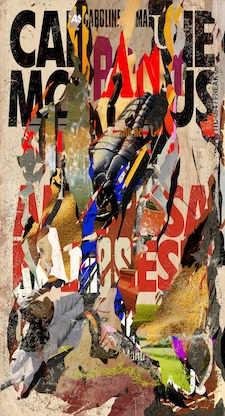 Caroline McManus’s Anamnesis is a hybrid work of inquiry, examining the strengths and failings of artificial intelligence through case studies that range from the absurd to the unsettling. The book unfolds in six parts, each probing a distinct aspect of AI. It opens with reflections on how spiritualist and conspiratorial thinking circulate through social platforms, followed by transcripts produced by Otter AI from YouTube monologues in which self-styled visionaries lecture on astral planes, chakras, alien civilizations, and pseudoscientific diets. These speakers seem unable to provide statements with semantic content: syntax collapses, prepositions drift, and subjects change mid-sentence. AI transcription exposes rather than clarifies their delirium. Typographical slips and mistranscriptions amplify the absurdity, producing accidental comedies of error and belief. Here, the machine becomes an unwitting collaborator in human incoherence.
McManus then turns to ChatGPT, questioning the model about its sources and evaluative standards. Feeding it samples drawn from the earlier transcripts—rambling speculations on quantum spirituality and alien life—she asks the system to analyze them. Its responses are grammatically flawless yet conceptually vacuous. ChatGPT simulates understanding without ever achieving it. Its lucidity masks its emptiness.
A 14-page, 10-column table in tiny type, 10 showings how human annotators evaluate text for AI training. Many of these workers live in refugee camps or other precarious conditions, earning pennies per task when they are paid at all. This hidden human labor economy undergirds the very systems touted as post-human.
Though she briefly entertains the idea that AI might someday act as a fraud detector, capable of exposing falsehood through logic alone, McManus’s optimism fades. Between those who invent nonsense and those who cannot tell the difference, is the abyss of stupidity—a gulf no algorithm can bridge. Bound by patterns and probabilities, AI mirrors our credulity. AI’s mechanical recall is not memory but its residue—a conservatism of syntax over spirit, the letter without the life.
The final section gathers interviews with workers whose jobs intersect with automation. Their reactions are ambivalent: AI promises efficiency but threatens livelihood.
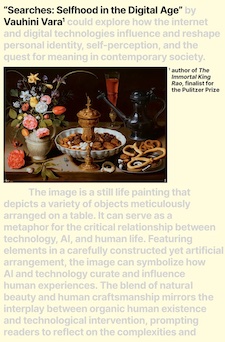 Vauhini Vara’s Searches: Selfhood in the Digital Age enters this same terrain from a more intimate angle. If Dick and McManus treat anamnesis as cosmic revelation or ironic simulation, Vara treats it as emotional archaeology—the attempt to recover a lost self through the prosthetics of AI.
In Searches: Selfhood in the Digital Age, Vauhini Vara explores how technology’s efficiencies have reshaped daily life while eroding our sense of connection. Her critique of high-tech capitalism—its convenience paired with its ecological and human costs—is familiar enough: online commerce outpaces the moral discomforts it creates. Where Vara’s book becomes more intriguing is in her experiments with AI as a writing partner, though the results are mixed.
At first, Vara lets AI assess her own prose, only to find that its feedback offers little more than polite summary—a mirror with no depth. Her project gains dimension when she begins using AI to riff on prompts, particularly around the death of her sister. Feeding the machine fragments of memory, she watches as it fabricates imagined scenes of their shared life. Vara doesn’t intend AI to write her memoir for her but to help her triangulate what she wants to say. Each resubmission of the prompt yields a fresh variation, reminiscent in a lower-key way of Raymond Queneau’s Exercises in Style, which retells a single incident in 99 ways. Through this iterative dialogue, AI becomes less an author than an accelerant of Vara’s introspection.
Later in the book, Vara asks AI to generate images that correspond to her memories. These illustrations, sentimental and clip-art-like, succeed less as art than as triggers—evoking new recollections and emotional nuances. Her use of AI here is less about aesthetics and more about recovery: how mechanical reproduction might reactivate grief. Yet she concedes that beyond this prompting function, AI offers little to serious writers. Its facility with cliché delights genre fans who prize productivity over depth, mistaking output for authorship, and claiming as under their own “authorship,” for instance, made-to-order romances.
Vara concludes by warning of AI’s broader social cost—the promise of personalized search and algorithmic convenience that isolates individuals within preference bubbles, further eroding communal bonds and civic cohesion. Ultimately, Searches is an ambitious but uneven inquiry: at its best when Vara wrestles personally with memory and loss, at its weakest when overrun by AI-generated text whose flatness she fully acknowledges. The book’s most valuable insight lies in what human specificity—our inimitable subjectivity—still offers that machines cannot.
AI has two significant shortcomings: AI cannot formulate new analogies and metaphors and thus cannot report insight. Even if it could generate patent-producing insights, it could not select from among the insights those which could potentially be income-generating. AI’s programming is weighted toward offering suggestions based on predictive / likelihood formulas, as it does in its ability to suggest how I might end or add to any particular sentence I’m writing, based on what, in the past, has been done by others. Thus, rather than paradigm-breaking/shifting insights and products, we’ve been handed every industry’s tendency to reinforce the structural integrity of the boxes it once claimed to be thinking outside of.
The perception of reality shaped by such systems is, in the deepest sense, conservative—rooted in precedent, allergic to risk, unable to imagine a world that does not already exist.