
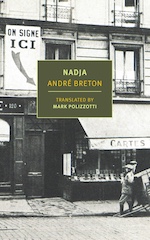
 The Book Beat reading group selection for August is Nadja by André Breton. We will meet virtually online via Zoom or in store on Wednesday, August 27 at 7:00 p.m.
The Zoom link will be sent on the afternoon of the meeting to anyone interested in attending.
The Book Beat reading group features international works in translation. The discussion group is free and open to the public. Please call (248) 968-1190 or email bookbeatorders@gmail.com for more information.
Books are in stock now and discounted 15%.
A new translation of one of the defining works of the French surrealist movement, an energetic autobiographical novel that is at once both a tumultuous romance story and an initiation into the surrealism of everyday life.
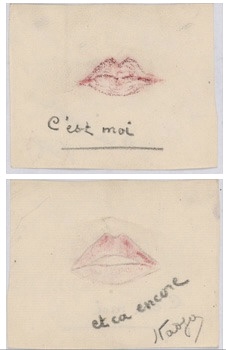
C’est moi; et ca encore; Nadja (It’s Me; and that again; Nadja), original illustrated letters from Nadja to Breton, 1926, lipstick and pencil on paper. From “The Witch’s Cradle,” Biennale Arte 2022.
In Paris, during the fall of 1926, André Breton met a young woman from the provinces who called herself Nadja because, she said, “in Russian it’s the beginning of the word for hope, and because it’s only the beginning.” Their love affair was brief, intense, and intensely self-conscious. They both talked exuberantly of the book that Breton would make out of their days and nights. And indeed a year later (after Nadja was institutionalized and Breton had moved on to other love affairs) he began to write Nadja—a book of memory and analysis taking its cue in part from Freud’s case studies, but also a book of ingeniously intercut images, drawing on Surrealist ideas to portray a soul whose very way of being approaches, in Breton’s words, “the extreme limit of the Surrealist aspiration.”
In this, the first new translation of Nadja in more than sixty years, Mark Polizzotti captures the youthful excitement, the abiding strangeness, and above all the freshness of Breton’s prose. He also provides an illuminating introduction about the fate of the real Nadja, whose identity remained jealously guarded until the twenty-first century.
A gripping tale of infatuation and a meditation on the surrealism of everyday life, Nadja is still a thing of convulsive beauty, impossible to pin or put down, a precursor to works of Julien Gracq, Julio Cortázar, and W.G. Sebald.
This edition of Nadja contains 44 images, which Breton “conceived from the outset as an integral element of the narrative,” as Mark Polizzotti writes in his introduction.
“The most remarkable of [Breton’s] sorceresses is Nadja. She predicts the future; she conjures up words and images that spring to her friend’s mind at the very same instant; and her dreams and sketches are oracular. She is a free spirit.”—Simone de Beauvoir
“In Nadja, André Breton does not express himself—which self would that be anyway?—or exploit himself; he surrenders himself…That is why Nadja is necessary, like a natural phenomenon.”—René Daumal
“A deft new translation by Mark Polizzotti…Nearly a century later, Nadja still matters because it reminds us that true self-discovery derives not from grand visions or spiritual transformation but from these small interactions with the mundane that hint at the enchantment of an otherwise banal world…Nadja was Breton’s love; Paris, his city. In the novel, and in his life, he haunts them both, and they torment him in kind.—Ben Libman, The New York Times
“Perhaps this book deserves another star or two; two stars reflects my personal level of enjoyment and new insight. Nadja is a young woman who is mysterious, romantic, rebellious, and strange. She is a symbol of the surrealist attitude towards life, its aesthetic vision and its psychological state. Nadja always attracts children. Glorying in the childlike is a trait shared by both romanticism and surrealism.
The narrator (nearly synonymous with Breton) is inspired and obsessed by Nadja, driven by her example. However, his predilection to surrealism exists independent of and prior to her. His surrealist politics embrace rebelliousness as a whole even when it displays contradictory enthusiasm for both left wing communism (buying a new book by Trotsky) and anarchism. (He writes of “…the magnificent days of riot called ‘Sacco-Vanzetti’.”)
There are limits to surrealistic/romantic irrationality here. At one point, the narrator exhibits a conventional streak of bourgeois self-preservation. He resists Nadja simultaneously stepping on the gas and covering his eyes while he is driving. And yet, he appreciates her gesture of “love” transcending the concern for life, reenacting it often in his mind. He also tells us that for Nadja there is little difference between the inside and outside of a sanitarium. (Surrealism is, after all, an embrace of the irrational.) The narrator reminds us there is, unfortunately, a big difference. In the sanitarium, one is behind locked doors in a visually impoverished setting and must face the unwanted intrusion of caretakers.
Written in 1928 by an acknowledged leader of the surrealist movement, Breton’s novel has been touted as the first and best surrealist romance. There are a few exciting/ interesting incidents and insights but overall it seems tediously tame, often irrelevant, and dated. There are several photos of buildings, scenes, and people mentioned in the narrative. The photos of people were mildly fascinating; the photos of buildings were not. There are also several surrealist sketches and again some mildly fascinating, some not. None, unfortunately, measure up to the famous works of Dali, Ernst, Magritte, etc. This book may be an historically important document/artifact in the development of surrealism, but it is not in my opinion so essential in the canon of world literature.”
–Reading group member Bill Corporandy wrote this review nearly 14 years ago, soon after he read the book. He added in an email, “In subsequent years I have come to appreciate it more though I would still not consider it a favorite. By the way, Nadja’s notion that there is little difference between the inside and outside of a sanitarium is also explored by Machado de Assis in his somewhat satirical long short story The Alienist (or the Psychiatrist).”
 André Breton (1896–1966), the son of a Norman policeman and a seamstress, studied medicine in Paris and was drafted to serve in World War I in 1915. While working on a neurological ward, he met Jacques Vaché, a devotee of Alfred Jarry, and Vaché’s rebellious spirit and suicide at the age of twenty-three would powerfully shape Breton’s sensibility. Thanks to the auspices of Paul Valéry, Breton worked as an assistant to Marcel Proust, and in 1919, along with Philippe Soupault and Louis Aragon, he founded the journal Littérature. The Magnetic Fields, the first book of automatic writing (published by NYRB Poets), appeared in 1920, and in 1924, having broken with Tristan Tzara and the Dadaists, Breton issued the Manifesto of Surrealism. Among his other major works are Anthology of Black Humor, Mad Love, and Surrealism and Painting.