
I arrogantly recommend… is a monthly column of unusual, overlooked, ephemeral, small press, comics, and books in translation reviews by our friend, bibliophile, and retired ceiling tile inspector Tom Bowden, who tells us, “This platform allows me to exponentially increase the number of people reached who have no use for such things.”
Links are provided to our Bookshop.org affiliate page, our Backroom gallery page, or the book’s publisher. Bookshop.org is an alternative to Amazon that benefits indie bookstores nationwide. If you notice titles unavailable online, please call and we’ll try to help.
Read more arrogantly recommended reviews at: i arrogantly recommend…
 The Other Girl
Annie Ernaux / Alison. L. Strayer
Seven Stories Press
Annie Ernaux’s latest book is addressed to her older sister Ginette as a letter. As usual for Ernaux, The Other Girl is brief and based on her own life. What is new is that while, for lo these many decades, Ernaux has been writing about herself, her mother, father, husbands, and lovers, she never until this book has talked about Ginette—and even then, in this book, introducing her by name only about halfway through.
That’s largely because Ginette died at age six, two years before Annie was born. Although Annie wasn’t told of another sister until she was ten, Ginette seemed always present to her parents: Ginette was nice, Ginette believed in God, and Ginette’s death broke her father’s heart. Her parents’ eyes were filtered by Ginette’s existence for the remainder of their lives whenever they saw Annie.
But why, as a title, didn’t Ernaux call her letter “My Sister,” instead of identifying her as one might a person having an affair—The Other Girl?
As a child…I always thought I was the double of another girl living in another place. That I wasn’t really living, either, and that this life was ‘writing,’ a fiction about another girl. This absence of being, or fictional being, needs to be explored further.
What was her parents’ fidelity towards Annie in light of Ginette? “Your [Ginette’s] presence inside them was indestructible.”
I wasn’t supposed to ask them anything because they didn’t want me finding out about you. I was supposed to comply with their desire for me not to know about you. I was supposed to comply with their desire for me not to know about you. It seems to me that breaking that law (but I did not even imagine doing so) would have been tantamount to uttering obscenities in front of them, or doing something even worse—bringing on a kind of cataclysm and an unusual punishment that I associate here with the phrase of Kafka’s father to his son, who relates it in his “Letter to His Father,” and which I immediately copied down the first time I read it, at the age of twenty-two, on my bed in the university halls of residence: I will tear you apart like a fish.
A complicity emerges over the decades between Annie and her parents, a complicity formed of a silence filled with what Ginette’s presence and absence means for each of them.
 Soft Burial
Fang Fang / Michael Berry
Columbia University Press
There are a lot of people who feel that when in time of major historical turmoil there is a transition of political power, this is a necessary process we must go through to stabilize the country. But I think we can all ask ourselves, Was it really necessary for them to use such brutality? —Fang Fang, Soft Burial
Before China’s Communist Party oversaw the exercises in mass murder at Tiananmen Square, during the ten years of the Cultural Revolution, and the four years’ famine of Mao’s Great Leap Forward, there was the Land Reform Movement of 1947-1952. During this five-year period, property held by landlords was to be redistributed among the peasants who tilled the soil for them. On paper, the transfer sounds like a simple idea: Divide a landlord’s holdings by the number of families that worked for him. Many landlords had supported Mao’s revolutionary forces by providing arms (or the money to buy arms) and paid far more in taxes than they were required to. For these acts of benefice, some landlords received letters from the new government attesting to their goodness at helping the cause.
However, a letter often was not good enough for peasants with personal grudges against their landlords, grudges that helped stir up local sentiment against wealthy families during “struggle sessions” (which reappeared during the Cultural Revolution), which could last for days. What could have been enacted through a fairly benign process quickly grew uncontrollable by even government officials. Wealthy families (and sometimes their servants) were brought to struggle sessions where they were denounced for their wealth (including denouncements from family members to save their own necks) and complaints against the family for slights real and imagined, followed by beatings, torture, and, finally, execution.
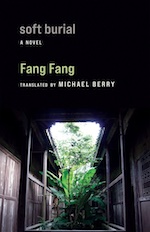
Soft Burial begins during China’s Land Reform Movement. As the story opens, the body of a young woman is discovered floating in a river. Bruised from head to toe and at first assumed dead, the body is tended to by a physician, a Dr. Wu, who discovers that she is still alive. Eventually, the woman awakens, but with no memory of how she ended up in the river or even what her name is. Dr. Wu tells her that some things are best forgotten. And so, she doesn’t pursue the matter.
At the hospital, while recuperating, she remains quiet but industrious, asking to take on extra tasks that may be available. When Dr. Wu first encounters her, she speaks only the words “ding zi” (nails); he adds another syllable, tao (not the Buddhist tao—that’s a different character with a slightly different pronunciation), and names her Ding Zitao.
She and Dr. Wu eventually marry and have a son, named Qinglin. Ding Zitao devotes her life to raising Qinglin, even working as a maid for other families after Dr. Wu dies prematurely, to ensure that Qinglin will be able to attend college; they live just above the poverty line. When Qinglin reaches mid-career as an architect, he builds a villa for his mother to spend her remaining days in, instead of the poverty that has consumed the last thirty years of her life, as a way of thanking her for the many sacrifices she made to ensure his success.
When Qinglin takes his mother to her new home, she begins experiencing a series of short but emotionally devastating images and phrases from her past, which she has long forgotten, that for the reader lack context but which immediately make Ding Zitao break into a cold sweat and pass out.
His mother receiving round-the-clock care at home, Qinglin takes up an offer from a former roommate in college, Long Zhongyong, to visit Eastern Sichuan. Long Zhongyong is an academic in architecture working on a project to document old, abandoned compounds formerly owned by landlords. During the trip, Qinglin makes inadvertent discoveries about his parents while Ding Zitao, in her hellish stupor, relives them.
I think every nation has those citizens who wish to forget everything and those who want to remember to learn, and Fang Fang does well at acknowledging that fact and in presenting each side’s rationale their position. The U.S. certainly has its share of citizens who resent being reminded of the many cruelties and deaths enacted in the name of We the People. Like Fang Fang, I think it’s better that nation’s face up to their history, difficult though that may be.
That’s what Ding Zitao’s does while she’s in a coma—goes through the eighteen stages of Buddhist hell—in which she faces both what she suffered and what she inflicted on others—so that she can finally have a burial with a casket, and thus a peaceful spirit that can rest.
 To the Kennels and Other Stories
Hye-Young Pyun / Sora Kim-Russell and Heinz Insu Fenkl
Arcade Publishing
Hye-Young Pyun is a Korean writer who focuses on the emotional strains and precarity of urban employment in Korea; To the Kennels is her fifth book to be translated into English. Pyun describes Korean work culture as consisting of punishing hours, steep competition (for even middling positions), and a strong press toward conformity. The eponymous tale, “To the Kennels,” has the feeling of a Twilight Zone episode, in which a protagonist discovers that his normal world is a type of hell from which escape is impossible, and his frustrated ability to escape is a matter of life or death for his son.
In “Birth of the Zoo,” a single man, with a lousy job at an insurance company, buys a rifle after a wolf escapes from a local zoo. He hopes to track down and kill the wolf by roaming town at night, where the beast has been reportedly seen. His unhappiness at work—and his co-workers’ unhappiness with him—owes to his being constantly behind in his duties, even though he works late and on the weekends. He ends up quitting his job—saying he wishes to devote his time to hunting down the wolf—and eventually finds a new job with a different insurance company. And he shoots and kills not a wolf, but a man dressed in animal pelts. His life has not improved, and the accidentally killing goes unreported.
The protagonist Park of “Lost and Found” is the last of his peers to receive a raise to team leader, when his boss gives him an assignment whose success is economically important to the company. After Park manages to lose all documents related to the assignment, his migraines become chronic (a lot of the characters in Kennels suffer from work-related migraines) and he no longer recognizes the faces of his co-workers, including his boss. When he finally confesses loss to his boss about losing the documents, his confession is met only with silence—which only worsens Park’s condition as he waits for the other shoe to drop.
Other stories focus on unhappy relationships (exacerbated by employment demands) and attempts to evade suffocating government regulations that prevent homeowners from upgrading their homes and property. The plot of “Nightwork,” for example, implies that authoritarian rules of conduct only encourage people’s dishonesty with each other and the government. Such dishonesty, in turn, only further erodes the foundation upon which civil society is built.
Sora Kim-Russell and Heinz Insu Fenkl provide seamless translations that, for all their effect of alienation with a culture different from America’s, spark flashes of familiarity for this U.S. reader whose leadership sees government as a tool for punishing its citizens for existing.
 Bedbugs
Martina Vidaic / Ellen Elias-Bursac
Sandorf Passage
Bedbugs takes the form of a single-paragraphed letter (across 200 pages) written by a woman named Gorana to an old friend on the occasion of Gorana’s coming to terms with the death of her husband just a few days after their wedding. Beginning with a chain of observations made by people-watching, Gorana’s letter slowly turns towards its theme, the observations having served to establish the contemporary cultural context of Serbia, where the action occurs. And—as if reporting about a dead spouse weren’t bad enough—Gorana, also confesses that she is writing the letter on the run after having burned down her apartment.
Gorana retails going to her sister’s house to stay with family for a short time, telling them nothing about her apartment. Nobody even knows she was once married. While Gorana’s letter serves as a place for recollecting her past and the events and personalities that shaped her, it also reveals her attitudes toward her profession—architecture—her goals within that profession, and the aesthetic and moral components of architecture that provide many of the tensions in her life, the compromises demanded of her seen by her clients merely as a person with services for hire.
These compromises, and her architectural partner’s willing acquiescence to them, has also led to the emotional breakdown her letter documents. After leaving her sister’s house, she eventually wanders her way to the house she grew up in, now empty. Recalling a hiding place in the flooring, she finds enough money to support her while she spends the next half-year remodeling the house, creating a home unsullied by compromise, based on her own talent and vision. Once she finishes the house—a little more than a year after the accident that killed her newlywed husband—she returns to her apartment’s landlord. It’s time for her to confront what she has been the architect of, and why.
 Girls Gone Wild
Katie Lane
2dcloud
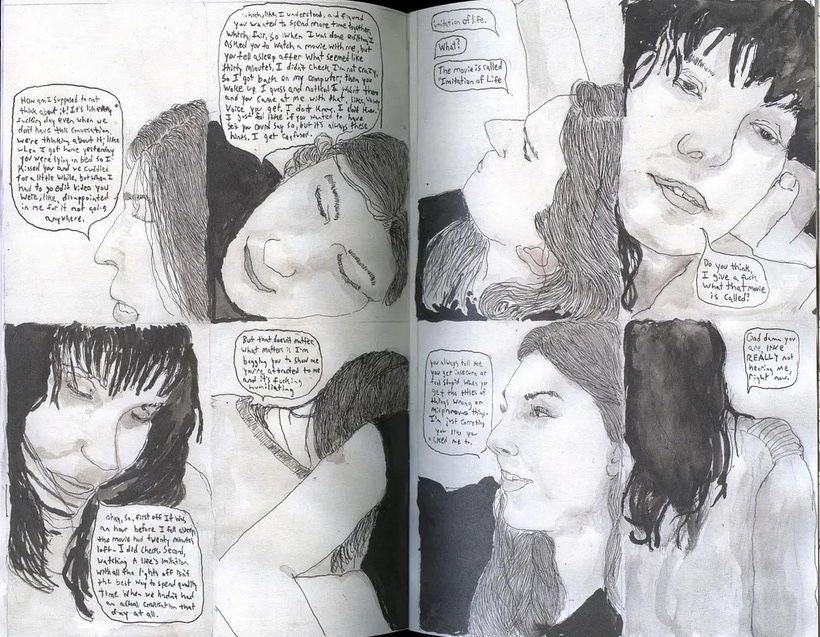
Girls Gone Wild collects two graphic stories rendered in grey washes, their narrative sweep presented, at least in the titular story, like a storyboard for a film, and in the second, “I Thought I Was Wrong,” almost haphazardly, as if in draft form, with the content still—or its emotional charge—still being worked out. In the erotic “Girls Gone Wild,” two transgendered women engage in a conversation so saturated in therapy-speak that I can’t tell if it’s meant parodically. At least the sex seems unconstrained by unnatural speech. That the dialogue in “Girls” is sometimes too small to read and in “I Thought” all but illegible seems to indicate that, for Lane, the message is in the images and the body language show. Lane’s visual artistry is the star of this show and shows an emerging talent worth keeping an eye on.
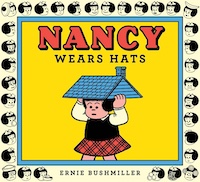 Nancy Wears Hats
Ernie Bushmiller
Fantagraphics
Visual jokes, absurd situations, and undaunted determination to have fun make up the daily comics Ernie Bushmiller created from 1949 to 1950 for his charming (but never cutesy or sentimental) pals, Nancy and Sluggo, with typically blind-sided assistance from Aunt Fritzi and a cast of anonymous walk-ons. Before “meta” became a common prefix to describe self-referential storytellers, Nancy was breaking the fourth wall, quite willing to remind you that an arrangement of black and white geometric shapes can be funny. Nancy Wears Hats is a strictly aces anthology, beautifully designed by Kayal E., but Nancy enthusiasts be alert: The contents of this volume also appear in Fantagraphics’ early reprint of Nancy strips, Nancy Loves Sluggo.
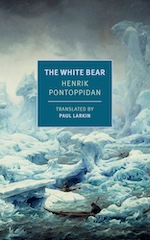 The White Bear
Henrik Pontoppidan / Paul Larkin
NYRB Classics
The Danish writer Henrik Pontoppidan, who won the Nobel Prize for literature in 1917, deals with themes of acceptance, rejection, idealism, and intolerance. The White Bear includes two of his novellas, the eponymous “The White Bear” and “The Rearguard,” both featuring indomitable protagonists, one gentle, the other volatile.
“The White Bear” concerns the life of a big, homely man, Thorkild Müller—rejected at home and by the community for his looks and moonish ways—often found staring into space for hours on end and having difficulty learning at school. With limited prospects at home for work and marriage in Denmark, his apparently dull-minded ways make him an ideal candidate for a Lutheran ministry to somewhere in Greenland. Above the Arctic Circle. No one is particularly worried that he doesn’t attend his theology classes (his heterodox notions of cleanliness raise eyebrows when he does attend), and the single correct answer he provides on his qualifying exam for the ministry is deemed sufficient (the other questions he ignores). Off to Greenland he goes.
In Greenland, he realizes his potential and is eventually absorbed as one of their own into the community he was sent to, marrying a local woman with whom he has two children. He is widely admired by his flock for his care and compassion, his absence of condemnation and scolding. As a representative of the Lutheran Church, he works within the spirit of its doctrines, for which he is loved by his congregation. The church hierarchy, however, inclined to observing the letter of the law, find Thorkild abhorrent. His distance from the theological machine—living high up in the Arctic Circle—makes the tensions ignorable. But a time comes when he must retire, return to Denmark, and face his adversaries.
“The Rearguard” describes the disintegrating marriage of a newlywed couple—she, Ursula Branth, from a genially conservative and bourgeois background; he, Jørgen Hallager, a brash, outspoken painter of the social realist movement. Both are idealists of a sort, but Hallger’s idealism is rigid, oppressive, and intolerant of other views or compromise:
Ah, fie, for shame … that folk simply could not stop believing that fairy-tale dross about the power of love to unite souls! … No no … Spite. Bile. Eternal struggle. That was it, Antagonism. Mutual hatred! Mutual revenge! That was what fired and welded things together! Kept them bright!
Jørgen tosses insults about so casually that he’s surprised people are offended by the “truths” about themselves he proffers unbidden. But for Jørgen, any point of view at variance with his own can only be attributed to the other’s greedy self-interest at the expense of the starving masses. Among those insulted by his boorishness are his father-in-law (who holds a respectable, upper-middle class appointment in government) and his (rapidly dwindling) peers willing to believe in or put up with his monomania. Ursula is treated no better than the rest. Both Ursula and Jørgen believe they can change the other—always a sign that at some point the relationship will be on life-support. When, at Jørgen’s apartment, in front of Ursula, Jørgen’s fellow painter and mentee, Thorkild Drehling, who has strong feelings for Ursula, denounces Jørgen for his cynicism and hostilities, matters have reached the breaking point. But is a breaking point reason enough to re-assess one’s commitments despite the consequences?
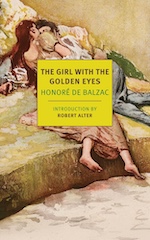 The Girl with the Golden Eyes
Honoré de Balzac / Carol Cosman
NYBR Classics
A novella among Balzac’s sprawling Human Comedy, The Girl with the Golden Eyes explores another niche within the fabric of French culture, from peasants to aristocracy. Balzac surveyed France’s (early 19th-century) state of human affairs and how its citizens’ relationships are informed and affected by the tensions among the various and competing needs and desires of each other to thrive or merely survive.
Our hero, Henri de Marsay, is a well-educated young man, wealthy and without parents or family. His tutelage under the instruction of a priest shaped him to be a tactful strategist in the arena of love, a subject towards which he is utterly cynical. The more prestigious the prey, the more excited he is by the prize of conquest. The titular heroine, Paquita Valdes, the girl with the golden eyes, is the daughter of a Spanish nobleman, tightly monitored by her chaperone and servants of the mansion who, together, form the gauntlet a would-be suitor would have to circumvent for a private audience.
But our Narcissus isn’t as clever or debauched as he imagines himself, and his isn’t the only game in town.

Did you know Chris Ware designed a pane of stamps for the U.S. Post Office? Coming out July 23.
“The meticulous artwork shows a bird’s-eye view of a bustling town. Each individual stamp is a frame of sequential art, telling the story of a mail carrier’s journey as she walks her daily route. Laid out in four rows of five stamps, the story progresses through a year’s four seasons, from top-left to bottom-right.”—USPS