Les Fauves by Georges Duthuit, 1949 (Matisse cover)
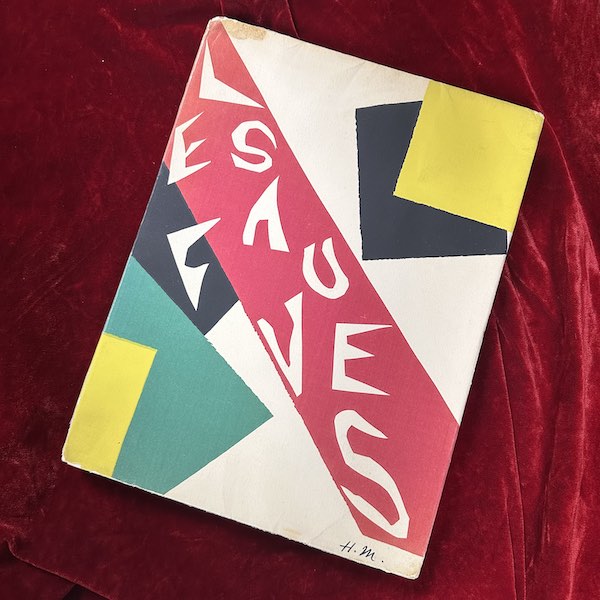
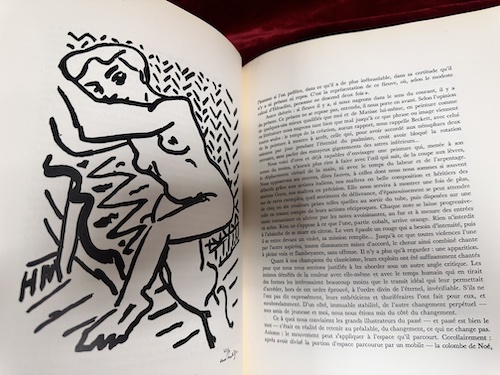
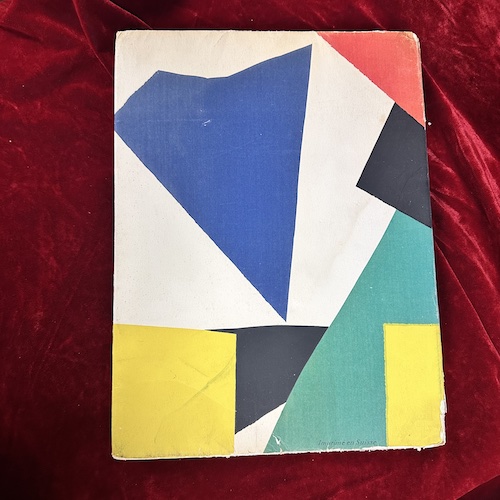
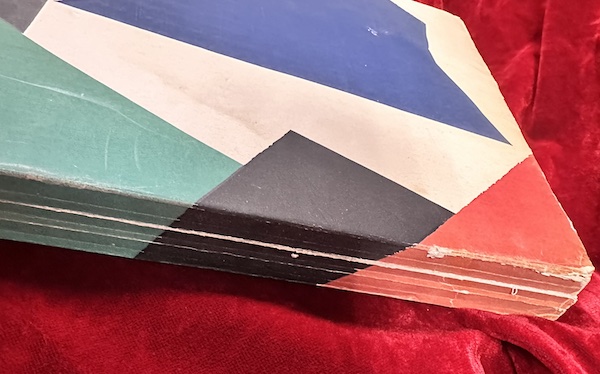
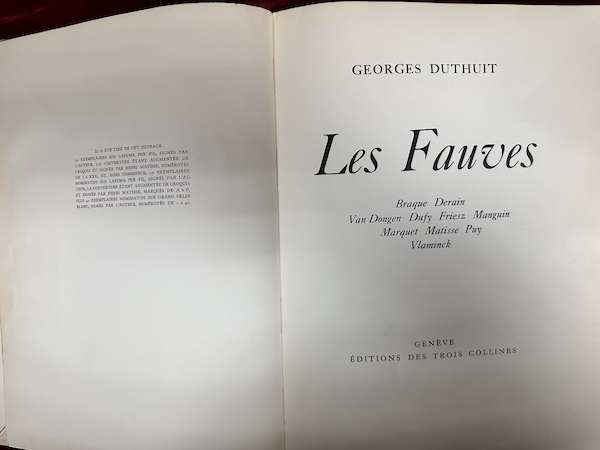
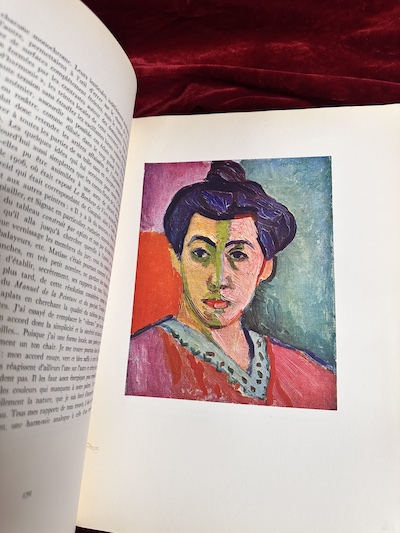
Les Fauves, by Georges Duthuit, Éditions Des Trois Collines, Geneva 1949, Cover by Henri Matisse, Good copy shaken but still intact, edge wear, sewn binding, cracking at spine, light stains on foredge, all plates intact, letter press, H: 12 11/16 in. (322 mm); W: 9 1/2 in. (241 mm); Depth: 1 1/8 in. (29 mm). Page: H: 12 1/2 in. (317 mm); W: 9 5/16 in. (236 mm). pochoir print in red, black, green, yellow, and blue of an original design by Matisse. Reproductions: 68 photolithographs of paintings on coated white wove paper (16 in colors, tipped in), plus 22 line block reproductions of drawings and woodcuts, (some with an ivory tone block) on cream wove paper. Text: letterpress (typeface: Baskerville). Text is in French.[j4 br]
(Film below is for reference only, taken from another copy)
Les Fauves, by Georges Duthuit, Éditions Des Trois Collines, Geneva 1949, Cover by Henri Matisse
It was the brutal brush strokes and bold, slightly mad colours of Fauvism that led to its proponents being nicknamed the “Wild Beasts”. But by the time the lead beast, Henri Matisse (1869-1964), designed the cover of this book on the movement, he had long abandoned the brush for the scissors. The wild colours remained but in the form of scraps of cut-out paper assembled into abstract shapes.
The way the cut-out squares begin to curve around the page from bottom left to top right prefigures the spiralling, slightly ragged cut-outs that would be stuck on to the canvas of one of the painter’s most popular works, “The Snail” (1953). The rather spiky letters, though, have the angular anxiety of expressionism, the initial “L” an arrow, the final “S” a snake. Only the colours wrap around on to the spine (red, black, green and yellow) and they continue on the back to create a wonderful abstract composition as fine as any of the artist’s canvases of the period.
Chronologically, this cover falls between two important commissions for Matisse. Two years before, he had published his book Jazz, a collection of paper collages interspersed with his writings and seemingly buzzing with the improvisational spontaneity of the music. After it he began work on the stunning Chapelle du Rosaire in Vence on the French Riviera, a 20th-century gesamtkunstwerk in which the stained glass windows, candle-holders, vestments and altar were all part of an overall artistic conception.
It might seem the most logical thing in the world to commission the artist who led the short-lived movement (about 1905-07) to do the cover for the book on Fauvism, but Matisse had moved a long way in those four decades. Although the colours maintain the bold ambition of the Fauves, the cover has nothing to do with the painterly ferocity of those early canvases. Yet the result is one of the most vivacious and magnetic art book covers of all time.
–Financial Times
$ 175.00