
Tom Bowden is a local educator, obsessive reader of strange quality lit, translation fan, cultural flâneur, and longtime friend of the Book Beat. His eclectic taste in books is one we are pleased to publish, featured below are recent Bowden reviews of his latest readings.
 The Hills Reply by Tarjei Vesaas
Norway’s land and water provides a severe and ascetic spiritual existence for its people (at least as represented by Vesaas here and Jon Fosse in his novels and plays). The unfettered joys are few, but life teems with sensory fullness. In this collection of stories, the language is often beautiful but the accounts sometimes favor abstraction over emotional and intellectual engagement, and engagement with the characters is made difficult by a terseness that borders on the catatonic, hiding the rich inner lives of people unable to express themselves.
“What is stillness like when it is so great that it cannot be grasped? When it has come gliding out of its own place and feels more oppressive than thunder?” —-Tarjei Vesaas
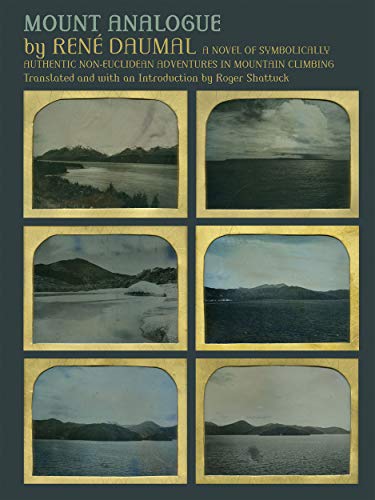 Mount Analogue by René Daumal
Imagine Jules Verne setting out to write a metaphysical version of “The Mysterious Island.” Twist that image a bit more until it becomes a ‘pataphysical version, Alfred Jarry’s science of imaginary solutions (to imaginary problems, I would add). Daumal wrote toward the end of Western Europe’s imperialist project, and “Mount Analogue” is clearly influenced by 19th-century travel books to lands exotic and otherwise unexplored, the travelers amounting to a ragtag group of the wealthy and bored, usually headed by a man, even wealthier and more bored, with an idea—supported by risible notions of “logic”—of where hidden lands may be found. In the case of Mount Analogue, that would be a mountain many times taller than Mt Everest, but previously undetected (and undetectable) by current levels of technology (circa the 1940s), and thus requiring a new science (i.e., ‘pataphysics) to locate for exploration. It seems fitting that the book ends in mid-sentence, since, a là Coleridge, that’s the point at which he was interrupted by a knock at the door. Unlike Coleridge, however, who merely lost his train of thought, Daumal lost his life. Tuberculosis had already considerably weakened him, and he died before he could continue his work. That said, “Mount Analogue” has for decades been a strong influence on writers and readers (and even composers: cf. John Zorn’s “Mount Analogue”) interested in surrealism, ‘pataphysics, and constraints (cf. OULIPO). Daumal clearly enjoyed taking an idea to its logical conclusion, no matter how silly the consequences, and the book is often amusing because of it.
You cannot stay on the summit forever; you have to come down again. So why bother in the first place? Just this: What is above knows what is below, but what is below does not know what is above. One climbs, one sees. One descends, one sees no longer, but one has seen. There is an art of conducting oneself in the lower regions by the memory of what one saw higher up. When one can no longer see, one can at least still know.
–Rene Daumal
A Cloud a Day by Gavin Pretor-Pinney
Clouds from around the world, in all seasons and times of day, at high and low altitudes, by photographers professional and amateur who share a love of cloud types and formations, from the dramatic to the mundane (mostly dramatic). Author Pretor-Pinney—founder of the online group The Cloud Appreciation Society—includes brief paragraphs with each picture, explaining what we’re looking at, and when and how it is formed. If you’re not interested in the science, the book will endear itself to you for the photographs, paintings, and prints it contains.
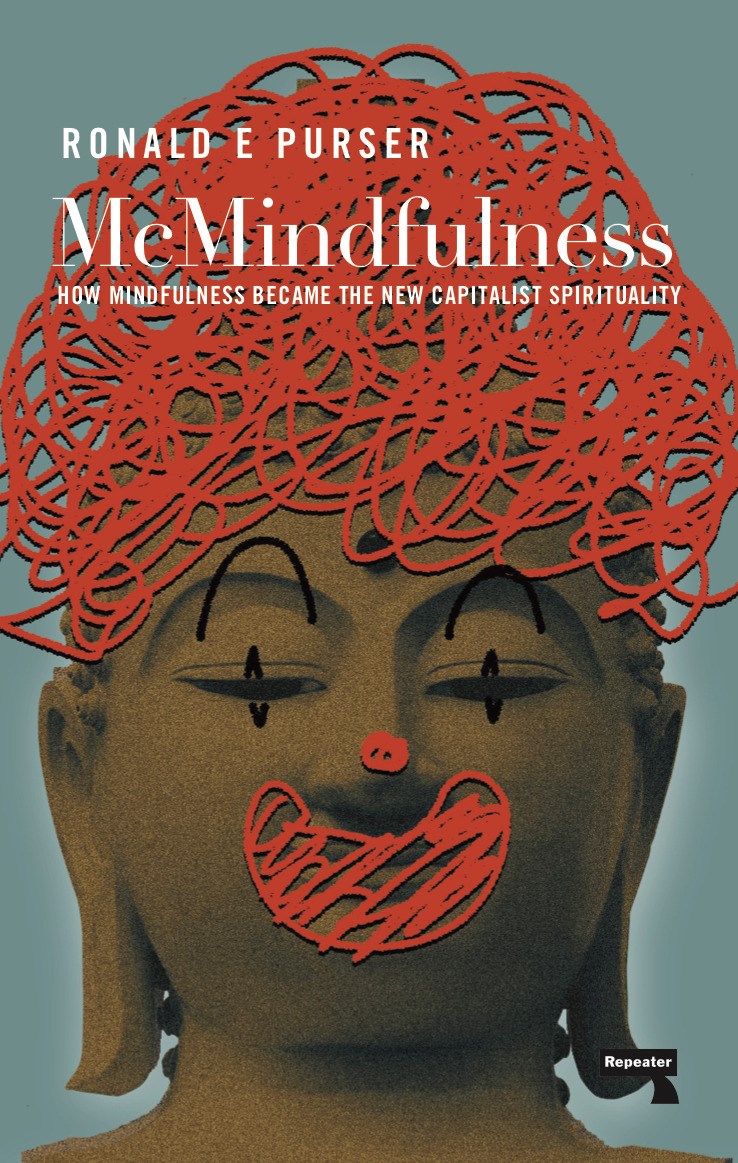 McMindfulness: How Mindfulness Became the New Capitalist Spirituality by Ronald Purser
Purser seems clearly qualified to critique the commodification of mindfulness, as a leftist professor of management at San Francisco State University and a practicing Zen Buddhist. Purser argues that the”mindfulness” industry—in its multiplicity of un- and ill-definition, as it is taught in schools, corporations, and the military (!)—tries to base its credibility on conflicting claims: that it is credible because mindfulness is based on Buddhist tradition, and if that seems too religious for your secular mind (as it ought), that it is credible because its beneficial effects have been measured and quantified by science. While stilling the mind can reduce blood pressure and stress levels (as can exercise, and at the same rates), it in no way does anything to alleviate the conditions that give rise to those health problems. That is, “mindfulness” in the sense of calm breathing and (unjudged) thoughts flitting is only the first step in Buddhism (which industry wants to simultaneously claim and deny), which then cultivates meditation on ethical development of the person—a point all forms of commodified mindfulness avoid.
So what? As a worker, your ability to shed some of the stress in your life is a good thing. But it does nothing to improve pay, working conditions, benefits, and so forth. Meditation is used, therefore, to instill complacency and passivity. Furthermore, employers are able to shift blame for job dissatisfaction back onto workers: Mindfulness has been shown to reduce stress and increase general health (studies Purser disputes); thus, for employees to not avail themselves of a *free* healthcare benefit is a moral failing. Unhappiness on the job—dull repetition, few hopes for advancement, bad pay, etc—is not due to systemic, corporate reasons but to poor choices on the part of the individual, who only needs to breath and eat “mindfully.”
As a practicing Buddhist, Purser seems particularly incensed by the lack of ethical focus among the mindfulness shills who like to drop Buddhist terminology into their patter, while discouraging practitioners (Google executives, for example) to think about the consequences of their actions.
“McMindfulness” is a solid take-down of an influential set of practices unmoored from ethical concerns, while couching itself in terms of social responsibility. Purser examines the methods practiced or taught by various vendors of mindfulness, states the results their practitioners claim the methods produce, then looks at the actual evidence available. Purser accounts for studies and meta-analyses of the effects of meditation and mindfulness, and he reports on conferences he’s attended, and questions he’s asked. (The biggest scam artist of all? Howard Zinn’s son-in-law.)
The upshot is that the mindfulness industry does nothing to make the world a better place. In fact, it encourages its practitioners to endure and tolerate ethically dubious behavior. . . Hey, the money’s good.
 You Had to Be There: Rape Jokes by Vanessa Place
Rape jokes purportedly reveal violent or hostile biases in our society. Racism, sexism, pedophilia, bestiality—expressed via rape and murder. In addition to women and girls, men and boys also get raped here—by strangers, siblings, parents, dogs, and priests. Weapons sometimes are sometimes part of the joke. In short, the book consists of atrocious acts described using the rhetoric of comedy . . SPOILER ALERT: In addition to the offensiveness, the vast majority of these jokes are just plain bad. But Vanessa Place is interested in the jokes that *do* make us laugh—when, and why. Even among the otherwise offended, do they find the same jokes funny, or do different absurdities described in the jokes appeal to different people, and why might that be? People do laugh at what they know to be fundamentally wrong. Why, what is going on in our heads to make that so?
Definitely on the “conceptual art” side of the lit continuum, overlapping with Peter Sotos and Kenneth Goldsmith.
 Murder Ballads and Other Legends by Bohumil Hrabal
A collection of stories from the ’60s, including a draft of part of Closely Watched Trains, after Hrabal had become a well-known (and -harassed) author. Hrabal humbly presents his stories as “pub tales,” but the tales reveal a deep core of violent and sexual amorality seething in the lives of these otherwise “regular folk.” Timothy West’s translation reads well in idiomatic English.
Making Comics by Lynda Barry
A guide to developing ideas for stories, fiction and non-fiction, using pictures as the primary way to tell them, and based on a cartooning class she’s taught for years. Aimed at people who have given up on drawing even for fun, Barry emphasizes spontaneity over draftsmanship and technique, using techniques to spur creativity, and teaches how to play with one’s creations so that the methods practiced always remains fun. (Her earlier book, “100 Demons!,” is about how she went about recapturing the joy in cartooning she had lost.) The book is funny, imaginative, filled will examples from former students, and has suggestions for keeping the imaginative pump primed that anybody from amateur to professional can benefit from.
State of War: MS-13 and El Savador’s World of Violence by William Wheeler
On the origin and rise of one of the world’s most eminent gangs and how national and international policies only exacerbate their reach and wealth, increasing their credibility as actors with power on par with the state’s. The reportage here is part of the Columbia (University) Global Reports series of long-form journalism on current events from around the world.
 The Spirit of Science Fiction by Roberto Bolaño. (now in paperback!)
Bottom line, if you’re already a fan of Bolaño’s, you’ll like this book. If you’re new to Bolaño, The Spirit of Science Fiction won’t put you off his work, but you probably won’t see what keeps his fans rapt for a new installment from the seemingly bottomless pit of manuscripts unpublished in Bolaño’s lifetime. Where does The Spirit fit in Bolaños overall work? Many of his novels use the same (or similar) characters, recycle similar keys events, break a story into kaleidoscopic shards that rely on cumulative effect to tell stories that are blurry at their edges. It’s as if Bolaño was re-telling the same set of stories from a variety of perspectives, some that overlapped, and others that significantly differ. Is The Spirit a complete work? It doesn’t feel like it, and no notes accompany the book. Most authors probably take a dozen drafts to achieve what Bolaño could produce in one, and The Spirt often has the feel of a draft—at which stage, we’re not given an indication. Some passages are beautiful and come close to Bolaño at his finest. Other passages—especially the conversational exchanges—feel like Bolaño talking to himself, trying out ideas. The best parts are the the letters to various American science-fiction authors by one of the novel’s characters, Jan Schrella. While there are echoes of other of Bolaño’s novels here—The Savage Detectives and The Third Reich are two that come to mind—there is new material here, too. But is it science fiction? As much as The Savage Detectives is a detective story.
Up until then, I had been an onlooker in Mexico City, a fairly pretentious recent arrival and clumsy twenty-one-year-old poet. The city, I mean, took no notice of me, and my dreams never escaped the confines of pedantry and deadly artifice. —-Roberto Bolaño